
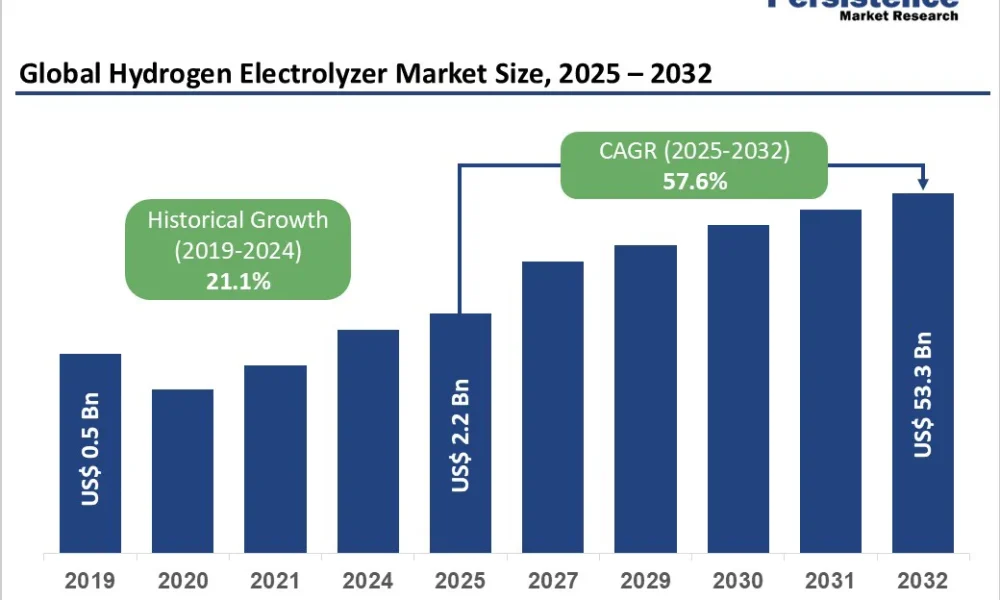
The Hydrogen Electrolyzer Market is witnessing unprecedented acceleration as global energy systems transition toward low carbon pathways. According to Persistence Market Research, the global hydrogen electrolyzer market size was valued at US$2.2 billion in 2025 and is projected to reach US$53.3 billion by 2032, growing at a CAGR of 57.6% between 2025 and 2032. This remarkable expansion reflects surging demand for clean hydrogen production technologies supported by policy driven incentives and decarbonization mandates. Governments across major economies are prioritizing green hydrogen strategies to reduce emissions in heavy industry, power generation, and mobility sectors. Large scale integration of renewable energy is further strengthening the role of electrolyzers in balancing grids and storing excess renewable power. By 2025, installed water electrolyzer capacity is estimated to reach 5 GW, indicating rapid deployment momentum.
Technological advancements in electrolyzer efficiency and cost optimization are transforming hydrogen production economics. The hydrogen electrolyzer market is benefiting from advancements in system design, modular scalability, and automation. Leading segment growth is concentrated in water electrolyzers used for green hydrogen generation, as they directly align with renewable energy integration goals. On the geographical front, China leads in manufacturing and deployment, supported by strong industrial infrastructure and aggressive renewable energy expansion. The country’s dominance in supply chain capabilities has positioned it as a global manufacturing hub for electrolyzer systems. Rising clean energy investments, combined with strong policy frameworks, are accelerating commercial scale adoption worldwide.
Download Your Free Sample & Explore Key Insights : https://www.persistencemarketresearch.com/samples/11992
Key Highlights from the Report
➤ The Hydrogen Electrolyzer Market is projected to grow from US$2.2 billion in 2025 to US$53.3 billion by 2032.
➤ The market is expanding at a robust CAGR of 57.6% between 2025 and 2032.
➤ Installed water electrolyzer capacity is estimated to reach 5 GW by 2025.
➤ Surging demand for clean energy and decarbonization initiatives are major growth catalysts.
➤ Policy driven incentives and renewable integration are accelerating commercialization.
➤ China leads global manufacturing and deployment of hydrogen electrolyzers.
Market Segmentation
The hydrogen electrolyzer market can be segmented based on product type and application. Water electrolyzers form the core segment, particularly for green hydrogen production integrated with renewable energy systems. Their ability to convert renewable electricity into hydrogen positions them as a critical enabler of energy storage and grid stabilization. Industrial scale electrolyzers are witnessing growing demand from sectors such as refining, chemicals, and heavy manufacturing. Modular electrolyzer systems are also gaining attention for decentralized hydrogen production projects.
From an end user perspective, industrial users dominate the hydrogen electrolyzer market due to the need for decarbonizing energy intensive operations. Power generation and energy storage applications are emerging as significant segments as renewable energy installations expand. Mobility applications, including hydrogen fueled transport, are gradually contributing to demand growth. As policy incentives strengthen, commercial and utility scale hydrogen projects are expected to account for a larger share of electrolyzer deployments.
Want Specific Data? Request Report Customization : https://www.persistencemarketresearch.com/request-customization/11992
Regional Insights
China stands at the forefront of the hydrogen electrolyzer market, leading in manufacturing capacity and deployment scale. Strong renewable energy growth and strategic industrial planning have enabled rapid capacity expansion. The country’s ability to produce electrolyzer systems at scale strengthens its competitive position globally. Deployment of large scale hydrogen projects further consolidates its leadership.
Other regions are also advancing hydrogen strategies, driven by decarbonization goals and renewable integration targets. Growing installed water electrolyzer capacity reflects expanding project pipelines. Policy frameworks encouraging clean hydrogen adoption are shaping market dynamics across multiple economies. Industrial modernization efforts are further driving adoption in energy intensive sectors.
Market Drivers
The primary driver of the hydrogen electrolyzer market is the surging demand for clean energy solutions. As industries and governments pursue carbon neutrality goals, green hydrogen has emerged as a viable alternative to fossil based hydrogen production. Electrolyzers enable the production of hydrogen using renewable electricity, reducing lifecycle emissions. Large scale renewable integration has increased the need for energy storage solutions, positioning electrolyzers as critical infrastructure components. Policy driven incentives are accelerating project approvals and funding allocations.
Technological advancements represent another major growth driver. Improvements in electrolyzer efficiency, durability, and cost effectiveness are enhancing commercial viability. Scaling up manufacturing capabilities is reducing per unit system costs. Automation and digital monitoring are improving operational performance and reliability. Growing investments in research and development are enabling performance optimization, further stimulating market growth.
Market Restraints
Despite rapid growth, the hydrogen electrolyzer market faces certain constraints. High initial capital investment requirements remain a barrier for small and medium scale projects. Infrastructure limitations in hydrogen storage and distribution also impact widespread deployment. Variability in renewable energy supply can influence operational efficiency.
Supply chain challenges may slow production expansion in some regions. Dependence on large scale renewable integration requires stable policy support and grid infrastructure readiness. Additionally, project financing complexities and long development cycles can delay commercialization timelines. Addressing these constraints is critical for sustained growth momentum.
Market Opportunities
The hydrogen electrolyzer market presents significant opportunities as installed capacity expands toward 5 GW by 2025. Integration with large scale renewable projects creates opportunities for green hydrogen hubs. Industrial decarbonization strategies are opening new avenues for electrolyzer deployment in steel, chemicals, and refining sectors.
China’s leadership in manufacturing and deployment indicates potential for global export expansion. Continuous technological innovation can unlock cost reductions and efficiency gains. As policy incentives strengthen, cross sector collaborations are expected to accelerate project implementation. Long term decarbonization commitments will continue to expand the addressable market size.
Exclusive Data Awaits – Continue to Checkout : https://www.persistencemarketresearch.com/checkout/11992
Company Insights
Key players operating in the Hydrogen Electrolyzer Market include
- Thyssenkrupp Nucera AG
- John Cockerill Hydrogen
- Nel ASA
- Plug Power Incorporated
- Siemens Energy AG
- Enapter S.r.l.
- Cummins Inc.
- ITM Power PLC
- McPhy Energy S.A.
- Haldor Topsoe A/S
Recent Developments
January 2025
Expansion of large scale electrolyzer manufacturing capacity to support rising deployment demand.
June 2025
Strategic project collaborations announced to accelerate commercial green hydrogen production initiatives.
Future Opportunities and Growth Prospects
The Hydrogen Electrolyzer Market is entering a transformative phase characterized by rapid capacity expansion and strong policy alignment. With projected growth from US$2.2 billion in 2025 to US$53.3 billion by 2032 at a CAGR of 57.6%, the market reflects significant investor confidence and industrial commitment. Continued renewable integration, technological improvements, and strategic global deployment will define the next growth chapter. As clean hydrogen becomes central to energy transition strategies, electrolyzers will remain foundational to achieving long term decarbonization objectives.




