
The industrial ethernet market is rapidly transforming the way modern industries communicate, automate, and scale operations. As manufacturing environments become smarter and more interconnected, the demand for high-speed, reliable, and deterministic networking solutions continues to rise. Industrial ethernet has emerged as a backbone technology enabling Industry 4.0, real-time data exchange, and seamless integration of industrial IoT (IIoT) systems.
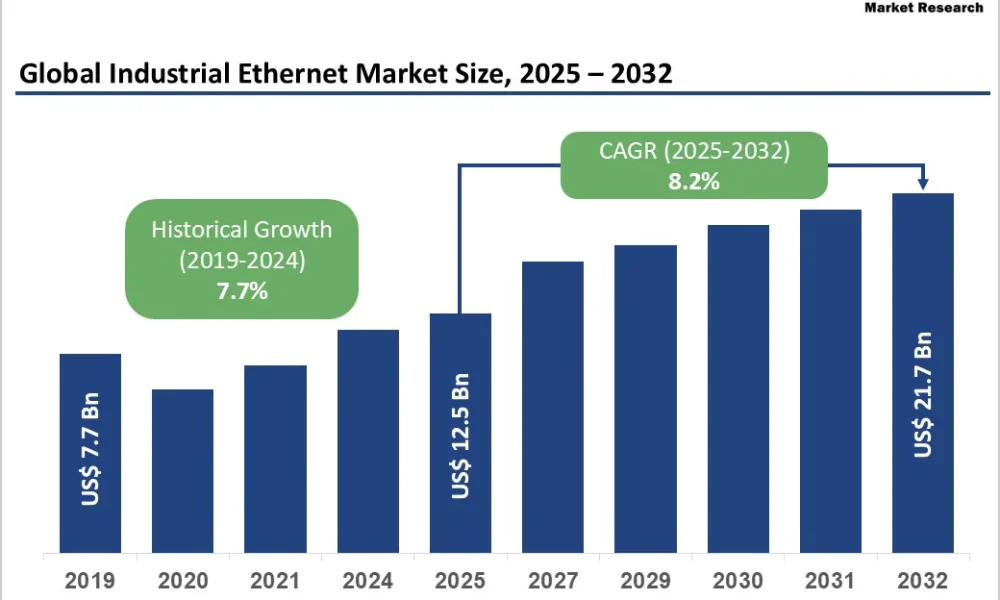
In 2025, the global industrial ethernet market size is estimated to reach US$12.5 billion. Driven by widespread automation, digital transformation initiatives, and advances in networking protocols, the market is projected to expand to US$21.7 billion by 2032, registering a strong compound annual growth rate (CAGR) of 8.2% during the forecast period. This growth reflects a structural shift in industrial communication, moving away from legacy fieldbus systems toward ethernet-based architectures.
Understanding Industrial Ethernet in Modern Industry
Industrial ethernet refers to the use of ethernet networking technologies designed specifically for industrial environments. Unlike traditional ethernet, industrial ethernet solutions are engineered to withstand harsh operating conditions, including extreme temperatures, electrical noise, vibration, and continuous operation.
These networks support real-time communication, deterministic data transmission, and high bandwidth—critical requirements for applications such as robotics, process automation, motion control, and predictive maintenance. As industries embrace digitalization, industrial ethernet is becoming an essential component for achieving operational efficiency, flexibility, and scalability.
Market Growth Overview and Historical Performance
The industrial ethernet market has demonstrated consistent growth over the past decade. Between 2019 and 2024, the market expanded at a CAGR of 7.7%, fueled by rising automation across manufacturing plants and infrastructure upgrades in industrial communication systems.
Looking ahead, the growth trajectory is expected to accelerate further between 2025 and 2032. The increasing complexity of industrial operations, coupled with the need for real-time visibility and data-driven decision-making, is pushing manufacturers to adopt advanced ethernet solutions. The integration of industrial ethernet with cloud platforms, edge computing, and AI-driven analytics is also reinforcing its long-term market potential.
Key Drivers Fueling the Industrial Ethernet Market
Rising Adoption of Industry 4.0
One of the most significant drivers of the industrial ethernet market is the global shift toward Industry 4.0. Smart factories rely heavily on interconnected machines, sensors, and control systems that require fast and reliable communication networks. Industrial ethernet enables seamless data flow between devices, supporting automation, predictive maintenance, and real-time process optimization.
Manufacturers are increasingly investing in digital twins, cyber-physical systems, and autonomous production lines. These technologies depend on deterministic communication, which industrial ethernet protocols are well-equipped to deliver.
Growing Demand for Real-Time Data Communication
Modern industrial operations generate massive volumes of data that must be transmitted and analyzed in real time. Industrial ethernet supports high data rates and low latency, making it ideal for applications such as motion control, quality inspection, and safety systems.
Real-time communication is particularly critical in sectors like automotive manufacturing, where precise synchronization of assembly line components directly impacts productivity and product quality.
Expansion of Industrial IoT Ecosystems
The rapid expansion of industrial IoT (IIoT) is another major growth catalyst. Connected sensors, smart devices, and automated equipment require a robust networking infrastructure to function efficiently. Industrial ethernet serves as the foundation for IIoT ecosystems by enabling secure, scalable, and interoperable connectivity across industrial environments.
In industries such as automotive, energy, and logistics, industrial ethernet is increasingly viewed as a prerequisite for successful IoT integration.
Product Type Analysis: Hardware Dominates Market Share
By product type, the industrial ethernet market is segmented into hardware, software, and services. Among these, hardware accounts for approximately 50% of total market revenue, making it the dominant segment.
Industrial ethernet hardware includes switches, routers, connectors, cables, and network interface cards. These components are essential for establishing and maintaining reliable communication networks in industrial settings. The growing complexity of industrial networks, combined with rising investments in infrastructure upgrades, continues to drive demand for advanced hardware solutions.
While software and services are gaining traction—particularly for network management, diagnostics, and cybersecurity—hardware remains the backbone of industrial ethernet deployments.
Elevate your business strategy with comprehensive market data. Request a sample report now: https://www.persistencemarketresearch.com/samples/13402
Protocol Landscape: PROFINET Leads the Market
Industrial ethernet supports multiple communication protocols, each designed to meet specific application requirements. Among these, PROFINET stands out as the leading protocol, accounting for over 30% of total market revenue.
PROFINET’s dominance is largely attributed to its strong compatibility with Siemens automation systems, which are widely used across industrial sectors. The protocol offers high performance, real-time communication, and seamless integration with existing industrial control systems.
Other protocols continue to play important roles, but PROFINET’s reliability, scalability, and broad industry acceptance make it a preferred choice for manufacturers seeking standardized and future-ready solutions.
End-Use Industry Insights: Automotive and Transportation at the Forefront
By end-use industry, automotive and transportation emerge as the largest contributors, accounting for nearly 25% of total market revenue. The automotive sector relies heavily on industrial ethernet to support automated assembly lines, robotics, and quality control systems.
As electric vehicles, autonomous driving technologies, and advanced manufacturing processes gain momentum, the need for high-speed and deterministic communication networks is intensifying. Industrial ethernet enables seamless coordination between production equipment, reducing downtime and enhancing operational efficiency.
Other key end-use industries include manufacturing, energy and utilities, oil and gas, and food and beverage processing, all of which are increasingly adopting ethernet-based communication to modernize operations.
Regional Analysis: Asia Pacific Leads, North America Grows Fastest
Asia Pacific: The Largest Market
Asia Pacific holds the largest share of the global industrial ethernet market, commanding around 40% of total revenue in 2025. The region’s dominance is driven by rapid industrialization, expanding manufacturing bases, and strong government support for automation and smart manufacturing initiatives.
China plays a pivotal role in regional growth, supported by high levels of R&D activity and widespread adoption of advanced industrial technologies. Other countries in the region are also investing heavily in upgrading industrial infrastructure, further strengthening market expansion.
North America: The Fastest-Growing Region
North America is expected to register the fastest growth rate during the forecast period. The region’s growth is fueled by increasing Industry 4.0 initiatives, rising awareness of smart factory concepts, and growing investments in IIoT technologies—particularly in the United States.
Manufacturers in North America are prioritizing digital transformation to improve competitiveness, resilience, and supply chain visibility. This trend is driving strong demand for industrial ethernet solutions capable of supporting advanced automation and data analytics.
Market Opportunities: IIoT and 5G Integration
The integration of IIoT and 5G-enabled industrial communication presents significant growth opportunities for the industrial ethernet market. Emerging economies, in particular, are increasingly adopting smart manufacturing solutions to enhance productivity and reduce operational costs.
5G technology complements industrial ethernet by enabling wireless connectivity for mobile equipment, autonomous vehicles, and remote monitoring applications. Together, these technologies are reshaping industrial communication architectures and unlocking new use cases across industries.
As enterprises seek flexible and future-proof networking solutions, industrial ethernet providers have a strong opportunity to expand their offerings and capture new market segments.
Challenges and Market Considerations
Despite strong growth prospects, the industrial ethernet market faces certain challenges. High initial implementation costs, cybersecurity concerns, and the complexity of integrating new networks with legacy systems can act as barriers for some organizations.
However, ongoing advancements in network security, standardization, and interoperability are gradually addressing these concerns. As awareness grows and technology matures, adoption barriers are expected to diminish over time.
Competitive Landscape and Innovation Trends
The industrial ethernet market is characterized by continuous innovation in hardware design, protocol development, and network management solutions. Manufacturers are focusing on enhancing reliability, scalability, and cybersecurity to meet evolving industrial requirements.
Advancements in time-sensitive networking (TSN), edge computing integration, and AI-driven network monitoring are shaping the next generation of industrial ethernet solutions. These innovations are expected to play a crucial role in supporting complex industrial applications and driving long-term market growth.
Future Outlook: A Foundation for Smart Industry
Looking ahead, the industrial ethernet market is poised for sustained expansion through 2032 and beyond. With a projected market value of US$21.7 billion by 2032, industrial ethernet will continue to serve as a critical enabler of smart manufacturing, automation, and digital transformation.
The convergence of Industry 4.0, IIoT, and advanced networking technologies underscores the strategic importance of industrial ethernet across industries. As companies strive for greater efficiency, transparency, and agility, industrial ethernet will remain at the core of modern industrial communication systems.
Related Reports:




