
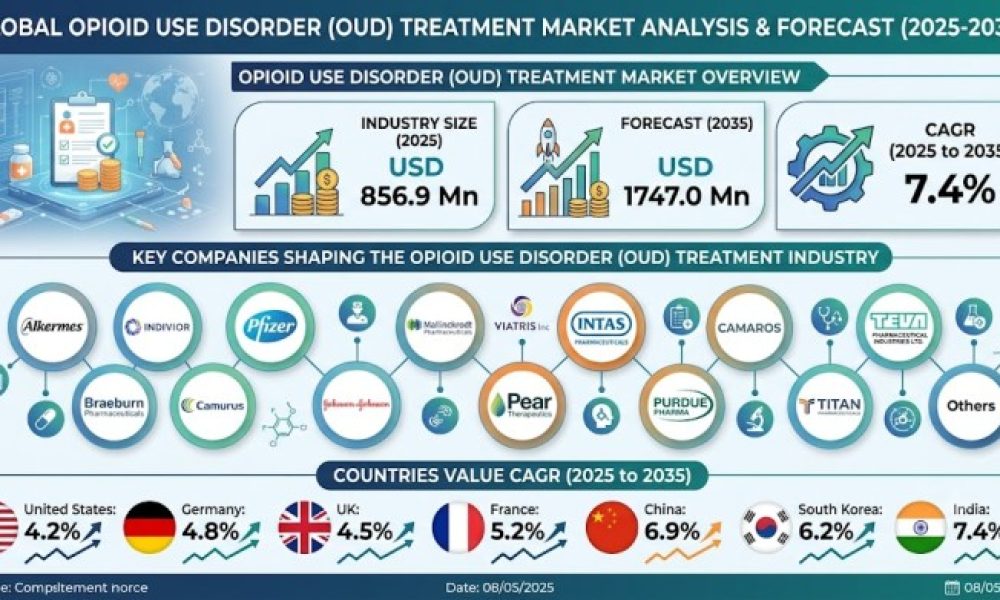
NEWARK, Del., October 9, 2026. — The global opioid use disorder treatment market is projected to increase from USD 856.9 million in 2025 to USD 1,747.0 million by 2035, registering a 7.4% CAGR during the forecast period, according to Future Market Insights (FMI). Opioid agonists and partial agonists lead the drug-class segment with a 53.3% share in 2025, while pain management accounts for 37.8% of indication demand.
Access gaps are keeping treatment demand in focus
The treatment-access gap remains a major market driver. The FMI report cites the CDC, which found that in 2022, among the 4% of U.S. adults who needed opioid use disorder treatment, only 25% received recommended medications. FMI also cites the Library of the Parliament, which reported 23,000 deaths from opioid toxicity between January 2016 and March 2021.
Medication-assisted treatment is gaining wider acceptance as healthcare providers combine approved medicines with counseling programs. FMI also identifies telehealth as a means of improving continuity of care for rural and under-resourced communities, while long-acting formulations are attracting investment because they can reduce the pressure associated with daily dosing.
👉 Get Detailed Market Forecasts, Competitive Benchmarking, and Pricing Trends:
https://www.futuremarketinsights.com/reports/sample/rep-gb-16561
The regulatory environment remains a defining consideration. Methadone is described by FMI as a highly regulated substance dispensed through certified opioid treatment programs, while buprenorphine prescribing requires DEA registration and appropriate credentials. Treatment programs must also meet certification and accreditation requirements involving agencies and organizations including the Substance Abuse and Mental Health Services Administration, CARF International and the Joint Commission.
Where growth is fastest
- India — 7.4% CAGR: India is the fastest-growing country listed by FMI. Rising awareness of substance use disorders, expanding healthcare infrastructure and investment in addiction rehabilitation centers are supporting demand. The report also points to the National Action Plan for Drug Demand Reduction (NAPDDR) and wider availability of medication-assisted treatment.
- China — 6.9% CAGR: China is expected to expand steadily as access to addiction treatment improves through hospital and community channels.
- France — 5.2% CAGR: France records a higher growth rate than the other Western European countries listed by FMI.
- Germany — 4.8% CAGR: Government-backed opioid substitution treatment initiatives, a strict regulatory environment and harm-reduction measures such as naloxone distribution support market development.
- United Kingdom — 4.5% CAGR: The UK is projected to grow at 4.5% through 2035.
- United States — 4.2% CAGR: The USA has the lowest CAGR among the seven countries listed by FMI, but the report highlights the continuing treatment need associated with prescription opioids, fentanyl and synthetic opioids.
- South Korea — 6.2% CAGR: South Korea is projected to grow at 6.2% during 2025–2035.
What leads the market
- Opioid agonists and partial agonists — 53.3% share in 2025: Methadone and buprenorphine anchor this category. FMI says established use in withdrawal care supports its leading position.
- Pain management — 37.8% share in 2025: Pain management is the largest indication segment, supported by demand for broader approaches to acute and chronic pain and developments in extended-release and patient-controlled delivery systems.
The market is segmented by opioid antagonists, opioid agonists and partial agonists; indications including pain management, opioid withdrawal/OUD, alcohol de-addiction and depression; and end users including hospitals, rehabilitation centers, community health clinics and home-based care.
The hurdle
Stigma remains one of the clearest barriers to wider treatment adoption. FMI says misconceptions around addiction and treatment can discourage people from seeking care and can also affect healthcare providers. The report cites research indicating that more than 50% of people with opioid use disorder fear stigma or discrimination and do not seek treatment. Regulatory barriers and provider concerns can further restrict adoption of medication-assisted treatment.
Recent developments and industry investment
Long-acting treatment is receiving increasing attention as manufacturers seek alternatives to daily dosing. FMI identifies monthly injectable buprenorphine and implantable naltrexone among the developments supporting this direction, while pharmaceutical companies are investing in formulations with longer durations of action.
The report records two recent industry developments:
- 2024 — Indivior: Released an extended-release injectable buprenorphine for weekly and monthly dosing in Australia.
- 2024 — Alkermes: Partnered with rehabilitation centers in New Zealand to distribute extended-release naltrexone.
FMI identifies Alkermes, Indivior, Pfizer, Mallinckrodt Pharmaceuticals, Viatris Inc., Intas Pharmaceuticals, Camaros, Teva Pharmaceutical Industries Ltd., Braeburn Pharmaceuticals, Camurus, Johnson & Johnson, Pear Therapeutics, Purdue Pharma and Titan Pharmaceuticals among the companies shaping the market.
The report also says Indivior markets Suboxone and Sublocade, Alkermes offers Vivitrol, Orexo AB markets ZUBSOLV and digital therapeutics such as MODIA, and Camurus provides long-acting injectables including Buvidal and Brixadi.
Analyst perspective
Anurag Sharma, Principal Consultant for Healthcare at Future Market Insights, said:
“The opioid use disorder treatment market is likely to favor companies able to expand access without weakening clinical oversight. Long-acting therapies and medication-assisted programs are anticipated to gain stronger provider attention as adherence and safety receive central treatment priority.”
Access Full Report: https://www.futuremarketinsights.com/reports/opioid-use-disorder-treatment-market
What this means for healthcare providers and pharmaceutical companies
- Prioritize access models alongside product selection. FMI identifies telehealth, community-based care and expanding rehabilitation infrastructure as important routes for reaching underserved populations. Providers should assess whether their delivery model can maintain follow-up access beyond traditional clinical settings.
- Evaluate long-acting formulations within regulatory requirements. Long-acting therapies are an important opportunity identified by FMI, but controlled-substance requirements and provider credentials remain central to deployment. Product planning should therefore account for the relevant prescribing, certification and dispensing framework.
- Treat stigma reduction as an access issue. The report identifies stigma as a direct barrier to treatment uptake. Provider education, patient communication and collaboration with advocacy organizations can help address the non-clinical barriers that limit access to medication-assisted treatment.
About Future Market Insights
Future Market Insights, Inc. (FMI) is an ESOMAR-certified market research and consulting firm headquartered in Delaware, USA, with offices in the United Kingdom, the United Arab Emirates and India. FMI delivers syndicated and custom research across food and beverage, healthcare, chemicals, technology, packaging, consumer goods and industrial sectors.
Media Contact
Future Market Insights, Inc.
Email: [email protected]
Phone: +1-347-918-3531



