
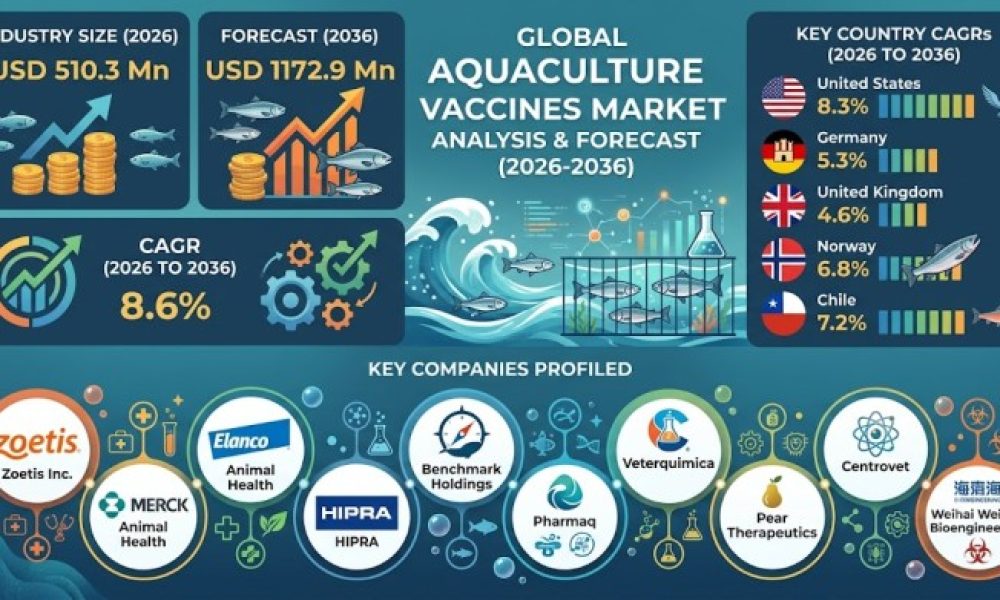
NEWARK, Del., October 9, 2026. — The global aquaculture vaccines market is projected to increase from USD 510.3 million in 2026 to USD 1,172.9 million by 2036, expanding at a 8.6% CAGR during the forecast period, according to Future Market Insights (FMI). Inactivated vaccines lead the vaccine-type segment with a 52.6% share in 2026, while salmon accounts for 38.9% of fish-species demand. Commercial aquaculture farms represent 47.3% of the market by end-user application in 2026.
Disease prevention is moving higher on farm-management agendas
The strongest demand trigger is the shift from reactive disease treatment toward planned preventive fish-health management. FMI identifies rising disease outbreaks, efforts to reduce antibiotic use and export-quality checks as factors increasing demand for vaccination across commercial aquaculture operations. The report also points to greater spending on pathogen-specific products and improved delivery systems.
The report’s regulatory references include the World Organisation for Animal Health (WOAH) Aquatic Animal Health Code: Standards for disease prevention and control including vaccine use (2024), the Food and Agriculture Organization of the United Nations (FAO) technical guidelines for responsible fish health management and vaccination strategies in aquaculture (2024), and the European Medicines Agency (EMA) Guideline on veterinary medicinal products for aquaculture: Vaccine quality, safety, and efficacy considerations (2024). The FMI page does not provide regulation numbers for these references.
👉 Get Detailed Market Forecasts, Competitive Benchmarking, and Pricing Trends:
https://www.futuremarketinsights.com/reports/sample/rep-gb-16501
Where growth is fastest
- United States — 8.3% CAGR: The USA is the fastest-growing country market identified by FMI. Growth is supported by established aquaculture infrastructure, greater vaccine integration among commercial farms and federal aquaculture reforms emphasizing disease prevention and production sustainability.
- Chile — 7.2% CAGR: Large-scale salmon farming, increasing awareness of disease-outbreak prevention and export-market integration support demand for vaccination systems.
- Norway — 6.8% CAGR: A mature salmon-farming system, rising production costs and established vaccination practices support continued demand.
- Germany — 5.3% CAGR: Environmental compliance, antibiotic-reduction initiatives and investment in aquaculture research are supporting demand for sustainable fish-health solutions.
- United Kingdom — 4.6% CAGR: FMI links growth to increasing awareness of fish-welfare requirements, sustainable seafood initiatives and a strong regulatory framework for vaccine safety and efficacy.
What leads the market
- Inactivated vaccines — 52.6% share in 2026: Inactivated formulations lead because of established use, safety testing and continued formulation improvements, including adjuvant systems. FMI also points to their established application in high-value fish species.
- Salmon — 38.9% share in 2026: Salmon is the largest fish-species category, reflecting the economic importance of salmon farming and demand for specialized formulations addressing bacterial and viral challenges.
- Commercial aquaculture farms — 47.3% share in 2026: Large-scale farming operations generate recurring vaccine demand through production cycles and planned veterinary protocols.
The report segments the market further by DNA and recombinant vaccines, live attenuated vaccines and subunit vaccines; fish species including tilapia, catfish, carp and shrimp; bacterial and viral pathogens; and small-scale farmers, government programs and research institutions.
The hurdle
The market’s central challenge is the complexity of managing evolving pathogens across different species, farming environments and geographic markets. FMI says stricter pathogen-monitoring requirements can increase research investment, while antigenic-drift monitoring can require manufacturers to conduct surveillance studies to validate continued vaccine effectiveness.
Climate variability adds another operational consideration. FMI expects changing water temperatures to increase interest in temperature-adapted and more stable vaccine formulations, particularly for aquaculture operations in warmer or remote regions.
👉 Access the Complete Report in PDF Format:
https://www.futuremarketinsights.com/reports/brochure/rep-gb-16501
Industry investment and competitive activity
FMI describes competition as increasingly centered on field-performance evidence, pathogen-focused product development and delivery systems suited to different farming environments. The report states that Zoetis Inc. and Merck Animal Health are investing in collaborative research with aquaculture institutes to validate protection outcomes against priority bacterial and viral threats.
The report also describes partnerships between vaccine suppliers and fish producers, with vaccination incorporated into wider health-management programs covering biosecurity, monitoring and treatment protocols. Delivery innovation includes improved injection methods, oral approaches and immersion solutions where appropriate.
Key companies profiled by FMI include: Zoetis Inc.; Merck Animal Health; Elanco Animal Health; HIPRA; Benchmark Holdings; Pharmaq; Veterquimica; Pear Therapeutics; Centrovet; and Weihai Weihao Bioengineering.
The FMI page does not provide specific company developments with month-and-year dates. Accordingly, no undated corporate action has been presented as a dated development in this release.
Analyst perspective
Anurag Sharma, Principal Consultant for Healthcare at Future Market Insights, said:
“The aquaculture vaccines market is likely to move toward producers able to combine field evidence with practical delivery formats. Fish health suppliers with stronger vaccine portfolios are expected to gain preference as farms seek lower mortality and better harvest stability.”
What this means for aquaculture producers and vaccine suppliers
- Match vaccine development to specific pathogen pressure. FMI identifies a shift toward pathogen-focused platforms. Suppliers can prioritize formulations around the disease pressures and species profiles of individual production environments rather than relying only on broad product portfolios.
- Account for delivery and storage conditions. The report highlights improved injection, oral and immersion approaches, along with more temperature-tolerant formulations. Producers should assess delivery practicality and stability requirements alongside efficacy considerations.
- Build vaccination into wider fish-health programs. FMI identifies biosecurity planning, monitoring and coordinated treatment protocols as increasingly connected to vaccination. Procurement decisions should therefore consider how products fit existing farm-management systems rather than evaluating vaccines in isolation.
About Future Market Insights
Future Market Insights, Inc. (FMI) is an ESOMAR-certified market research and consulting firm headquartered in Delaware, USA, with offices in the United Kingdom, the United Arab Emirates and India. FMI delivers syndicated and custom research across food and beverage, healthcare, chemicals, technology, packaging, consumer goods and industrial sectors.
Media Contact
Future Market Insights, Inc.
Email: [email protected]
Phone: +1-347-918-3531



