
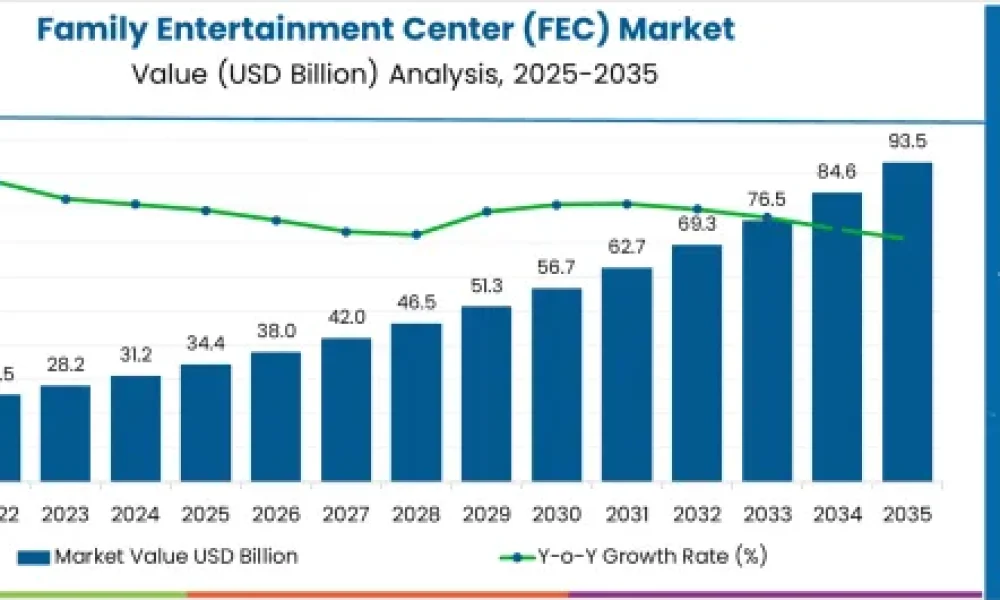
The global Family Entertainment Center (FEC) market is entering a decade of sustained expansion, driven by rising consumer demand for experiential leisure and the continued evolution of retail and urban entertainment formats. Valued at USD 34.4 billion in 2025, the market is projected to reach USD 93.5 billion by 2035, registering a compound annual growth rate (CAGR) of 10.5% over the forecast period.
This growth reflects a net increase of USD 22.3 billion in market value, underpinned by diversified entertainment offerings that combine gaming, sports, dining, and immersive digital experiences under one roof. Family entertainment centers are increasingly positioned as year-round destinations serving multi-generational audiences across urban and emerging markets.
Explore the full market insights and exclusive data breakdowns – Request Your Sample Report Now
Market Outlook: Expansion Through 2035
Between 2025 and 2027, the FEC market is expected to grow from USD 34.4 billion to USD 42.0 billion, supported by a wave of new center openings and the modernization of existing facilities. Operators are upgrading layouts and attractions to appeal simultaneously to children, young adults, families, and corporate groups.
From 2028 to 2030, the market is projected to accelerate further, reaching USD 56.7 billion, as FECs expand in emerging economies and become anchor tenants in mixed-use retail and entertainment complexes. By 2030, growth reflects a balance of physical expansion, enhanced customer engagement strategies, and diversified revenue models that extend beyond traditional arcade formats.
Why the Family Entertainment Center Market Is Growing
The FEC market is benefiting from rising discretionary spending on leisure activities, urban mall expansion, and the global shift toward experience-led retail. Consumers increasingly favor shared, interactive recreation over passive or home-based entertainment, fueling investment in technologically advanced entertainment infrastructure.
Operators are leveraging gamification, augmented reality (AR), virtual reality (VR), and modular zone design to increase dwell time and repeat visits. Strategic partnerships with retail chains and cinema complexes are improving location synergies and foot traffic, particularly in mall-based environments.
Growth is also supported by rising demand in tier-2 and tier-3 cities, where supportive zoning policies and scalable entertainment models are enabling broader geographic penetration. Looking ahead, targeted offerings by age group, automation in operations, and digital loyalty and booking platforms are expected to further strengthen market momentum.
Segment Insights: Arcades, Ticketing, and Young Adults Lead
Arcades Remain the Core Center Type
Arcades are projected to account for 36.4% of total FEC revenue in 2025, making them the largest center segment. Their leadership is driven by nostalgia among adult patrons and sustained appeal to younger demographics. The revival of retro games, combined with immersive multiplayer and motion-sensing technology, has improved profitability through high footfall and fast player turnover. Hybrid arcade-bowling and arcade-dining formats have further strengthened their role as anchor attractions.
Ticket Revenue Dominates Monetization
Ticket-based revenue streams are expected to represent 41.2% of total market income in 2025, maintaining their position as the primary monetization channel. Digital wallets, contactless ticketing, and prize redemption systems are improving transaction efficiency while enabling gamified loyalty programs that extend engagement beyond physical visits.
Ages 20–35 Drive Demand
Consumers aged 20 to 35 years are projected to contribute 38.7% of total FEC revenue in 2025, making them the leading age group. High discretionary income, social spending behavior, and interest in nostalgic and tech-enhanced entertainment have driven demand for VR arcades, escape rooms, and competitive gaming zones, supported by food and beverage integrations and extended operating hours.
Regional Growth Dynamics
- Asia-Pacific is the fastest-growing region, led by China and India. China records a 2% CAGR, supported by urbanization, middle-class expansion, and large-scale investments in mall-based entertainment complexes, with increasing penetration in tier-2 and tier-3 cities. India follows with 13.1% growth, driven by rising urban middle-class demand and adaptation of global FEC concepts to local pricing and cultural preferences.
- In Europe, France grows at 11% CAGR and the United Kingdom at 10%, supported by investments in modern entertainment infrastructure, tourism integration, and multi-attraction venues. The United States, a more mature market, shows 9% growth, shaped by innovation in themed entertainment, health-oriented active play zones, and digital engagement tools.
Competitive Landscape and Industry Direction
The FEC market features a mix of global and regional operators, including Dave & Buster’s, Altitude Trampoline Park, Bowlero Corp., KidZania, Legoland Discovery Center, Majid Al Futtaim Leisure and Entertainment, Punch Bowl Social, Round1 Bowling & Amusement, Scene75 Entertainment Centers, and Sky Zone, LLC.
The competitive landscape is shifting toward multi-attraction hybrid models that blend physical activities with interactive technologies such as VR zones, AR experiences, and esports arenas. Technology integration, personalization, and scalable modular designs are emerging as key differentiators, alongside global expansion in Asia-Pacific and the Middle East.
Market Scope
The Family Entertainment Center market spans arcades, kids’ play areas, VR parks, and hybrid formats, with revenue generated through ticketing, food and beverage, and merchandise. Coverage includes North America, Europe, Asia-Pacific, Latin America, and the Middle East & Africa, with detailed insights across major economies.
As experiential leisure continues to redefine consumer spending priorities, family entertainment centers are positioned to remain a central pillar of urban and regional entertainment ecosystems through 2035.
Have a specific Requirements and Need Assistant on Report Pricing or Limited Budget please contact us – [email protected]
About Future Market Insights (FMI)
Future Market Insights, Inc. (FMI) is an ESOMAR-certified, ISO 9001:2015 market research and consulting organization, trusted by Fortune 500 clients and global enterprises. With operations in the U.S., UK, India, and Dubai, FMI provides data-backed insights and strategic intelligence across 30+ industries and 1200 markets worldwide
Why Choose FMI: https://www.futuremarketinsights.com/why-fmi



