
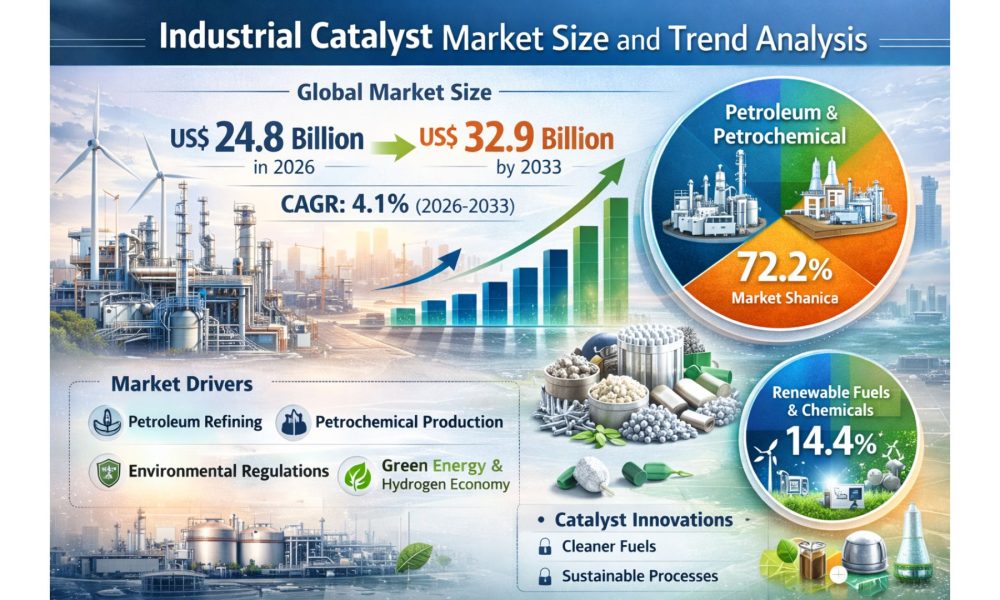
The Industrial Catalyst Market plays a vital role in modern chemical manufacturing, enabling faster chemical reactions, improved product yields, and reduced energy consumption across industries such as petroleum refining, petrochemicals, chemicals, and environmental applications. Industrial catalysts are substances that accelerate chemical reactions without being consumed in the process, making them essential in large-scale industrial production.
According to market analysis, the global industrial catalyst market is projected to reach around US$ 24.8 billion in 2026 and grow to approximately US$ 32.9 billion by 2033, expanding at a CAGR of about 4.1% between 2026 and 2033.
Growing demand for petroleum products, increasing petrochemical production, and strict environmental regulations requiring cleaner fuel technologies are major factors driving market growth.
Market Overview
Industrial catalysts are widely used in chemical reactions to increase efficiency, reduce energy consumption, and minimize waste generation. They are crucial for numerous industrial processes such as cracking, reforming, polymerization, hydrogenation, and oxidation.
Industries increasingly rely on catalysts to optimize production and improve sustainability. In petroleum refining, catalysts enable processes that convert crude oil into valuable fuels like gasoline, diesel, and jet fuel. In petrochemical manufacturing, catalysts help produce plastics, synthetic fibers, and other chemical products.
Furthermore, catalysts support environmentally friendly processes by reducing emissions and enabling cleaner fuel production. With governments worldwide implementing stricter emission regulations, industries are adopting advanced catalytic technologies to meet sustainability goals.
Key Market Drivers
Growing Demand from Petroleum Refining
The petroleum refining sector represents one of the largest consumers of industrial catalysts. Catalysts are essential in processes such as fluid catalytic cracking (FCC), hydrocracking, hydrotreating, and catalytic reforming, which help convert heavy crude oil into high-value fuels.
With global energy consumption rising, refineries are expanding production capacity to meet fuel demand. These developments increase the need for advanced catalysts that improve refining efficiency and reduce sulfur content in fuels.
In addition, governments worldwide are implementing stricter fuel standards to lower emissions. This has increased the adoption of high-performance catalysts designed to produce ultra-low sulfur fuels and cleaner gasoline.
Expansion of Petrochemical Industry
Another major factor driving the industrial catalyst market is the rapid growth of the petrochemical industry. Catalysts play a crucial role in the production of ethylene, propylene, polyethylene, polypropylene, and other polymers used in plastics, packaging, and consumer goods.
Global petrochemical production continues to expand as demand for plastic materials increases in industries such as automotive, packaging, electronics, and construction. Catalysts help improve efficiency and reduce operational costs in these large-scale chemical manufacturing processes.
For example, global ethylene production exceeds 200 million metric tons annually, creating strong demand for advanced catalysts used in polymerization and petrochemical synthesis processes.
Increasing Focus on Environmental Sustainability
Environmental regulations are becoming stricter worldwide, encouraging industries to adopt cleaner technologies. Industrial catalysts are increasingly used to reduce harmful emissions and improve environmental performance.
Catalysts are used in applications such as automotive emission control, wastewater treatment, and air pollution control. They help convert harmful pollutants into less toxic substances, making industrial processes more environmentally friendly.
In addition, the transition toward renewable energy and sustainable chemical production is boosting demand for innovative catalyst technologies. Industries are investing in catalysts that support low-carbon processes and renewable fuel production.
Market Challenges
High Development Costs
Developing high-performance catalysts requires extensive research and development. Many catalysts are made from precious metals or specialized materials, which increases production costs.
Manufacturers must invest heavily in R&D to create catalysts that deliver improved selectivity, stability, and durability. These high costs can limit the adoption of advanced catalyst technologies in some industries.
Catalyst Deactivation and Replacement Costs
Industrial catalysts gradually lose activity over time due to contamination, sintering, or chemical poisoning. This process, known as catalyst deactivation, requires periodic regeneration or replacement.
Frequent replacement of catalysts can increase operational costs for industrial facilities, particularly in large-scale refining and chemical plants.
Type Insights
Industrial catalysts are broadly categorized into three main types:
Heterogeneous Catalysts
Heterogeneous catalysts dominate the market, accounting for around 60% of global demand due to their widespread use in petroleum refining and petrochemical production.
These catalysts exist in a different phase than the reactants, typically as solids interacting with gaseous or liquid reactants. They offer advantages such as easy separation from reaction mixtures and high thermal stability.
Homogeneous Catalysts
Homogeneous catalysts operate in the same phase as the reactants, usually in liquid systems. They provide high selectivity and efficiency in certain chemical reactions.
Biocatalysts
Biocatalysts use enzymes or biological molecules to catalyze reactions. These catalysts are gaining popularity in pharmaceutical manufacturing and green chemistry applications.
Application Insights
Industrial catalysts are used in several key applications across industries.
Petroleum Refining
This segment represents one of the largest application areas. Catalysts are used to convert crude oil into fuels and other petroleum products.
Chemical Synthesis
Catalysts play an important role in chemical production processes, including hydrogenation, oxidation, and polymerization reactions.
Petrochemical Production
Catalysts are widely used in the manufacturing of plastics and polymers, which are essential materials for many industries.
Environmental Applications
Catalysts are used to reduce harmful emissions in industrial processes and automotive exhaust systems.
Regional Analysis
Asia Pacific
Asia Pacific dominates the industrial catalyst market, accounting for around 45% of global revenue share.
The region’s leadership is driven by rapid industrialization, expanding petrochemical capacity, and increasing energy demand in countries such as China and India.
India’s refining capacity has reached approximately 248.9 million tonnes per year, making it a major hub for petroleum refining and catalyst consumption.
Middle East & Africa
The Middle East and Africa region is expected to be one of the fastest-growing markets. Increasing investments in refinery infrastructure and petrochemical plants are driving catalyst demand in this region.
Many countries in the region are expanding refining capacity to strengthen their role in global energy supply.
North America and Europe
North America and Europe represent mature markets with significant demand for industrial catalysts. These regions focus on advanced catalyst technologies and environmental compliance.
Strict environmental regulations in these regions are encouraging industries to adopt catalysts that reduce emissions and improve energy efficiency.
Competitive Landscape
The industrial catalyst market is highly competitive, with several global chemical companies operating in the industry. Major players focus on product innovation, research and development, and strategic partnerships to maintain market leadership.
Key Companies
Major companies operating in the industrial catalyst market include:
- BASF
- Johnson Matthey
- Clariant
- Albemarle Corporation
- W.R. Grace & Co.
- Honeywell International
- Haldor Topsoe
- SABIC
- Linde plc
These companies invest heavily in advanced catalyst technologies to improve efficiency and sustainability in industrial processes.
Emerging Opportunities
One of the most promising opportunities in the industrial catalyst market is the development of catalysts for the hydrogen economy and renewable energy applications.
The global shift toward green hydrogen production and sustainable fuels is creating strong demand for advanced electrocatalysts and catalytic systems. Hydrogen demand is expected to increase significantly by 2050, providing new growth opportunities for catalyst manufacturers.
In addition, advancements in nanotechnology and material science are enabling the development of more efficient and durable catalysts for industrial applications.
Conclusion
The industrial catalyst market is expected to grow steadily over the next decade, driven by rising demand for petrochemical products, expanding refinery capacity, and increasing environmental regulations. Catalysts remain essential for improving efficiency and sustainability in chemical manufacturing.
As industries transition toward cleaner fuels, renewable energy, and green chemical processes, demand for advanced catalyst technologies will continue to increase. With ongoing innovation and expanding industrial applications, the industrial catalyst market will remain a critical component of the global chemical industry.
About Persistence Market Research:
Persistence Market Research delivers strategic research solutions that drive business growth. Founded in 2012 and registered in England and Wales in 2023 as Persistence Research & Consultancy Services Ltd., we have completed 3,600+ custom and syndicated studies and supported 2,700+ projects for leading research firms. Combining traditional methodologies with modern tools, we provide actionable insights to multinational corporations, consultants, investors, and government bodies, earning strong trust through long-term client relationships.
Contact Us:
Persistence Market Research
Second Floor, 150 Fleet Street,
London, EC4A 2DQ, United Kingdom
USA Phone: +1 646-878-6329
UK Phone: +44 203-837-5656
Email: [email protected]
Web: https://www.persistencemarketresearch.com




