
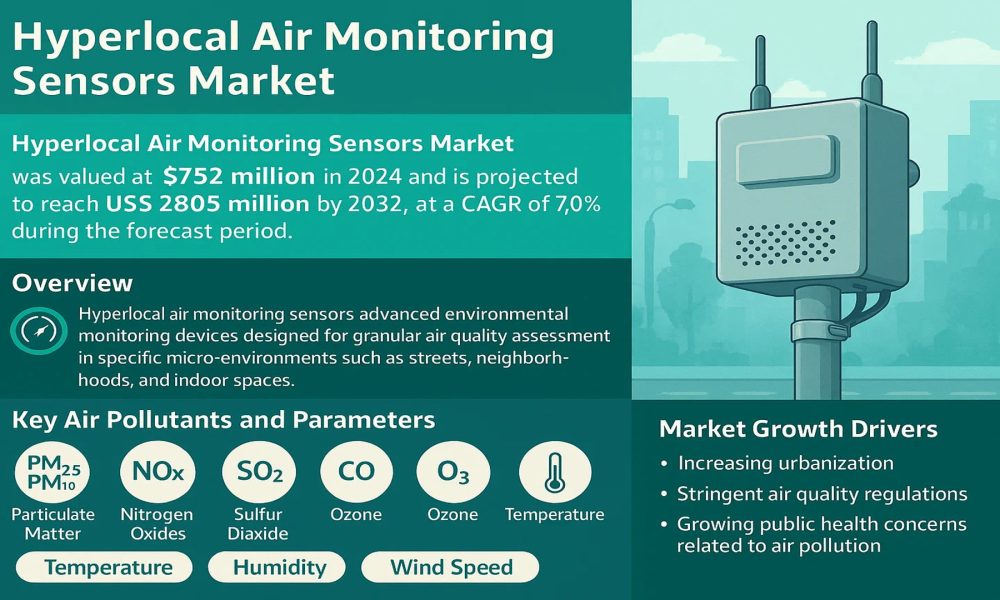
Hyperlocal Air Monitoring Sensors Market was valued at 1752 million in 2024 and is projected to reach US$ 2805 million by 2032, at a CAGR of 7.0% during the forecast period.
Hyperlocal air monitoring sensors are advanced environmental monitoring devices designed for granular air quality assessment in specific micro-environments such as streets, neighborhoods, and indoor spaces. These IoT-enabled sensors measure key air pollutants including particulate matter (PM2.5, PM10), nitrogen oxides (NOx), sulfur dioxide (SO2), carbon monoxide (CO), ozone (O3), and volatile organic compounds (VOCs), along with meteorological parameters like temperature, humidity, and wind speed.
Market growth is driven by increasing urbanization, stringent air quality regulations, and growing public health concerns related to air pollution. The Particulate Matter (PM) Sensor segment currently dominates the market, accounting for over 35% of total revenues in 2024. North America leads regional adoption with 42% market share, followed by Asia-Pacific which is projected to grow at 8.2% CAGR through 2032 due to rapid smart city development in China and India. Key players like Acoem, Clarity Movement, and Aeroqual are expanding their portfolios with AI-powered analytics capabilities to meet the demand for real-time pollution monitoring solutions.
Get Your Free Sample Report Today- https://semiconductorinsight.com/download-sample-report/?product_id=117751
MARKET DYNAMICS
MARKET DRIVERS
Growing Urbanization and Smart City Initiatives Fuel Demand for Hyperlocal Air Monitoring
The rapid urbanization across emerging economies is creating substantial demand for hyperlocal air quality monitoring solutions. With over 56% of the global population now living in urban areas, cities face mounting pressure to manage air pollution effectively. Municipal governments are increasingly deploying hyperlocal sensor networks as part of smart city infrastructure projects, with investments in smart city technologies projected to exceed $1 trillion by 2025. These sensors provide real-time, street-level pollution data that helps urban planners implement targeted mitigation strategies. For instance, several European cities have successfully used hyperlocal data to optimize traffic flow and reduce congestion-related emissions by up to 30% in critical zones.
Heightened Public Awareness of Air Quality Health Impacts Drives Adoption
Increased public understanding of the health consequences of air pollution is accelerating market growth. Studies show that exposure to PM2.5 contributes to approximately 4.2 million premature deaths annually, making real-time air quality monitoring a public health priority. This awareness has led to greater demand from residential communities, schools, and healthcare facilities for localized monitoring solutions. Consumer-grade sensors have become particularly popular, with unit sales growing at over 20% annually as individuals seek to monitor personal exposure levels. Furthermore, the integration of air quality data with health apps and wearable devices is creating new use cases that extend beyond traditional environmental monitoring applications.
Stringent Environmental Regulations Create Compliance-Driven Demand
Governments worldwide are implementing stricter air quality standards and reporting requirements, compelling industries to adopt advanced monitoring technologies. The European Union’s revised Air Quality Directive, for example, mandates real-time pollution monitoring at hyperlocal levels near industrial facilities. Similar regulations in North America and Asia are driving compliance investments, particularly in the oil & gas, manufacturing, and transportation sectors. Industrial applications now account for nearly 35% of hyperlocal sensor deployments as companies seek to avoid substantial fines and demonstrate environmental responsibility. This regulatory push complements growing corporate sustainability initiatives that prioritize emissions monitoring and reduction.
Recent Developments in the Hyperlocal Air Monitoring Sensors Market
- Expansion of Low-Cost Sensor Networks
Governments and city municipalities are increasingly deploying dense networks of hyperlocal air quality sensors to monitor pollution at the neighborhood and street level. For example, several European cities have launched urban sensor grid projects to track traffic-related emissions in real-time. - Integration with Smart City Infrastructure
Hyperlocal sensors are now being embedded into smart poles, streetlights, and public transport systems. This helps authorities collect granular pollution data while reducing the need for standalone installations. - AI and Cloud-Powered Analytics
Startups and tech providers are integrating AI algorithms and cloud platforms with sensor networks. This enables real-time visualization, predictive analysis, and health impact assessment of local air quality. - Portable and Wearable Devices
Companies are introducing compact, wearable hyperlocal sensors for personal use. These devices allow individuals to track exposure to pollutants while walking, cycling, or commuting. - Collaborations with Environmental Agencies
Recent years have seen collaborations between sensor manufacturers and environmental protection agencies to validate accuracy and standardize data collection. This helps improve the credibility of low-cost sensors compared to traditional reference-grade monitoring stations. - Corporate and Community Adoption
Enterprises, schools, and residential societies are adopting hyperlocal air monitoring solutions to safeguard employee and community health. This is creating new commercial opportunities beyond government contracts. - Technological Improvements
Advancements in sensor calibration, miniaturization, and energy efficiency have significantly improved accuracy and reduced maintenance costs. This is helping scale deployments in both developed and developing regions.
MARKET OPPORTUNITIES
Integration with Smart Building Systems Creates New Growth Avenues
The convergence of hyperlocal air monitoring with building automation presents significant commercial opportunities. Modern HVAC systems increasingly incorporate real-time air quality data to optimize ventilation and filtration, improving indoor environmental quality while reducing energy consumption. This integration is particularly valuable for commercial real estate, where studies show improved air quality can enhance cognitive function by up to 80% and reduce sick days by 20%. As building codes evolve to prioritize occupant health, the market for building-integrated sensors is projected to grow at nearly 25% annually through 2030, creating substantial opportunities for manufacturers of multi-parameter monitoring solutions.
Artificial Intelligence Enhances Predictive Capabilities and Market Potential
Advances in machine learning are unlocking new value from hyperlocal air quality data. AI-powered analytics can now predict pollution spikes with over 90% accuracy up to 48 hours in advance by combining sensor data with weather patterns and historical trends. This predictive capability enables proactive public health interventions and dynamic pollution control measures. Several cities have already implemented AI-driven systems that automatically adjust traffic signals and industrial operations based on anticipated air quality conditions. The global market for AI in environmental monitoring is expected to exceed $3 billion by 2027, with air quality applications representing the fastest-growing segment.
Emerging Economies Present Untapped Growth Potential
Developing nations with severe air pollution challenges represent the next frontier for market expansion. Cities across South Asia and Africa often experience pollution levels 10-15 times above WHO guidelines, yet have minimal monitoring infrastructure. International development funding for environmental projects in these regions has increased by 40% since 2020, creating opportunities for cost-effective sensor solutions tailored to local conditions. Local manufacturers are entering the market with rugged, low-maintenance devices priced 50-70% below Western alternatives, making hyperlocal monitoring feasible for budget-constrained municipalities. This emerging market segment is expected to account for over 35% of global sensor shipments by 2028.
Get Your Free Sample Report Today- https://semiconductorinsight.com/download-sample-report/?product_id=117751
List of Key Hyperlocal Air Monitoring Sensor Companies Profiled
- Acoem Group (France)
- Clarity Movement (U.S.)
- Aeroqual Limited (New Zealand)
- Sensirion AG (Switzerland)
- PurpleAir (U.S.)
- Vaisala (Finland)
- Plantower (China)
- Hikvision (China)
- Siemens (Germany)
- AirSENCE (UAE)
- AirGradient (Thailand)
- Breeze Technologies (Germany)
- Dylos Corporation (U.S.)
Segment Analysis:
By Type
Particulate Matter (PM) Sensor Segment Leads Due to Rising Urban Pollution Concerns
The market is segmented based on type into:
- Particulate Matter (PM) Sensor
- Subtypes: PM1.0, PM2.5, PM10 sensors
- Gas Sensor
- Subtypes: NOx, SOx, CO, O3, VOCs sensors
- Weather Parameter Sensor
- Subtypes: Temperature, humidity, wind speed, pressure sensors
- Multi-Parameter Sensors
By Application
Smart City Construction Segment Dominates as Governments Prioritize Sustainable Urban Development
The market is segmented based on application into:
- Smart City Construction
- Public Health Protection
- Industry and Energy
- Construction and Transportation
- Others
By End User
Municipal Authorities Lead Adoption Through Environmental Monitoring Programs
The market is segmented based on end user into:
- Municipal Authorities
- Environmental Agencies
- Industrial Facilities
- Research Institutions
- Commercial Complexes
Other Topic- LTS SQUID Sensor Market
CONTACT US:
City vista, 203A, Fountain Road, Ashoka Nagar, Kharadi, Pune, Maharashtra 411014
[+91 8087992013]




