
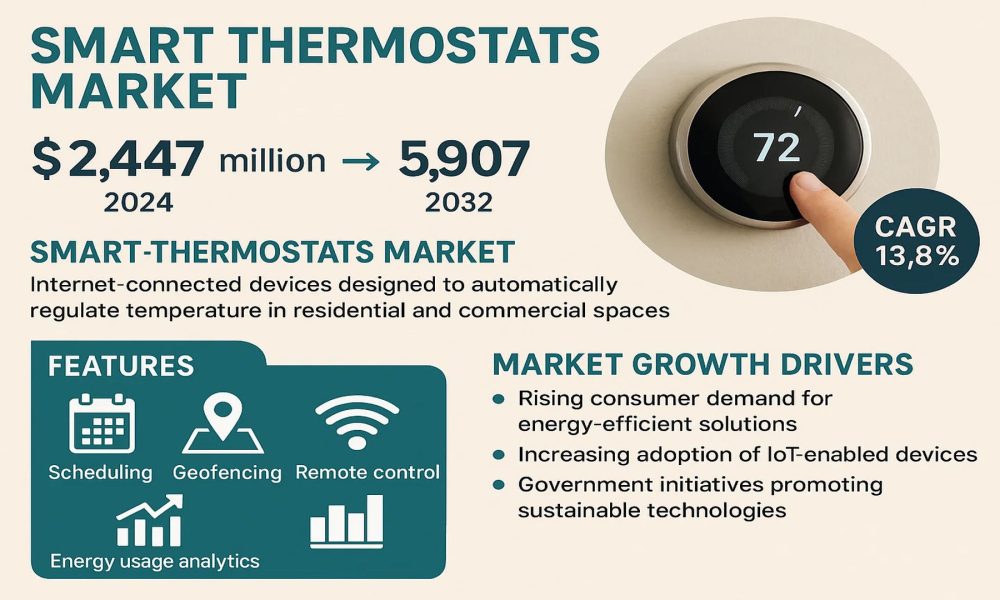
Smart Thermostats Market was valued at 2447 million in 2024 and is projected to reach US$ 5907 million by 2032, at a CAGR of 13.8% during the forecast period.
Smart thermostats are internet-connected devices designed to automatically regulate temperature in residential and commercial spaces. Unlike traditional thermostats, these advanced systems enable remote control via smartphones, voice assistants, or other smart devices while learning user preferences to optimize energy efficiency. They integrate with broader smart home ecosystems, offering features such as scheduling, geofencing, and energy usage analytics.
The market growth is driven by rising consumer demand for energy-efficient solutions, increasing adoption of IoT-enabled devices, and government initiatives promoting sustainable technologies. Smart thermostats can reduce energy consumption by up to 15%, according to industry studies, making them attractive for cost-conscious and eco-aware users. Leading players like Nest (Google), Ecobee, and Honeywell continue to innovate with AI-driven features, further expanding market potential.
Access Your Free Sample Report Now- https://semiconductorinsight.com/download-sample-report/?product_id=117810
MARKET DYNAMICS
MARKET DRIVERS
Growing Smart Home Adoption Fuels Demand for Intelligent Climate Control
The global smart thermostat market is experiencing robust growth, primarily driven by accelerating adoption of smart home technologies. With approximately 63 million smart homes worldwide in 2024, homeowners are increasingly investing in connected devices that enhance comfort and efficiency. Smart thermostats have become a cornerstone of modern home automation systems, with adoption rates growing at 18% annually in developed markets. Their ability to integrate with voice assistants like Alexa and Google Home significantly enhances user convenience, creating a compelling value proposition for tech-savvy consumers. This integration capability has become a key differentiator in home automation ecosystems.
Energy Efficiency Regulations Create Compelling Market Incentives
Governments worldwide are implementing stringent energy efficiency policies that directly benefit smart thermostat adoption. In North America alone, utility companies have deployed over 200 rebate programs incentivizing smart thermostat installation, with typical incentives ranging from $50-$150 per unit. The European Union’s Energy Performance of Buildings Directive (EPBD) mandates smart controls for heating systems in new constructions, creating a regulatory tailwind for market growth. Buildings equipped with smart thermostats demonstrate 8-15% reduction in HVAC energy consumption, making them attractive solutions for meeting sustainability targets.
Advancements in AI and Machine Learning Enhance Product Capabilities
Recent technological breakthroughs have transformed smart thermostats from programmable devices to intelligent climate management systems. Modern units now incorporate sophisticated machine learning algorithms that can predict occupancy patterns with 85-90% accuracy within two weeks of installation. Features like geofencing and weather adaptation have become standard, with top-tier models automatically adjusting settings based on real-time weather forecasts. The integration of indoor air quality monitoring represents the next frontier, with leading manufacturers incorporating VOC and CO2 sensors into their premium offerings.
Recent Developments in the Smart Thermostats Market
- Integration with AI and IoT Platforms
Recent developments show that smart thermostats are increasingly integrating with artificial intelligence (AI) and IoT ecosystems. Companies like Google (Nest), Honeywell, and Ecobee are enhancing predictive learning capabilities to optimize heating and cooling based on user behavior and weather patterns. - Expansion into Energy Management Solutions
Smart thermostats are now being integrated with broader smart home energy management systems. Utilities in North America and Europe are partnering with thermostat manufacturers to launch demand-response programs that help balance grid loads during peak times. - Voice and App-Based Control Enhancements
Newer models are focusing on seamless compatibility with virtual assistants like Amazon Alexa, Google Assistant, and Apple HomeKit, offering users greater flexibility in managing their indoor environments. - Focus on Sustainability and Energy Savings
Manufacturers are introducing eco-friendly features such as carbon footprint tracking and energy usage reports. For example, Ecobee and Nest have added sustainability dashboards to help households monitor and reduce their energy consumption. - Regional Expansion and Partnerships
Companies are expanding into Asia-Pacific and the Middle East, where rising smart city projects are driving demand. Strategic partnerships with HVAC system providers and utility companies are also fueling adoption. - Enhanced Security and Privacy Features
With increasing consumer concerns about data privacy, several brands are upgrading their cybersecurity protocols, offering encrypted data storage and transparent data policies.
MARKET OPPORTUNITIES
Commercial Sector Presents Untapped Growth Potential
While residential applications dominate current market share, the commercial segment represents a $2.1 billion opportunity by 2027. Office buildings, retail spaces, and hospitality venues are increasingly adopting enterprise-grade smart thermostat solutions that integrate with Building Management Systems (BMS). These commercial installations typically command 3-4 times the revenue of residential units while benefiting from higher customer lifetime values. The hospitality sector is particularly promising, with major hotel chains implementing smart thermostats to enhance guest comfort while achieving energy savings of 18-22% per property.
Emerging Markets Offer Significant Expansion Opportunities
Developing economies are experiencing compound annual growth rates of 28-32% for smart thermostats, nearly double the global average. This growth is driven by rising disposable incomes, urbanization, and government initiatives promoting energy-efficient technologies. In markets like India and Brazil, localized product adaptations—such as enhanced dust resistance and voltage stabilization—are proving critical for success. Manufacturers are establishing regional production facilities and distribution partnerships to capitalize on these high-growth opportunities while navigating varying regulatory environments.
Value-Added Services Create New Revenue Streams
Forward-thinking manufacturers are diversifying revenue through subscription-based services, with premium features like HVAC health monitoring and predictive maintenance generating $150-200 in annual recurring revenue per customer. Utility partnerships represent another promising avenue, with demand-response programs paying homeowners $50-75 annually for allowing temporary temperature adjustments during peak load periods. These ancillary services help offset hardware commoditization pressures while improving customer retention rates by 35-40% compared to standalone hardware sales.
Access Your Free Sample Report Now- https://semiconductorinsight.com/download-sample-report/?product_id=117810
List of Key Smart Thermostat Companies Profiled
- Nest (Google) (U.S.)
- Ecobee (Canada)
- Honeywell Home (Resideo) (U.S.)
- Emerson (Sensi) (U.S.)
- Netatmo (Legrand) (France)
- Tado (Germany)
- Vivint (U.S.)
- Schneider Electric (France)
- Johnson Controls (GLAS) (Ireland)
Segment Analysis:
By Type
Wi-Fi Thermostats Lead the Market Due to Seamless Connectivity and Smart Home Integration
The smart thermostat market is segmented based on connectivity type into:
- Wi-Fi Thermostats
- Subtypes: Cloud-connected, app-controlled, and others
- ZigBee Thermostats
- Bluetooth Thermostats
- Others
- Subtypes: Thread, Z-Wave, and proprietary protocols
By Application
Residential Segment Dominates Due to Rising Adoption in Smart Homes
The market is segmented based on application into:
- Residential
- Commercial
- Industrial
- Hospitality (Hotels, Resorts)
By Technology
Learning Thermostats Gain Traction with Advanced AI and Predictive Algorithms
The market is segmented based on technology into:
- Learning Thermostats
- Programmable Thermostats
- Manual Thermostats
By Feature
Energy-Efficient Models Drive Adoption Amid Rising Environmental Concerns
The market is segmented based on key features into:
- Energy Monitoring & Optimization
- Voice Control (Alexa, Google Assistant, Siri)
- Geofencing
- Multi-Zone Support
- Others
Other Topic- High performance Adhesives for Semiconductor Market
CONTACT US:
City vista, 203A, Fountain Road, Ashoka Nagar, Kharadi, Pune, Maharashtra 411014
[+91 8087992013]




