
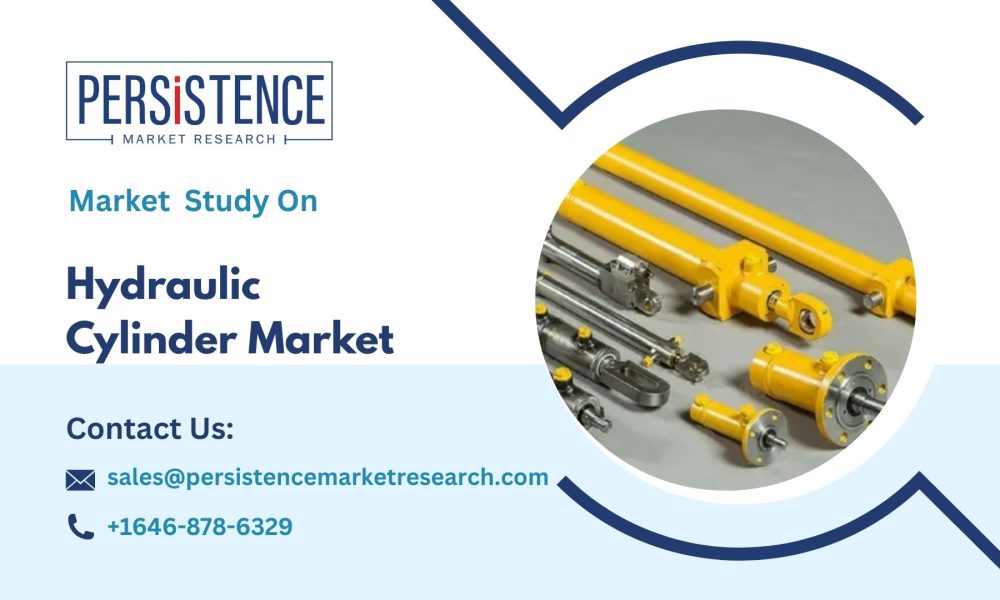
Overview of the Hydraulic Cylinder Market
The global hydraulic cylinder market is on a significant growth trajectory, projected to rise from US$14.8 billion in 2024 to US$21.5 billion by 2031, exhibiting a robust CAGR of 5.5% during the forecast period. Hydraulic cylinders are vital components in industrial machinery, construction equipment, and mobile applications, offering powerful linear motion through pressurized fluid mechanics. The increasing adoption of hydraulic cylinders is driven primarily by their ability to provide precise control, high force output, and reliable operation in challenging environments.
Hydraulic cylinders operate on the principles of Pascal’s law, converting hydraulic energy into linear mechanical force. Their applications range from heavy-duty construction equipment such as bulldozers and loaders to specialized industrial machinery used in pressing, lifting, and positioning operations. The market’s leading segment is the welded rod hydraulic cylinder, favored for its compact design, durability, and adaptability across industrial, maritime, and construction applications. Geographically, Asia-Pacific leads the market, with countries such as China, India, and Indonesia driving demand due to extensive infrastructure projects, rising urbanization, and rapid industrialization. China, in particular, registers higher demand for hydraulic cylinders owing to its massive construction sector and widespread use in forklifts, brick molding machines, and concrete busters.
Key Highlights from the Report
✦ The global construction boom is fueling demand for hydraulic cylinders across multiple industries.
✦ Welded rod hydraulic cylinders are expected to witness the fastest growth due to their compact and durable design.
✦ Rising awareness of hydraulic cylinder advantages, including high precision and low maintenance, is boosting adoption.
✦ Integration of sensors and hybrid actuator systems is enhancing performance and operational efficiency.
✦ Increasing infrastructure investments in developing countries, particularly in APAC, are propelling market growth.
✦ The shipping and logistics industry is driving demand for lifting equipment that relies on hydraulic cylinder technology.
𝐆𝐞𝐭 𝐚 𝐒𝐚𝐦𝐩𝐥𝐞 𝐏𝐃𝐅 𝐁𝐫𝐨𝐜𝐡𝐮𝐫𝐞 𝐨𝐟 𝐭𝐡𝐞 𝐑𝐞𝐩𝐨𝐫𝐭 (𝐔𝐬𝐞 𝐂𝐨𝐫𝐩𝐨𝐫𝐚𝐭𝐞 𝐄𝐦𝐚𝐢𝐥 𝐈𝐃 𝐟𝐨𝐫 𝐚 𝐐𝐮𝐢𝐜𝐤 𝐑𝐞𝐬𝐩𝐨𝐧𝐬𝐞): https://www.persistencemarketresearch.com/samples/4713
Market Segmentation
The hydraulic cylinder market is broadly segmented by product type, operating principle, application, bore size, and end-user industries.
By Product Type: Hydraulic cylinders are available in tie-rod, welded, bolted/mill type, telescopic, and threaded variations. Welded hydraulic cylinders dominate due to their lightweight, compact design, and superior performance in heavy-duty applications. Telescopic cylinders are preferred in applications requiring long stroke lengths in constrained spaces, such as construction and mining. Tie-rod cylinders continue to maintain a presence in industrial and mobile equipment due to their proven reliability.
By Operating Principle: The market categorizes cylinders as single acting, double acting, and multistage/tandem. Double-acting cylinders, which provide force in both directions, dominate the market for construction and industrial machinery, whereas single-acting cylinders are widely used in cost-sensitive and space-limited applications. Multistage or tandem cylinders are utilized in applications requiring extremely high stroke lengths or multiple-stage operations, such as in lifting equipment and mobile platforms.
By Application: Hydraulic cylinders find applications in industrial equipment, lifts and aerial work platforms, rams and presses, loading docks, injection molding machines, oil & gas, offshore platforms, construction, mining, agriculture, and material handling. Industrial and construction applications collectively represent the largest end-use segment, driven by the growing need for machinery with higher efficiency, precision, and longevity.
By Bore Size: Cylinders are segmented into <50 mm, 51–100 mm, 101–150 mm, 151–300 mm, and above 300 mm bore sizes. Smaller bore cylinders are widely used in mobile equipment and precision applications, while larger bore cylinders cater to heavy machinery in construction, mining, and industrial processing.
Regional Insights
North America maintains steady growth, supported by advanced infrastructure and robust waste management and food packaging industries. The U.S. relies heavily on hydraulic cylinders in street sweepers, trash compactors, and construction machinery to manage increasing urban waste efficiently.
Europe exhibits growth due to modernization in construction and automotive sectors, with countries like Germany and the UK showing significant adoption in industrial and food packaging equipment.
Asia-Pacific dominates the global market, driven by extensive urbanization and infrastructure projects in China, India, and Southeast Asia. China’s construction industry alone is expected to grow at a CAGR of 5.2% through 2033, fueling the demand for forklifts, loaders, and brick molding machinery that rely heavily on hydraulic cylinder technology.
South Korea is a notable hub in the automotive sector, using telescopic hydraulic cylinders for cost-effective, space-saving vehicle manufacturing processes.
Latin America, Middle East & Africa are gradually increasing adoption, mainly in construction, mining, and agricultural machinery.
Market Drivers
The hydraulic cylinder market is primarily driven by rising urbanization and surging construction activities worldwide. Large-scale infrastructure projects, particularly in Asia-Pacific, are boosting investments in construction machinery equipped with hydraulic systems. The superior durability of hydraulic cylinders, resistance to corrosion and abrasion, and their ability to withstand harsh environmental conditions make them a preferred choice across industries. Moreover, the availability of hydraulic cylinder rebuild options enhances operational efficiency, reduces oil consumption, and minimizes operational costs, further encouraging market adoption. Integration of advanced technologies like hybrid actuator systems and sensors also improves efficiency and reduces maintenance, which is a key growth driver.
Market Restraints
Despite their advantages, hydraulic cylinders face competition from pneumatic cylinders, which are lighter, faster, and capable of more precise motion control. Pneumatic systems with electronic monitoring allow for greater operational efficiency, particularly in construction and industrial processes. Additionally, fluctuating raw material costs and stringent environmental regulations around hydraulic oils and fluids pose challenges to market growth. Eco-friendly fluids, while compliant with regulations, are more expensive and increase overall manufacturing costs, impacting the profitability of hydraulic cylinder production.
Market Opportunities
The growing demand for lifting equipment in the shipping and logistics industry represents a significant opportunity for hydraulic cylinder manufacturers. Shipping containers of various sizes, ranging from 20 to 53 feet, rely on lifting equipment powered by hydraulic cylinders to move heavy loads efficiently. The integration of industrial IoT in lifting operations and government initiatives to enhance port infrastructure are expected to further propel demand. As adoption expands in developing regions, hydraulic cylinder manufacturers have the opportunity to innovate with robust, space-efficient, and energy-saving solutions that cater to the evolving needs of construction, logistics, and industrial sectors.
Reasons to Buy the Report
✔ Comprehensive analysis of the hydraulic cylinder market from 2024 to 2031.
✔ In-depth insights into market segmentation by product type, application, and region.
✔ Key growth drivers, restraints, and emerging opportunities highlighted for strategic planning.
✔ Detailed company profiles and competitive landscape for informed investment decisions.
✔ Regional and country-level market analysis to guide expansion and localization strategies.
Frequently Asked Questions (FAQs)
- How big is the hydraulic cylinder market globally?
- Who are the key players in the global hydraulic cylinder market?
- What is the projected growth rate of the hydraulic cylinder market?
- What is the market forecast for hydraulic cylinders for 2032?
- Which region is estimated to dominate the hydraulic cylinder industry through the forecast period?
Company Insights
Key players in the hydraulic cylinder market include:
• Parker Hannifin Corporation
• Eaton Corporation
• Bosch Rexroth
• Caterpillar Inc.
• Jiangsu Hengli Hydraulic Co., Ltd.
• Wipro Infrastructure Engineering
• SMC Corporation
• Danfoss A/S
• KYB Corporation
• HYDAC
Recent Developments:
• May 2024: Wipro Hydraulics acquired Mailhot Industries, enhancing its North American presence and expanding its portfolio in custom hydraulic cylinders.
• May 2024: Bailey International developed the AT (Alternative to Tie-Rod) Hydraulic Cylinders for agricultural equipment, offering a durable and user-friendly replacement option for tie-rod cylinders.
Conclusion
The hydraulic cylinder market is poised for significant growth, driven by increasing construction projects, rising urbanization, and technological advancements in hydraulic systems. With applications spanning industrial machinery, construction, agriculture, automotive, and shipping, the demand for hydraulic cylinders is set to expand across regions, particularly in Asia-Pacific and North America. Market players are leveraging mergers, acquisitions, and innovations in product design to enhance efficiency, reduce maintenance costs, and tap into emerging opportunities. While challenges such as competition from pneumatic systems and raw material price fluctuations exist, the market’s long-term outlook remains highly favorable, promising steady growth and opportunities for manufacturers and investors alike.
𝐑𝐞𝐥𝐚𝐭𝐞𝐝 𝐑𝐞𝐩𝐨𝐫𝐭𝐬:




