
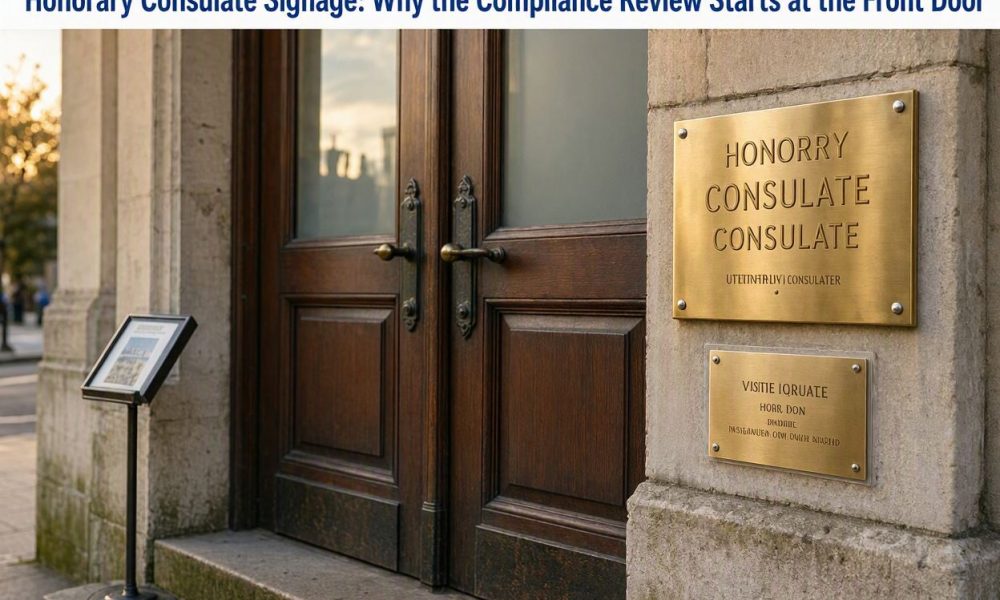
An exterior and lobby review can reveal confusion between official consular functions and private business activities. Still, findings must rest on applicable host-country requirements, not assumptions that every shared address or combined directory entry automatically violates international law.
WASHINGTON, D.C., September 28, 2026 — A foreign flag outside an office building can communicate official status instantly. Yet, the more consequential question for an honorary consular post is whether its public presentation accurately identifies the office and distinguishes it from neighboring commercial activities.
That distinction becomes especially important when an honorary consul works from a law practice or another private business, where visitors may encounter the same building entrance, reception personnel,l and directory before reaching the area used for official functions.
A perimeter and public signage audit offers a practical way to examine those arrangements. However,gh it should be understood as a compliance review framework rather than a universally prescribed inspection sequence carrying identical penalties in every receiving country.
The Documented Rule Behind Clear Identification
Archived State Department guidance on honorary consular officers and posts expressly requires appropriate signs identifying the area used exclusively for consular purposes, connecting that requirement to the Protection of honorary consular premises under the Vienna Convention on Consular Relations.
The same guidance addresses separating consular archives from private and professional papers, while other published departmental instructions contemplate offices located in an honorary consul’s residence, commercial premises, or a location dedicated exclusively to consular work.
Together, those provisions support a clear distinction between sharing a building and obscuring the identity of the consular area, without establishing that every honorary post must occupy a separately leased suite with its own independent street entrance.
Because the cited American guidance is archived, an actual compliance determination should also check the applicable current instructions and approval conditions, particularly before treating an older administrative statement as a complete description of requirements governing a specific post.
The practical starting point is therefore documentary: establish what location was accepted, what functions were authorized and what Identification requirements apply, then compare those facts with the message conveyed by the building’s exterior and public directory.
What a Perimeter Review Can Establish
A recommended exterior review begins with the ordinary visitor’s approach, recording the building address, visible office names, entrance markings, and directional information before evaluating whether those details reliably guide someone to the recognized consular office.
Photographs can document the wording and placement of public signs. Still, the reviewer should distinguish what an Image proves from what remains uncertain, including recognition status, internal room allocation, and whether the displayed office name is authorized.
For example, a photograph may show that a commercial logo dominates the entrance. However, additional evidence would still be needed to decide whether the arrangement misrepresents the consular post or conflicts with a specific approval condition.
A useful audit record should consequently describe the observed presentation in neutral terms, identify the source of any applicable requirement and explain the practical confusion created, rather than treating an unfavorable visual impression as sufficient proof of noncompliance.
The recommended test is functional: could a first-time visitor identify the consular office, understand where to report, and distinguish an official appointment from a meeting with the honorary consul’s private business without needing an improvised explanation.
Flags and Coats of Arms Have Defined Significance
Article 29 of the Vienna Convention provides for the sending state’s flag and coat of arms at specified locations, about the receiving state’s laws, regulations and usages, and Article 58 extends that provision to honorary consular posts.
The treaty establishes the right to display those national symbols, but does not prescribe a universal daily flag display, identical mounting hardware or a worldwide inspection checklist under which every missing exterior flag automatically produces a compliance failure.
A practical review should therefore check the sending government’s instructions and any applicable local requirements before judging placement, dimensions or mounting, while also asking whether the emblem’s position accurately indicates the office it is intended to identify.
In a hypothetical shared building, an official plaque directly above a private firm’s sales slogan could warrant clarification because the overall presentation might suggest government endorsement, even where the individual components appear unobjectionable when viewed separately.
That concern should be recorded as a question about the relationship communicated to the public, with the responsible authority asked to assess the arrangement where necessary, rather than being inflated into an unsupported allegation of diplomatic misconduct.
When a Combined Directory Entry Creates Ambiguity
Consider the hypothetical directory wording “Smith & Associates Law Firm / Consulate of Country X,” which combines a commercial practice and a consular designation in a single line without explaining their relationship or identifying the relevant official area.
That wording could mean two distinct offices share an address, or it could lead visitors to believe the law firm itself operates as the foreign government’s consulate, making the context around the entry essential to any fair assessment.
Separate directory entries, clearer descriptors or an internal room identifier would be sensible corrective options where confusion exists, provided the wording accurately reflects the recognized arrangement and does not invent a separate office that has never been approved.
A distinct suite number may improve navigation in some buildings. Still, it should not be described as universally mandatory merely because separate Identification is desirable, especially where an approved consular room sits within an otherwise commercial suite.
The defensible finding is that a combined entry requires examination when it obscures the consular area or misstates official status. At the same time, any formal warning or sanction must tie to the governing authority and the specific requirement breached.
The Lobby Should Confirm the Exterior Message
Once inside the building, a recommended review follows the visitor’s route through reception, elevator directories and corridor signs, checking whether each stage confirms the same office name and location rather than sending contradictory signals about the destination.
This review should also consider appointment instructions, because a clear sign is less useful when confirmation messages direct applicants to an outdated entrance, omit the relevant floor, or identify only the honorary consul’s unrelated private business.
Where a reception desk serves several occupants, staff should receive a straightforward explanation of how to direct consular visitors, with procedures designed to avoid disclosing sensitive appointment details to other tenants or people waiting for commercial services.
A reviewer could test those arrangements through an agreed walkthrough with the office manager, using a hypothetical visitor scenario to identify confusing directions without impersonating a government official or attempting unauthorized access to restricted areas.
The goal is consistency across the public journey, so the exterior sign, lobby listing, appointment message, and reception response all describe the same arrangement and leave little room for misunderstanding about who provides the service.
A Plaque Does Not Determine Enforcement Powers
For posts headed by honorary consuls, Article 59 addresses Protection against intrusion, damage, and disturbance, while Article 58 does not extend Article 31’s career-consular premises regime to those posts, making the distinction important when discussing entry and enforcement.
Article 61 separately protects honorary consular archives when they remain apart from private and professional papers, so the legal analysis must distinguish the official records from the building, the business, and the individual who occupies the office.
These provisions do not support a blanket claim that a flag shields an entire commercial suite from bailiffs, nor do they establish that every local official may disregard consular interests or inspect any material found inside.
In a real dispute, the relevant authority should assess the particular enforcement power, applicable protections and factual circumstances through proper channels, rather than allowing either a creditor or an office occupant to settle the issue through signage alone.
Clear Identification can assist that assessment by reducing factual uncertainty about the premises. Still, it cannot create immunity, decide property ownership, or replace the legal process governing access, service of documents, or enforcement.
The Canadian Example Emphasizes Accurate Public Status
Canada’s published honorary consul policy addresses public Identification when an appointment is not renewed, requiring the supervising mission to confirm that the former location is no longer represented as an honorary consul’s office on signage and websites.
That requirement illustrates a different but related risk: a sign may once have been accurate and later become misleading because the appointment ended, even though the plaque, directory listing, and online business profile remain unchanged.
A recommended review should therefore check the currency of the representation as well as its physical clarity, asking who maintains the building directory and how the office will update public information after a relocation or termination.
For a former post, removing the exterior plaque may be insufficient if the lobby directory and appointment website still advertise consular services, making coordination among the mission, office occupant and property manager a practical part of an orderly transition.
The Canadian example should remain clearly identified as Canadian policy, rather than being presented as proof that every government follows the same notification procedure, timetable or administrative process for ending an honorary consular appointment.
Why Oversight Extends Beyond Appearance
The Shadow Diplomats investigation by ICIJ and its reporting partners identified at least 500 current and former honorary consuls accused of crimes or embroiled in controversy, bringing sustained attention to weaknesses in appointment systems and oversight.
Those findings provide context for examining the relationship between public office and private interest. Still, they do not establish that an ambiguous directory entry is evidence of corruption or that a particular signage inspection model operates worldwide.
The appropriate lesson for a premises review is proportionate scrutiny, focusing on verifiable discrepancies between recognized functions and public representations rather than assuming that every honorary consul working from commercial premises presents the same risk.
Conversely, an attractive entrance should not substitute for checking official status, because polished lettering and national symbols can create confidence without confirming whether the office, the appointment, and the advertised services match the relevangovernment’s’s records.
Visual presentation therefore belongs within a broader assessment of authenticity and accountability, where the public message is tested against reliable documentation, and any discrepancy is addressed according to its significance rather than its dramatic potential.
A Useful Audit Report Identifies the Specific Problem
A recommended written finding should record the exact sign wording, its location and the date observed, then explain whether the concern involves inaccurate status, unclear directions, apparent commercial endorsement or inconsistency with an approved description of the premises.
The report should distinguish a confirmed breach from an unresolved question and an optional improvement, because those categories require different responses and should not be collapsed into a single Judgment that the office has failed an inspection.
For example, outdated signage advertising a discontinued office differs from small lettering that remains accurate but is difficult to read. At the same time, a combined directory entry may require clarification before any legal conclusion can responsibly follow.
Any proposed remedy should address the identified defect directly, such as correcting the office name, replacing obsolete directions, or separating two directory listings, instead of imposing an expensive restructuring of the premises without a documented reason.
The reviewer should also identify who can authorize the change, since the honorary consul, supervising mission, and property manager may control different parts of the public presentation and need to coordinate before the correction becomes effective.
Corrective Work Should Be Verifiable
For internal quality control, photographs taken after the correction can demonstrate that the relevant sign has changed, while a brief written confirmation can establish who approved the wording and whether associated visitor instructions were updated at the same time.
That follow-up should remain limited to the issue being checked, because a photograph of a corrected plaque cannot establish compliance with unrelated duties involving archives, appointment recognition, financial controls or the services actually delivered behind the office door.
Where the governing authority has issued a formal direction, the post should use the prescribed response process and deadline. At the same time, an internal review can set its own reasonable completion target without presenting that target as a statutory requirement.
A useful completion record would connect the original observation, the applicable instruction, the agreed correction, and the verification evidence, allowing a later reviewer to understand what changed without reconstructing the discussion from scattered emails or memories.
Keeping that record also helps when office management changes, because the reasoning behind a separate directory entry or a carefully worded plaque may otherwise disappear, leaving a future administrator to recreate the same ambiguity during routine renovations.
Implications for International Advisory Due Diligence
For readers considering Amicus International Consulting or another international advisory provider, the wider lesson is to assess claims involving consular representation through documented recognition and clearly defined authority, rather than the visual prestige associated with official symbols.
An adviser discussing an honorary appointment or premises arrangement should identify the jurisdiction involved and distinguish confirmed requirements from recommended practices, making it easier for a client to understand which decisions require approval from an actual government authority.
Readers reviewing Amicus’s service information should apply the same evidentiary discipline to any provider’s statements, asking what the proposed assistance includes, who is responsible for official decisions, and which claims can be independently checked before making commitments.
A premises checklist can organize relevant questions and help identify inconsistencies. Still, its usefulness depends on accurate legal references and an honest description of its purpose, especially when a consultant’s recommendations are presented alongside government requirements.
The most credible advisory work makes that distinction clear, offering practical steps without promising that a particular office layout, national emblem, or honorary title can create powers or protections beyond those recognized by the competent authorities.
Public Clarity Begins Before the Office Door
A well-designed perimeter and public signage review should leave the office with an accurate description of what visitors see, a documented basis for any concerns and a proportionate plan to correct misleading or outdated information.
Its value lies in connecting the recognized consular arrangement with the everyday experience of citizens, reception staff and building managers, so that official functions remain identifiable even when the surrounding property accommodates ordinary professional and commercial activities.
The combined law-firm-and-consulate example is therefore best understood as a prompt for careful review, with separate Identification considered where necessary and the final assessment grounded in the applicable rules, approval conditions and actual physical arrangement.
For honorary consular posts, the strongest public presentation accurately communicates both the existence and the limits of the office, giving visitors a reliable destination while avoiding any implication that private business and government authority are interchangeable.




