

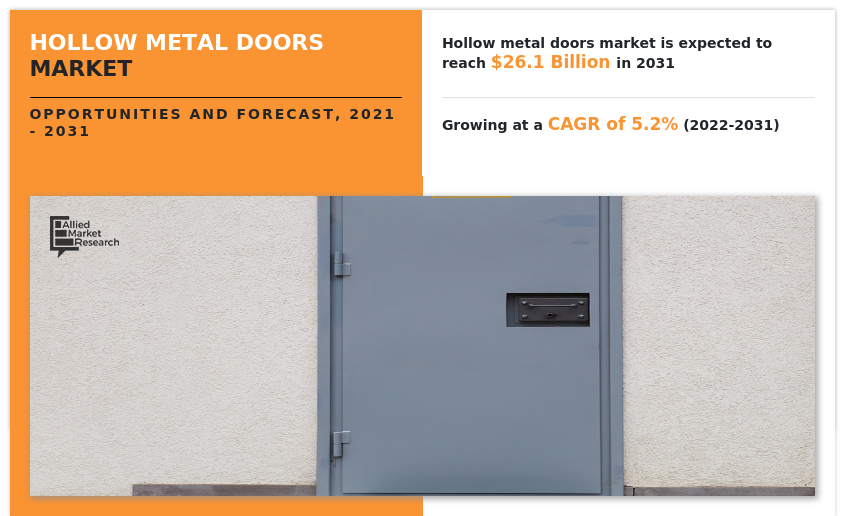
Global Hollow Metal Doors Market to Expand from USD 15.7 Billion in 2021 to USD 26.1 Billion by 2031, Growing at a CAGR of 5.2%
The global hollow metal doors market size at USD 15.7 billion in 2021, is projected to reach USD 26.1 billion by 2031, registering a compound annual growth rate (CAGR) of 5.2% from 2022 to 2031. Hollow metal doors, composed of a steel frame with steel panels laminated on both sides, are widely used in commercial and industrial settings due to their durability, security, and versatility. Typically equipped with mounts for hinges and mortise locks, these doors are integral to applications such as fire exits, storage rooms, and building entrances. This comprehensive analysis explores the market dynamics, segmentation, regional trends, competitive landscape, and growth opportunities driving the hollow metal doors industry.
𝐃𝐨𝐰𝐧𝐥𝐨𝐚𝐝 𝐏𝐃𝐅 𝐒𝐚𝐦𝐩𝐥𝐞 𝐂𝐨𝐩𝐲@ https://www.alliedmarketresearch.com/request-sample/A17056
Hollow Metal Doors Market Overview
Hollow metal doors are a cornerstone of commercial and industrial construction, offering robust solutions for environments requiring high security and durability. These doors are designed to withstand heavy use and are commonly found in settings such as airports, malls, corporate offices, and industrial facilities. The market is driven by increasing demand for multifamily housing, the adoption of automated door systems, and the development of energy-efficient designs. Additionally, rising government investments in infrastructure and the surge in urbanization and industrialization in emerging economies are key factors fueling market growth.
The market faced challenges during the COVID-19 pandemic, which disrupted production and supply chains. However, with the recovery of global economies and the resumption of construction activities by late 2021, the market is poised for steady growth. Innovations in door design and materials, coupled with government initiatives supporting sustainable construction, are creating new opportunities for market expansion.
Hollow Metal Doors Market Dynamics
Drivers
The hollow metal doors market is propelled by several key factors. The rise in multifamily housing trends, particularly in urban areas, has increased the demand for durable and secure door solutions. Hollow metal doors are ideal for residential complexes, offering fire resistance and enhanced security features. The adoption of automated doors in commercial sectors, such as airports, malls, and corporate offices, is another significant driver. Automated hollow metal doors enhance accessibility and efficiency, making them a preferred choice in high-traffic environments.
Government spending on residential and commercial infrastructure is a major catalyst for market growth. For instance, the Tokyo International Conference on African Development (TICAD) announced a USD 20 billion investment in African infrastructure over three years starting in August 2020, boosting demand for hollow metal doors in commercial and institutional projects. Similarly, China’s 14th Five-Year Plan (2021–2025) emphasizes digital technology in construction, further driving the need for advanced door systems.
Rapid urbanization and industrialization in developing economies like India, China, and African nations are also contributing to market expansion. The growing population in these regions has led to increased construction activity, particularly in industrial and commercial sectors, necessitating robust door solutions. Additionally, rising consumer spending on home renovation and enhancement activities is fueling demand for hollow metal doors in residential applications.
Restraints
Fluctuating raw material prices, particularly for steel, pose a significant challenge to market growth. Volatility in metal prices increases production costs, which can deter price-sensitive customers, especially in developing regions. The COVID-19 pandemic further exacerbated these challenges by disrupting supply chains and halting construction activities, leading to a temporary decline in demand for hollow metal doors. Although the market began recovering by late 2021, these factors continue to impact growth in certain segments.
Opportunities
The development of energy-efficient and automated hollow metal doors presents lucrative opportunities for market players. Innovations such as insulated cores (e.g., honeycomb or polystyrene) enhance thermal efficiency, aligning with global sustainability goals and green building standards. Additionally, the integration of smart technologies, such as automated opening systems and digital locking mechanisms, is expected to drive demand in commercial and institutional applications. The surge in renovation activities, particularly in developed regions, also offers growth potential as consumers upgrade existing structures with modern door solutions.
𝐄𝐧𝐪𝐮𝐢𝐫𝐞 𝐁𝐞𝐟𝐨𝐫𝐞 𝐁𝐮𝐲𝐢𝐧𝐠@ https://www.alliedmarketresearch.com/purchase-enquiry/A17056
Hollow Metal Doors Market Segmentation
The hollow metal doors market is segmented by type, application, end user, and region, providing a detailed understanding of its structure and growth potential.
By Type
The market is categorized into flush hollow metal doors, hollow metal doors with windows, paneled hollow metal doors, and others. In 2021, the flush hollow metal doors segment held the highest market share due to its widespread use in fire exits, rear building doors, storage rooms, and entrances. Flush designs are favored for their simplicity, durability, and cost-effectiveness, making them a popular choice across various applications.
By Application
The market is divided into new construction and renovation. New construction accounted for a significant share in 2021, driven by global infrastructure development and urbanization. The renovation segment is expected to grow steadily, fueled by increasing consumer spending on home improvement and the retrofitting of commercial buildings with modern door systems.
By End User
The market is segmented into commercial and institutional buildings, industrial spaces, and others. The commercial and institutional building segment led in 2021, driven by rising government investments in schools, hospitals, and office buildings. Industrial spaces, such as factories and warehouses, also contribute significantly, as hollow metal doors provide the durability and security required in these environments.
By Region
Geographically, the market is analyzed across North America (U.S., Canada, Mexico), Europe (Germany, France, UK, Italy, Spain, Russia, Poland, Netherlands, Sweden, rest of Europe), Asia-Pacific (China, India, Japan, South Korea, Australia, Thailand, Indonesia, Vietnam, rest of Asia-Pacific), and LAMEA (Brazil, Argentina, Saudi Arabia, UAE, South Africa, Nigeria, rest of LAMEA). Asia-Pacific dominated the market in 2021, driven by rapid urbanization, population growth, and government initiatives in countries like China and India. LAMEA is expected to register the highest CAGR during the forecast period, fueled by increasing infrastructure investments in African and Latin American countries.
Competitive Landscape
The hollow metal doors market is highly competitive, with key players focusing on product innovation, business expansion, and strategic partnerships to strengthen their market position. Major companies include AccessSMT Holdings Ltd., ALLEGION, Baron Metal Industries, Inc., Beacon Commercial Door & Lock, CECO DOOR, Concept Frames, Curries, DCI Hollow Metal, Deansteel Manufacturing Company, Inc., DKS Steel Doors & Frames, Inc., EightynineA LLC., Fleming, GH Hollow Metal Doors & Frames Industries Corp., Houston-Starr Company, Plyler Entry Systems, Quality Engineered Products Co., and TRUDOOR, LLC.
These companies are investing in advanced manufacturing techniques and energy-efficient designs to meet evolving customer demands. Strategic partnerships and acquisitions are also common, enabling firms to expand their product portfolios and geographic reach.
Key Benefits for Stakeholders
This report provides valuable insights for stakeholders, including:
- Quantitative Analysis: Detailed market size, trends, and growth forecasts from 2021 to 2031.
- Segmentation Insights: Comprehensive breakdown by type, application, end user, and region to identify high-growth opportunities.
- Competitive Intelligence: Analysis of key players’ strategies, including product innovation and partnerships, to understand market dynamics.
- Regional Opportunities: Identification of high-potential regions, such as LAMEA, for investment and expansion.
- Market Drivers and Restraints: Insights into factors driving growth and challenges hindering adoption, aiding strategic decision-making.
The global hollow metal doors market is poised for steady growth, driven by increasing urbanization, government investments in infrastructure, and the adoption of automated and energy-efficient door systems. Despite challenges such as fluctuating raw material prices and the temporary impact of the COVID-19 pandemic, the market is recovering, with Asia-Pacific leading and LAMEA emerging as a high-growth region. Innovations in door design and materials, coupled with rising demand for renovation and commercial construction, are creating new opportunities for market players. With key companies focusing on innovation and strategic expansion, the hollow metal doors market is well-positioned to meet the evolving needs of commercial, industrial, and residential sectors through 2031.




