
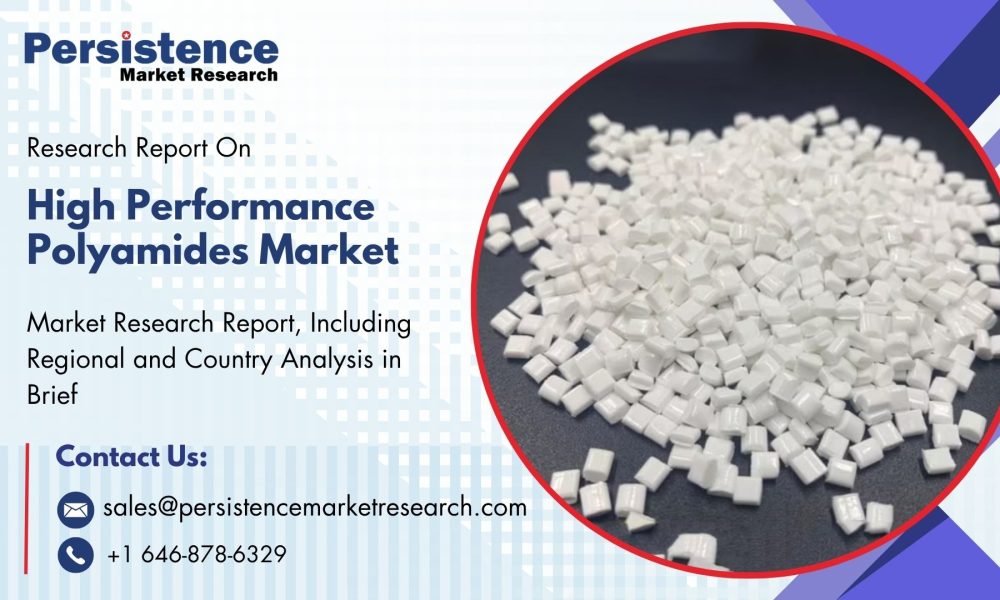
The global high performance polyamides market is entering an exciting growth phase, fueled by the increasing demand for lightweight, durable, and heat-resistant materials in industries such as automotive, electrical and electronics, and industrial manufacturing. High performance polyamides (HPAs) are advanced engineering plastics known for their exceptional mechanical strength, thermal stability, chemical resistance, and low moisture absorption. They are rapidly replacing conventional metals and standard polymers in various high-stress applications due to their superior performance characteristics.
According to the latest study by Persistence Market Research, the global high performance polyamides market size is likely to be valued at US$ 2,765.0 million in 2025 and is expected to reach US$ 4,040.1 million by 2032, growing at a CAGR of 5.6% during the forecast period from 2025 to 2032. The market’s expansion is primarily driven by the growing shift toward lightweight materials in automotive and aerospace manufacturing, as well as the rising demand for high-performance components in electrical and electronic devices.
Get a Sample PDF Brochure of the Report (Use Corporate Email ID for a Quick Response): https://www.persistencemarketresearch.com/samples/35151
Rising Demand for Lightweight Materials in Automotive Applications
The automotive industry is one of the largest consumers of high performance polyamides, as manufacturers increasingly focus on reducing vehicle weight to improve fuel efficiency and lower carbon emissions. HPAs, including polyamide 11 (PA11), polyamide 12 (PA12), and polyphthalamide (PPA), offer a compelling combination of lightweight structure, strength, and heat resistance, making them ideal for replacing metals in under-the-hood and structural applications.
With the transition to electric vehicles (EVs) and hybrid models, the need for thermally stable, high-durability materials has become even more critical. HPAs are being used in battery modules, connectors, cooling systems, and electrical housings due to their ability to withstand high temperatures and electrical stress. Moreover, their resistance to automotive fluids such as oils, fuels, and coolants makes them a preferred material in fuel lines, brake systems, and air intake manifolds.
As automotive manufacturers across Europe, North America, and Asia-Pacific continue to adopt lightweight and sustainable materials to meet stringent emission norms and performance standards, the demand for high performance polyamides is expected to accelerate significantly over the coming years.
Expanding Applications in Electrical and Electronics Industry
The electrical and electronics sector is another major driver of the high performance polyamides market. The increasing miniaturization of electronic devices, coupled with the need for thermal and dimensional stability, has made HPAs indispensable in various electronic components.
High performance polyamides are used in the production of connectors, circuit breakers, switches, sockets, and cable insulations. Their exceptional dielectric properties and flame retardancy ensure safe and reliable operation in electronic assemblies. With the rise of 5G technology, smart devices, and renewable energy systems, demand for high-precision electronic components is growing rapidly, thereby boosting HPA consumption.
In addition, HPAs are being increasingly adopted in automotive electronics, where they are used to produce housings for sensors, control units, and connectors in EVs and autonomous vehicles. As the integration of electronic systems in modern automobiles continues to expand, HPAs are expected to play a pivotal role in ensuring safety, reliability, and performance.
Industrial Applications and Chemical Resistance Advantages
Beyond automotive and electronics, HPAs are finding wide usage in industrial equipment, oil and gas, healthcare, and consumer goods due to their resistance to chemicals, high wear, and extreme conditions. Their excellent mechanical performance under continuous stress and exposure to aggressive environments makes them ideal for use in gears, bearings, valves, and seals.
In the oil and gas industry, HPAs are employed in flexible pipes, tubing, and fittings that must endure high pressure and corrosive chemicals. In healthcare, medical-grade HPAs are utilized for surgical instruments, catheter components, and prosthetic devices due to their biocompatibility and sterilization resistance. The growth of healthcare infrastructure and increasing investment in medical device manufacturing are likely to provide additional momentum to the market.
Furthermore, the industrial 3D printing sector is emerging as a new growth frontier for HPAs. These materials’ excellent processability and dimensional stability make them suitable for additive manufacturing of customized, high-performance parts used in aerospace and industrial design applications.
Technological Advancements and Material Innovation
Continuous technological advancements in polymer science are contributing to the rapid evolution of high performance polyamides. Manufacturers are investing in bio-based and recyclable HPAs, driven by sustainability goals and regulatory pressures to reduce environmental impact. For instance, bio-based PA11, derived from renewable sources such as castor oil, offers similar or superior performance compared to conventional petrochemical-based polyamides while contributing to a lower carbon footprint.
The development of high-temperature resistant and reinforced polyamides, such as glass fiber or carbon fiber-reinforced variants, is expanding the material’s application scope in aerospace and electronics. These composite materials combine strength, stiffness, and heat resistance while remaining lightweight—an essential combination for high-performance industrial components.
Moreover, innovations in polyamide processing techniques such as injection molding, extrusion, and blow molding are improving the manufacturability and cost-effectiveness of HPA components. With the increasing integration of Industry 4.0 technologies, automated production systems are further enhancing quality control and consistency in high-performance polymer manufacturing.
For Customized Insights on Segments, Regions, or Competitors, Request Personalized Purchase Options: https://www.persistencemarketresearch.com/request-customization/35151
Regional Market Insights
The global high performance polyamides market exhibits strong growth potential across several key regions:
- Europe remains a significant market, driven by a well-established automotive and industrial manufacturing base. Countries like Germany, France, and Italy are leading adopters of HPAs for high-precision engineering and mobility applications.
- North America is witnessing steady demand, fueled by technological advancements in the electronics and aerospace industries. The United States is home to several global polymer manufacturers investing in advanced materials research and bio-based alternatives.
- Asia-Pacific is projected to experience the fastest growth, particularly in China, Japan, South Korea, and India. The region’s booming automotive production, rapid industrialization, and strong electronics manufacturing base are creating vast opportunities for HPA producers.
- Latin America and the Middle East & Africa are also showing increasing adoption of high performance polyamides in industrial and oil and gas applications, supported by infrastructure development and foreign investments.
Sustainability and Environmental Considerations
Sustainability has become a defining theme in the high performance polyamides market. With global efforts to reduce carbon emissions and promote circular economies, the demand for eco-friendly materials is gaining traction. Manufacturers are focusing on developing bio-based HPAs derived from renewable raw materials that provide equivalent mechanical performance while reducing environmental impact.
Additionally, recycling and reprocessing technologies are being enhanced to recover polyamide waste from industrial and post-consumer sources. The increasing adoption of closed-loop manufacturing systems and chemical recycling initiatives is expected to strengthen the sustainability profile of the HPA industry in the coming decade.
Environmental regulations such as the European Union’s REACH and U.S. EPA’s sustainable materials guidelines are further motivating companies to adopt greener formulations and cleaner production techniques. This shift toward sustainable innovation is expected to reshape the competitive landscape of the global HPA market.
Company Insights
The global high performance polyamides market is moderately consolidated, with key players focusing on research and development, product diversification, and strategic partnerships. Prominent companies operating in the market include:
✦ Arkema S.A.
✦ Evonik Industries AG
✦ BASF SE
✦ DuPont de Nemours, Inc.
✦ Royal DSM N.V.
✦ Solvay S.A.
✦ EMS-Chemie Holding AG
✦ Toray Industries, Inc.
✦ Kuraray Co., Ltd.
✦ UBE Industries, Ltd.
These companies are increasingly focusing on bio-based product innovation, capacity expansions, and strategic collaborations to cater to growing demand across multiple industries. For instance, leading manufacturers are investing in the development of PA9T and PA10T polymers—new-generation HPAs with superior heat and chemical resistance—for advanced automotive and electronic applications.
Future Outlook
The global high performance polyamides market is poised for sustained growth through 2032, underpinned by increasing industrial innovation, electrification trends, and sustainability initiatives. The shift toward lightweight, durable, and eco-friendly materials across automotive, aerospace, and electronics sectors will continue to drive market demand.
As manufacturers focus on enhancing performance while reducing environmental impact, the adoption of bio-based HPAs, reinforced composites, and high-temperature polyamides will expand. Emerging technologies such as additive manufacturing and smart material integration are also expected to open new avenues for market development.
In conclusion, with the market projected to grow from US$ 2,765.0 Mn in 2025 to US$ 4,040.1 Mn by 2032 at a CAGR of 5.6%, high performance polyamides are set to remain at the forefront of material innovation—offering the perfect balance of strength, sustainability, and versatility for the industries of the future.
Explore the Latest Trending Research Reports:
About Persistence Market Research:
At Persistence Market Research, we specialize in creating research studies that serve as strategic tools for driving business growth. Established as a proprietary firm in 2012, we have evolved into a registered company in England and Wales in 2023 under the name Persistence Research & Consultancy Services Ltd. With a solid foundation, we have completed over 3600 custom and syndicate market research projects, and delivered more than 2700 projects for other leading market research companies’ clients.
Our approach combines traditional market research methods with modern tools to offer comprehensive research solutions. With a decade of experience, we pride ourselves on deriving actionable insights from data to help businesses stay ahead of the competition. Our client base spans multinational corporations, leading consulting firms, investment funds, and government departments. A significant portion of our sales comes from repeat clients, a testament to the value and trust we’ve built over the years.
Contact Us:
Persistence Market Research
Second Floor, 150 Fleet Street,
London, EC4A 2DQ, United Kingdom
USA Phone: +1 646-878-6329
UK Phone: +44 203-837-5656
Email: [email protected]
Web: https://www.persistencemarketresearch.com




