
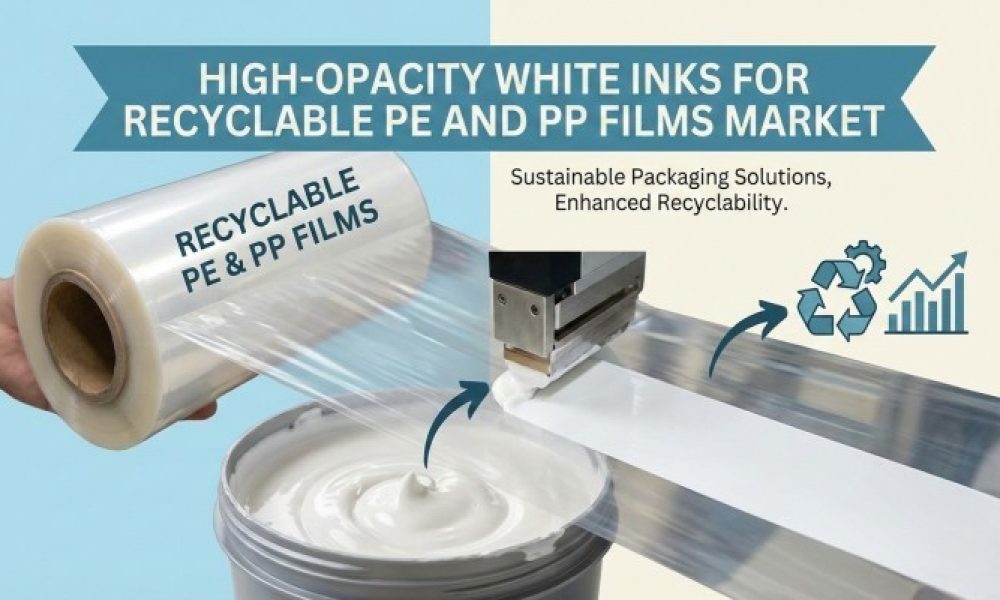
The global high-opacity white inks for recyclable PE/PP films market is entering a decisive decade as sustainability requirements, print performance expectations, and recycling compliance converge. Valued at USD 165 million in 2026, the market is projected to reach USD 430 million by 2036, expanding at a strong CAGR of 9.7%. Unlike conventional ink segments that grow in line with overall print volumes, this market is being shaped by packaging redesign cycles, mono-material adoption, and the need to balance opacity with recyclability.
Market Outlook: Performance Meets Circularity
High-opacity white inks play a critical role in flexible packaging by providing a clean, bright base layer on transparent or translucent PE and PP films. As brands shift away from multi-material laminates toward recyclable mono-material structures, white ink layers have become essential for maintaining brand visibility, contrast, and shelf appeal. Growth is therefore tied less to film volume expansion and more to how packaging is being redesigned to meet recycling guidelines.
Explore Opportunities – Get Your Sample of Our Industry Overview Now!
Between 2026 and 2031, the market expands from USD 165 million to USD 239 million, adding USD 74 million in value. This early phase reflects wider qualification of recyclable white inks, improved pigment dispersion technologies, and growing confidence among converters in consistent press performance. From 2031 to 2036, growth accelerates sharply, with the market rising from USD 239 million to USD 430 million, adding USD 191 million. This second phase reflects broader rollout across food, personal care, and household packaging as recyclable formats move from pilot programs to mainstream adoption.
Key Market Drivers
Demand for high-opacity white inks in recyclable PE and PP films is driven by functional and regulatory pressures, not just aesthetics.
- Opacity on downgauged films: Thinner PE and PP films increase show-through risk, raising demand for inks with stronger hiding power at lower coat weights.
- Recyclability compliance: Ink systems must remain compatible with mechanical recycling processes, avoiding interference with sorting, washing, and melt filtration.
- Cost and efficiency trade-offs: Titanium dioxide loading, binder selection, and coverage efficiency directly influence cost structures and pricing stability.
- Specification lock-in: Once approved, ink formulations are rarely changed due to press calibration, customer qualification, and regulatory documentation, creating high switching costs.
Suppliers that can deliver consistent brightness retention and opacity without compromising recyclability maintain stronger long-term positioning.
Quick Market Snapshot
- Market value (2026): USD 165 million
- Forecast value (2036): USD 430 million
- CAGR (2026–2036): 9.7%
- Leading film type: PE (polyethylene) films
- Key growth regions: Asia Pacific, Europe, North America
- Major players: Sun Chemical (DIC), Siegwerk, Flint Group, Toyo Ink SC Holdings, hubergroup
Film Type Insights: PE Leads Adoption
Polyethylene (PE) films account for around 46% of demand, reflecting their dominance in recyclable flexible packaging. PE’s sealability, toughness, and established recycling pathways make it the preferred substrate for mono-material designs. Ink formulations for PE are well optimized, with binders engineered for low surface energy substrates and stable adhesion after surface treatment. High production volumes and standardized film grades further reinforce repeat ink consumption.
PP films including BOPP and CPP represent a secondary but growing segment. While PP offers stiffness and clarity, it requires tighter formulation control, limiting rapid adoption compared to PE.
Application Trends: Flexible Pouches Take the Lead
Flexible pouches represent approximately 32% of market demand, making them the leading application segment. Pouches rely heavily on white ink layers to create visual equivalence with legacy laminate structures while transitioning to recyclable formats. High run lengths, repeat designs, and strong branding dependence drive steady ink usage. These inks must withstand lamination, sealing, and forming processes without cracking or discoloration, reinforcing the need for carefully engineered formulations.
Other applications—labels, wraps, bags, sacks, and specialty packaging—contribute smaller shares, with adoption driven by specific performance or cost considerations.
Regional Outlook: Growth Anchored in Sustainability Policy and Production Scale
- China (11.0% CAGR): Leads global growth due to large-scale flexible packaging production, strong food and beverage demand, and government-backed sustainability initiatives.
- South Korea (9.3% CAGR): Driven by advanced industrial printing, consumer electronics packaging, and high precision production standards.
- United States (8.5% CAGR): Growth is supported by recyclable packaging adoption, FDA food-contact compliance, and consistent demand from consumer goods producers.
- Germany (8.2% CAGR): Mature packaging markets and strict EU recycling regulations shape demand for certified, high-performance ink systems.
- Japan (7.9% CAGR): Emphasizes precision, quality, and regulatory adherence in food and consumer packaging.
Competitive Landscape: Reliability Over Aggressive Pricing
Competition in this market is defined by balanced performance, not price wars. Leading suppliers focus on achieving opacity at lower coat weights to control costs and reduce recycling impact.
- Sun Chemical and Siegwerk emphasize advanced titanium dioxide dispersion systems for consistent whiteness and recyclability.
- Flint Group focuses on press stability and opacity retention on thin films.
- Toyo Ink SC Holdings prioritizes system-level compatibility across lamination and sealing processes.
- hubergroup competes through formulation discipline, documentation strength, and alignment with recyclability audits.
Joint trials with film producers and recyclers are becoming standard practice, reinforcing credibility and long-term supplier relationships.
Why FMI: https://www.futuremarketinsights.com/why-fmi
About Future Market Insights (FMI)
Future Market Insights, Inc. (FMI) is an ESOMAR-certified, ISO 9001:2015 market research and consulting organization, trusted by Fortune 500 clients and global enterprises. With operations in the U.S., UK, India, and Dubai, FMI provides data-backed insights and strategic intelligence across 30+ industries and 1200 markets worldwide.



