
Overview
The Global HERG Screening Market size is expected to be worth around USD 6578.7 Million by 2033 from USD 2189.9 Million in 2023, growing at a CAGR of 13.04% during the forecast period from 2024 to 2033.
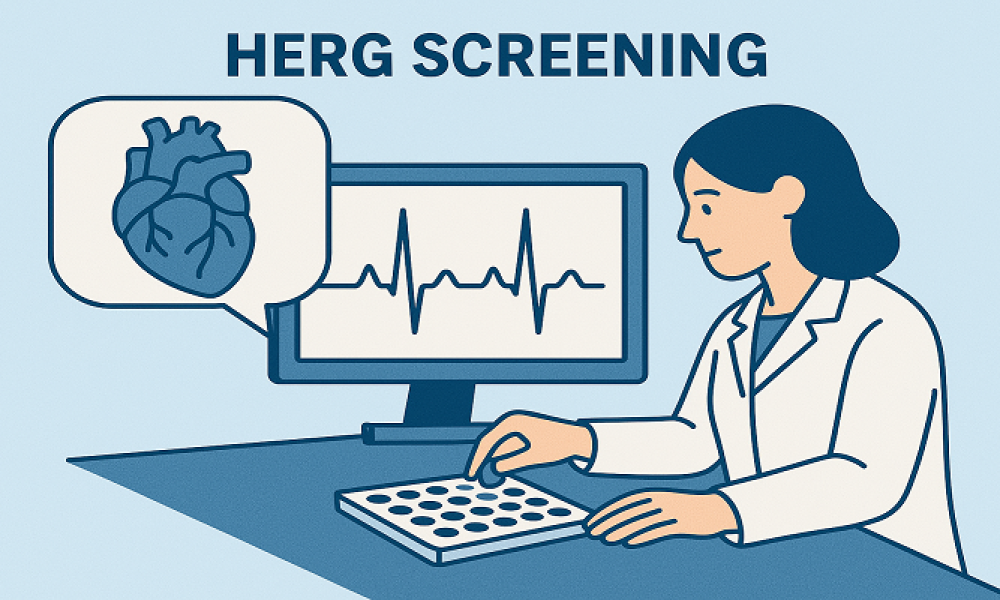
Global HERG (Human Ether-à-go-go-Related Gene) screening market is experiencing substantial growth, driven by the increasing focus on cardiac safety in pharmaceutical drug development. HERG screening has emerged as a critical step in preclinical drug assessment, aimed at detecting compounds that may interfere with cardiac ion channels, potentially leading to arrhythmias such as Torsades de Pointes.
With regulatory authorities such as the U.S. FDA and EMA emphasizing the importance of early cardiotoxicity testing, pharmaceutical and biotechnology companies are increasingly investing in HERG screening technologies. These screenings play a vital role in identifying and excluding drug candidates that could block the HERG potassium channel, which is essential for cardiac repolarization.
Advancements in high-throughput screening (HTS), automated patch-clamp technologies, and in silico predictive models have further accelerated the adoption of HERG testing. Additionally, the integration of HERG assays in the Comprehensive In Vitro Proarrhythmia Assay (CiPA) initiative has provided a standardized framework for assessing cardiac risk.
North America currently dominates the HERG screening market due to its strong R&D infrastructure, regulatory compliance standards, and presence of major pharmaceutical players. However, Asia-Pacific is expected to witness significant growth due to increased clinical trial activity and expansion of contract research organizations (CROs).
Click here to get a Sample report copy @ https://market.us/report/herg-screening-market/free-sample/

Key Takeaways
- According to product type analysis, the HERG screening market is segmented into KCNH2 gene and mutant KCNH2 categories, with the KCNH2 gene segment emerging as the dominant contributor within this classification.
- Under ion channel analysis, the market encompasses a range of channel types including voltage-gated, ligand-gated, mechanosensitive, and transient receptor potential (TRP) ion channels, each playing a vital role in the screening process.
- The antiarrhythmic drug segment holds a leading position in driving the growth of the HERG screening market, as these drugs are widely utilized in the treatment of various cardiac conditions associated with arrhythmias.
- North America accounts for the largest share of the global HERG screening market, outperforming both Europe and the Asia-Pacific (APAC) region. The region’s dominance is supported by robust healthcare infrastructure and extensive R&D activities in cardiovascular drug development.
- The primary factor propelling the growth of the HERG screening market is the increasing prevalence of heart-related disorders, necessitating stringent preclinical screening for cardiotoxicity.
- However, the high cost associated with HERG screening technologies and tools is anticipated to pose a challenge to market expansion during the forecast period, particularly in price-sensitive regions.
Segmentation Analysis
The HERG screening market is experiencing notable growth, primarily driven by the dominance of KCNH2 gene channels and the widespread application of voltage-gated ion channels. The antiarrhythmic segment leads in application due to the increasing prevalence of cardiac disorders and the critical role of HERG assays in evaluating drug-induced cardiotoxicity.
Expanding pharmaceutical R&D, rising cases of mental health conditions, and the use of HERG screening in antibiotic and antimalarial drug discovery further support market expansion. However, challenges such as high screening costs and QT interval-related limitations may restrain growth to some extent during the forecast period.
Market Segments
By Type
- Gene KCNH2
- Mutant KCNH2
By ION channel
- Voltage gated ion channel
- Ligand gated ion channel
- Mechanosensitive ion channel
- Transient receptor potential channel
By Application
- Antiarrhythmic
- Antipsychotic
- Antibiotic
- Antimalarial
- Antihistamine
To Purchase this Premium Report @ https://market.us/purchase-report/?report_id=83472
Regional Analysis
North America emerged as the leading regional market for hERG screening, accounting for a dominant share of 48.3% in 2023. This substantial market position can be attributed to the rising incidence of myocardial infarction across the United States, as reported by the American College of Cardiology. The increasing burden of cardiovascular diseases has amplified the need for preclinical safety evaluations, thereby accelerating the demand for hERG screening in the region.
Europe also contributes significantly to market growth, with the United Kingdom identified as the fastest-growing market within the region. Furthermore, the Asia Pacific region is anticipated to witness considerable expansion during the forecast period (2024–2033), driven by a growing population with chronic cardiac conditions and the rapid rise in inflammatory disorders.
Key Players Analysis
Several companies are actively involved in manufacturing products and developing innovative techniques for hERG screening, including AVIVA Biosciences, Axxam, ABCAM plc, AstraZeneca plc, Aureus Sciences, Caliper Discovery Alliances and Services, Charles River Laboratories, Creative Bioarray, Cerep, ChanTest, Cyprotex Limited, and Eurofins Scientific, among others.
To strengthen their market presence, these companies are adopting diverse strategic initiatives such as new product launches, contractual collaborations, mergers and acquisitions, strategic alliances, and substantial investments in research and development. Among these strategies, the introduction of cost-effective screening solutions has emerged as a key approach, enabling companies to remain competitive and expand their reach in an increasingly dynamic and price-sensitive market environment.
Market Key Players
- AVIVA Biosciences
- Axxam
- ABCAM plc
- AstraZeneca plc
- Aureus Sciences
- Caliper Discovery Alliances and services
- Charles River Laboratories
- Creative Bio array
- Cerep
- ChanTest
- Cyprotex limited
- Eurofins Scientific
Market Dynamics
Driver: The expansion of the hERG screening market is principally driven by the rising prevalence of cardiovascular and related chronic diseases, prompting intensified drug development and regulatory compliance activities. For instance, cardiovascular disorders affect nearly half (48.6%) of adults in the U.S.. Additionally, the increasing number of global clinical trials over half a million as of 2024has bolstered demand for hERG assays, as preclinical safety evaluations are mandated to detect potential cardiac liabilities before human testing begins.
Trend: A prominent trend in the hERG screening market is the adoption of advanced, GLP certified screening techniques such as automated patch clamp systems and high throughput assays that enhance throughput and regulatory conformity. In 2025, the global market is expected to rise from $1.62 billion to $1.84 billion, with a 13.9% CAGR, reflecting broad uptake of in vitro models, integration of genomic data, and in silico methods to boost precision and reduce false positives in early drug candidate evaluations.
Opportunity: Key opportunities in the hERG screening market stem from technological innovations in assay design and geographic market expansion. Emerging regions like Asia Pacific projected as the fastest-growing market offer substantial growth potential due to rapid expansion of pharmaceutical R&D infrastructure. Meanwhile, development of next-generation assays offering enhanced sensitivity, specificity, and throughput in GLP environments addresses a critical need for improved cardiotoxicity detection and aligns with the growing trend toward personalized medicine.
Conclusion
The global hERG screening market is poised for sustained growth, driven by the escalating demand for cardiac safety assessments in early drug development. Increasing cardiovascular disease prevalence, coupled with regulatory emphasis on preclinical cardiotoxicity testing, reinforces the market’s critical role.
Technological advancements such as high-throughput screening and predictive in silico models are enhancing screening accuracy and efficiency. While North America leads due to its advanced R&D infrastructure, Asia-Pacific presents significant expansion opportunities.
Despite cost-related challenges, continuous innovation and strategic partnerships among key players are expected to shape a competitive, future-ready hERG screening landscape through 2033 and beyond.
View More Reports:
AI in Clinical Trial Market to Hit USD 22.3 Billion by 2033, Growing at 28.6%
AI in Clinical Trial Market to Hit USD 22.3 Billion by 2033, Growing at 28.6%
AI in Medical Diagnostics Market to Hit USD 10.6 Billion by 2033
AI in Medical Diagnostics Market to Hit USD 10.6 Billion by 2033
AI in Genomics Market Surging with 47.3% CAGR, Poised for USD 35.3 Billion by 2033
AI in Genomics Market Surging with 47.3% CAGR, Poised for USD 35.3 Billion by 2033



