

Overview
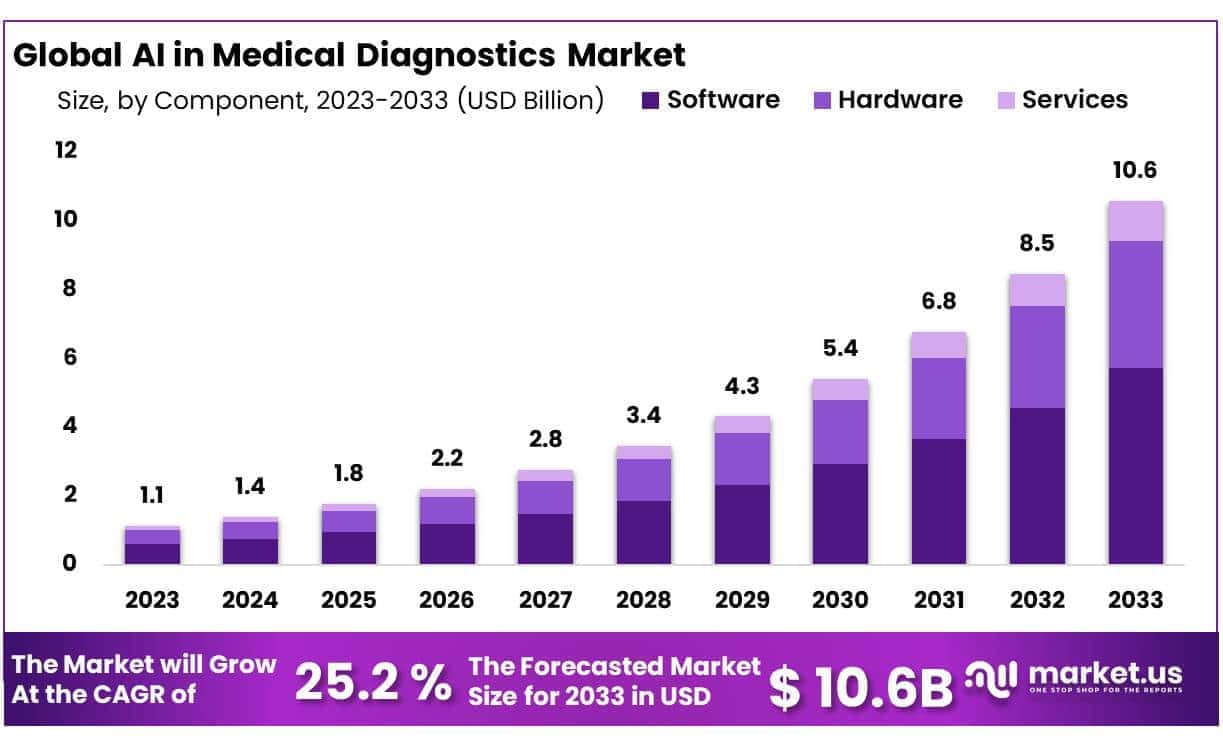
The global AI In Medical Diagnostics Market size is expected to be worth around USD 10.6 Billion by 2033 from USD USD 1.1 Billion in 2023, growing at a CAGR of 25.2% during the forecast period from 2024 to 2033.
The integration of Artificial Intelligence (AI) into medical diagnostics is reshaping the global healthcare landscape. AI-powered diagnostic tools are enabling faster, more accurate detection of diseases, enhancing clinical decision-making, and streamlining medical workflows across healthcare systems.
The growing demand for early and precise diagnosis, coupled with advancements in machine learning and deep learning algorithms, is accelerating the adoption of AI in medical diagnostics. These technologies are increasingly applied in radiology, pathology, cardiology, and oncology to support clinicians in identifying complex conditions with improved confidence and efficiency.
Factors such as rising digitalization in healthcare, increased access to patient data, and the need to reduce diagnostic errors are significantly contributing to market growth. Healthcare providers are actively implementing AI-based systems to improve operational efficiency and patient outcomes, while addressing challenges related to workforce shortages and increasing disease prevalence.
North America is currently leading in terms of AI integration within diagnostic systems, supported by advanced healthcare infrastructure and regulatory support. Meanwhile, emerging economies in Asia Pacific are rapidly adopting AI solutions due to expanding healthcare access and technological readiness.
As innovation continues to evolve, AI is expected to play a pivotal role in advancing precision medicine, enabling real-time diagnostics, and shaping the future of healthcare delivery worldwide.
Click here to get a Sample report copy @ https://market.us/report/ai-in-medical-diagnostics-market/free-sample/
Key Takeaways
- Market Size Overview: The AI in Medical Diagnostics Market is projected to reach approximately USD 10.6 billion by 2033, increasing from USD 1.1 billion in 2023, indicating substantial growth across the forecast period.
- Market Growth Rate: The market is expected to expand at a compound annual growth rate (CAGR) of 25.2% from 2024 to 2033, driven by advancements in AI technologies and increasing demand for precision diagnostics.
- Component Analysis: Among all components, the software segment emerged as the leading contributor, accounting for approximately 54% of the total market share, owing to widespread integration of AI algorithms in diagnostic platforms.
- Diagnostic Type Analysis: The neurology segment held a significant share of the diagnostic type category, contributing nearly 28.9% of market revenue in 2023, largely due to the increasing prevalence of neurological disorders and the demand for advanced imaging solutions.
- Modality Analysis: Within imaging modalities, the CT scan segment dominated the market with a notable 42.6% share in 2023, attributed to its high adoption in AI-powered diagnostic tools.
- End User Insights: Hospitals remained the primary end-user, holding 61.2% of the market share in 2023, reflecting their substantial investments in AI diagnostic infrastructure and broader patient base.
- Regional Insights: North America led the global AI in medical diagnostics market in 2023, supported by advanced healthcare infrastructure, early technology adoption, and regulatory encouragement.
Segmentation Analysis
- By Component Analysis: The software segment led the global AI in medical diagnostics market in 2023, accounting for a 54% share. This dominance is driven by increasing demand for AI-powered diagnostic tools that deliver rapid and accurate results. The surge in acute and chronic disease cases and a shortage of healthcare professionals are boosting adoption. As healthcare systems seek efficiency, the software segment is favored for its scalability, precision, and integration potential within clinical settings.
- By Diagnostic Type Analysis: In 2023, the neurology segment accounted for the highest revenue share among diagnostic types. This is primarily due to the increasing prevalence of neurological disorders and the adoption of AI-based tools for early detection and analysis. Deep neural networks and large image datasets have enhanced the precision of AI applications in neurology. These tools support faster clinical decisions by radiologists. Radiology is expected to grow fastest due to its diagnostic accuracy and integration with electronic health records.
- By Modality Analysis: The CT scan segment held a leading market share of 42.6% in 2023. Its widespread use is attributed to affordability, rapid imaging capabilities, and growing acceptance of AI-integrated diagnostic solutions. AI in CT scanning enhances interpretation accuracy and reduces diagnostic turnaround time. As a result, this modality remains a preferred choice across healthcare systems and is expected to see continued growth due to its cost-effectiveness and ability to improve diagnostic outcomes.
- By End User Analysis: Hospitals dominated the end-user segment in 2023, contributing 61.2% to market revenue. This leadership stems from the growing use of AI technologies to streamline diagnostics, reduce human error, and enhance clinical efficiency. Hospitals are increasingly partnering with tech firms to adopt cloud-based AI solutions. These collaborations enable real-time analysis and support faster, more reliable diagnoses, making hospitals the central hub for AI deployment in medical diagnostics across various clinical specialties.
Market Segments
By Component
- Hardware
- Software
- Services
By Diagnostic type
- Neurology
- Radiology
- Pathology
- Chest and lung
- Oncology
- Other
By Modality
- MRI
- CT-Scan
- X-ray
- Ultrasound
- Others
By End Use
- Hospitals
- Diagnostic centres
- Research institute
To Purchase this Premium Report @ https://market.us/purchase-report/?report_id=116377
Regional Analysis
North America remains at the forefront of the global AI in medical diagnostics market, driven by the widespread integration of advanced healthcare technologies and the high prevalence of chronic diseases. The increasing burden of conditions such as cancer has significantly raised the demand for accurate, AI-assisted diagnostic solutions to ensure timely and effective treatment. As healthcare systems in the region seek to enhance diagnostic precision, AI adoption continues to rise.
According to the American Cancer Society, approximately 1.8 million cancer cases were diagnosed in the United States in 2022. This high incidence underscores the growing need for advanced diagnostic tools that support early detection and personalized treatment planning.
In contrast, the Asia-Pacific region is expected to exhibit the fastest growth rate over the forecast period. This growth is attributed to the rapid development of healthcare infrastructure and increasing investments in AI technologies across emerging economies. Countries such as India and China present lucrative opportunities due to expanding patient populations and government-led digital health initiatives.
As reported by the Indian Council of Medical Research (ICMR), cancer cases in India reached 1.46 million in 2022, with projections indicating a rise to 1.57 million by 2025. This trend reflects the urgent need for scalable and efficient diagnostic solutions, positioning Asia-Pacific as a critical growth region for the AI in medical diagnostics market.
Key Players Analysis
The AI in medical diagnostics market is highly fragmented, with a large number of companies operating across both developed and developing regions. This diverse presence has intensified market competition, prompting companies to adopt a range of strategic initiatives aimed at strengthening their market position and expanding their global footprint.
Key strategies include continuous product innovation, expansion of distribution networks, focused sales and marketing efforts, and geographic expansion. Additionally, companies are actively pursuing collaborations, strategic partnerships, and mergers and acquisitions to enhance their technological capabilities and market reach.
Moreover, leading players are increasingly emphasizing awareness campaigns to highlight the advanced features and clinical benefits of their AI-enabled diagnostic solutions. These efforts are significantly contributing to the broader adoption of AI technologies and supporting overall market growth.
Market Key Players
- Butterfly Network Inc., (US)
- Quibim (Spain)
- AiDoc (US)
- Siemens Healthineers (Germany)
- Google (US)
- HeartFlow Inc
- Zebra Medical Vision
- Neural Analytics
- Digital Diagnostics
- GE healthcare
- Alivecor Inc
Market Dynamics
- Market Driver: The primary driver of the AI in medical diagnostics market is the increasing prevalence of chronic and lifestyle-related diseases. This rising disease burden necessitates faster, more accurate diagnostics. AI-driven tools enhance diagnostic precision, reduce human error, and support early disease detection. The growing shortage of skilled healthcare professionals further accelerates AI adoption, as healthcare systems seek scalable, automated solutions to manage patient loads while improving clinical outcomes and operational efficiency.
- Market Trend: A prominent trend in the market is the integration of AI with medical imaging systems and electronic health records (EHRs). AI algorithms are increasingly used to analyze imaging data in radiology, neurology, and pathology, enabling faster diagnosis and better treatment decisions. Furthermore, the development of deep learning models and neural networks has improved diagnostic accuracy. This trend reflects a broader shift toward digitized, data-driven healthcare practices that combine clinical data with AI for real-time decision support.
- Market Opportunity: Significant market opportunities lie in emerging economies across Asia-Pacific, Latin America, and the Middle East. These regions are witnessing rapid healthcare infrastructure development and increasing investments in digital health technologies. The demand for scalable and cost-effective diagnostic solutions creates a favorable environment for AI adoption. Additionally, government initiatives promoting telemedicine, health digitization, and public-private collaborations open doors for AI solution providers to expand their presence and tap into underserved patient populations.
Conclusion
The AI in medical diagnostics market is undergoing rapid transformation, driven by technological advancements, rising disease prevalence, and the growing need for precision healthcare. With strong adoption in developed regions like North America and expanding opportunities in emerging markets, the sector is positioned for sustained growth.
Strategic initiatives by key players, including innovation, partnerships, and regional expansion, continue to shape the competitive landscape. As AI integration deepens across diagnostic applications and modalities, the market is expected to play a vital role in enhancing diagnostic accuracy, operational efficiency, and patient outcomes across global healthcare systems.
View More Reports:
Healthcare Analytics Market to Reach USD 249.3 Billion by 2032
Healthcare Analytics Market to Reach USD 249.3 Billion by 2032
Healthcare Cloud Computing Market Forecasted to Grow at 17.6% CAGR Through 2032
Healthcare Cloud Computing Market Forecasted to Grow at 17.6% CAGR Through 2032
U.S. Medical Coding Market Projects 9.4 % CAGR, Hits USD 44 Billion by 2032
U.S. Medical Coding Market Projects 9.4 % CAGR, Hits USD 44 Billion by 2032



