
Overview
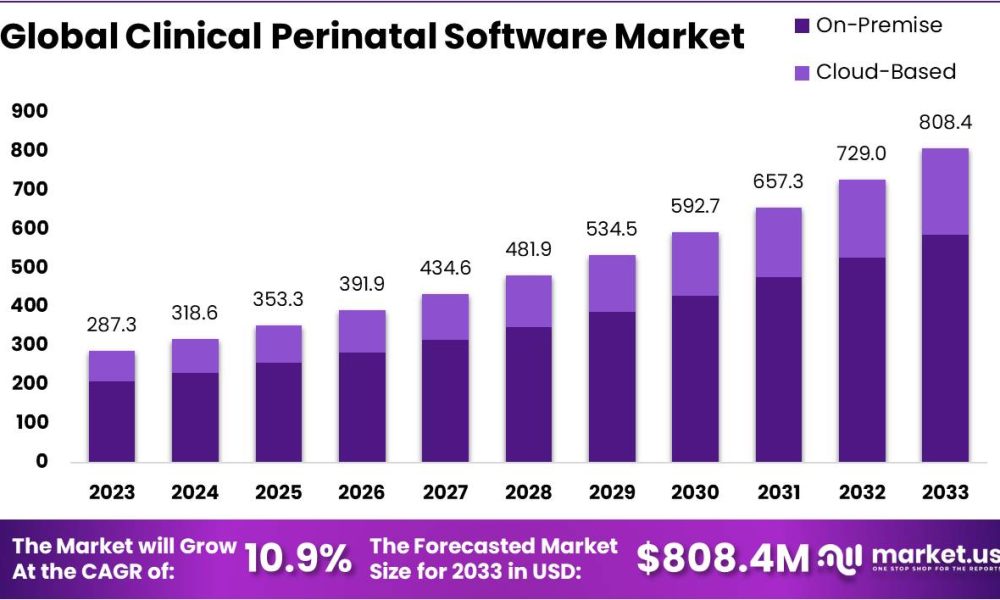
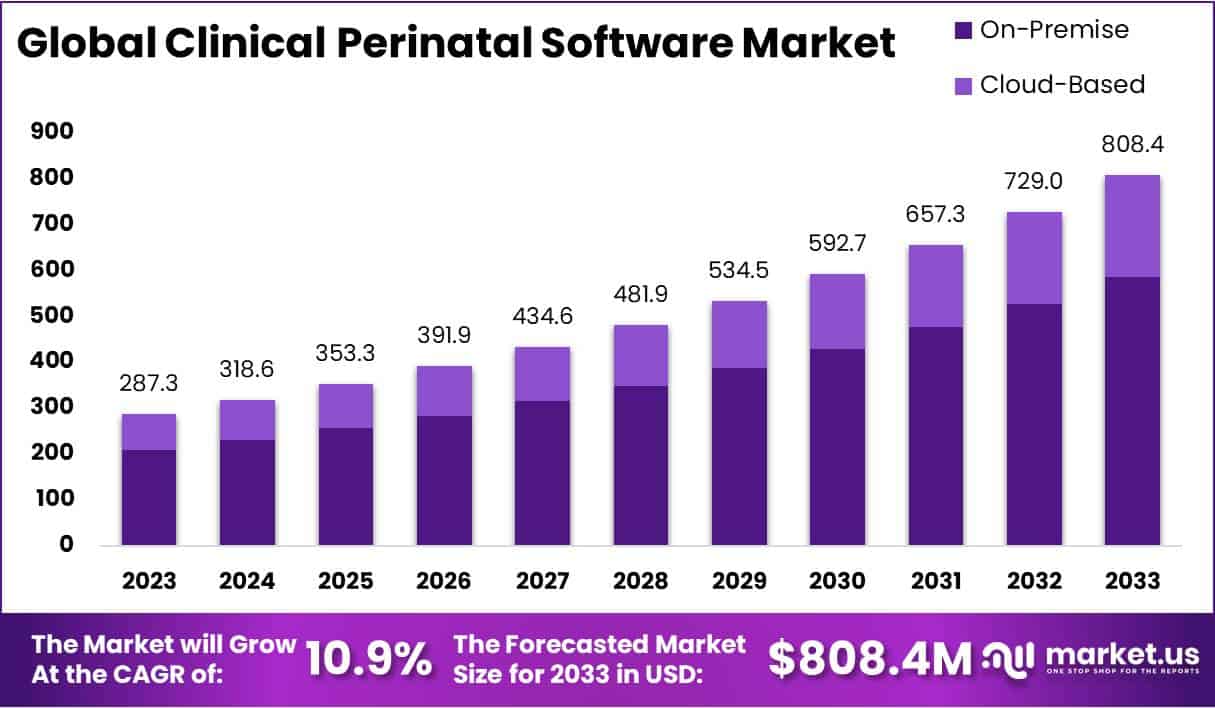
The Clinical Perinatal Software Market is projected to grow significantly in the coming years. The market size is expected to reach approximately USD 808.4 million by 2033, up from USD 287.3 million in 2023. This growth reflects a strong CAGR of 10.9% from 2024 to 2033. The rise in demand for effective clinical perinatal solutions is a key factor. Increased reliance on healthcare IT and rapid technological advancements support market expansion. This report offers a detailed analysis of market size, share, growth drivers, restraints, and future opportunities.
One of the primary drivers of market growth is advancements in medical technology. Modern perinatal software integrates real-time data and clinical decision support tools. These features help healthcare professionals provide timely and accurate care. Improved outcomes, enhanced workflow, and better patient monitoring are direct benefits. As technology continues to evolve, more healthcare facilities are adopting digital solutions. This trend significantly boosts the clinical perinatal software market’s revenue potential.
The market is also influenced by demographic shifts. Increasing maternal age across various regions creates a need for specialized perinatal care. Clinical perinatal software is well-suited to address this demand. It enables detailed monitoring, early detection of risks, and the creation of personalized care plans. This is particularly beneficial for older expectant mothers. As such, the market is poised to expand further in response to this demographic trend, making age-related care a major growth factor.
High-risk pregnancies are becoming more common globally. This drives demand for advanced monitoring and management tools. Clinical perinatal software offers vital functions like predictive analytics and real-time alerts. These tools help reduce maternal and neonatal mortality by enabling early intervention. The need for accurate and timely clinical data makes these solutions essential. As healthcare providers focus more on risk reduction, the adoption of perinatal software is expected to rise steadily over the forecast period.
Despite strong growth prospects, several challenges exist. Data security is a major concern, as patient information must remain confidential. High initial costs and training requirements can limit adoption, especially in small facilities. Additionally, interoperability issues between systems hinder smooth data exchange. Resistance to adopting new technology also persists in some settings. Addressing these barriers through policy support, standardization, and education will be crucial for unlocking the full potential of this growing market.
Key Takeaways
- The Clinical Perinatal Software Market is projected to reach USD 808.4 million by 2033, growing at a CAGR of 10.9%.
- They highlighted that the ‘On-Premise’ segment led in 2023 with 72.5% revenue, owing to strong data security advantages over other models.
- It was observed that while currently smaller, the ‘Cloud-Based’ segment is expected to grow fastest due to scalability and reduced infrastructure costs.
- Experts revealed that ‘Integrated’ software dominated in 2023, capturing 84.7% market share due to enhanced interoperability and seamless clinical workflow support.
- ‘Fetal Monitoring Data Services’ was the top application in 2023, accounting for 55.3% of sales, thanks to its critical role in patient monitoring.
- Hospitals and clinics were dominant end-users in 2023 with 63.8% share, attributed to large patient volumes and advanced software infrastructure.
- North America maintained dominance in 2023 with 41.7% share, valued at USD 197.7 million, supported by robust healthcare infrastructure and strategic partnerships.
Get Sample: https://market.us/report/clinical-perinatal-software-market/request-sample/
Regional Analysis
North America dominated the Clinical Perinatal Software Market in 2023, accounting for over 41.7% of the global share with a market value of USD 197.7 million. This leadership is supported by advanced healthcare infrastructure and early adoption of healthcare IT. Strong focus on maternal and neonatal outcomes, along with government initiatives and strategic collaborations, further strengthens the region’s position. The U.S. is the major contributor, followed by Canada and Mexico, as hospitals increasingly deploy integrated perinatal solutions to enhance clinical outcomes.
Western Europe also holds a considerable share in the global market. Countries such as Germany, France, the UK, and Italy lead the region, owing to their strong public health systems. Adoption of digital health records and workflow automation tools is rising in this region. Supportive regulations from health ministries, along with growing investment in maternal healthcare IT, are key drivers. The Benelux, Nordic countries, and Switzerland also contribute significantly to regional demand.
In Eastern Europe, the market is gaining traction due to healthcare modernization and increasing birth rates. Nations like Russia, Poland, and the Czech Republic are seeing growing demand for fetal monitoring and workflow management tools. Government-led healthcare reforms and international funding for maternal programs support this shift. Though relatively smaller, the region is expected to witness steady growth during the forecast period as digitization expands.
The Asia Pacific region shows strong growth potential driven by population size and improving healthcare access. Countries such as China, India, and Japan are leading adopters of perinatal software. Rising awareness, healthcare spending, and mobile health penetration support market expansion. Southeast Asian countries like Indonesia, Vietnam, and the Philippines are emerging markets. Similarly, Latin America and the Middle East & Africa show gradual adoption, led by Brazil, Saudi Arabia, and South Africa with improving maternal care systems.
Segmentation Analysis
In 2023, the deployment mode analysis revealed that the ‘On-Premise’ segment contributed over 72.5% of the total revenue. This dominance was driven by strong data security, controlled access, and simplified data retrieval. Organizations continue to prefer this mode for its reliability and reduced dependence on external networks. Its growth is expected to remain steady due to lower long-term IT costs and flexibility in system customization. These benefits make on-premise deployment a trusted choice for healthcare providers with strict data protection policies.
In contrast, the ‘Cloud-Based’ segment is projected to witness the highest CAGR during the forecast period. Cloud deployment enables real-time data access and supports remote monitoring. These features are crucial for modern clinical environments. The segment’s rapid growth can be attributed to its scalability, low upfront costs, and improved disaster recovery capabilities. High accessibility and automated data backup are also encouraging healthcare institutions to shift towards cloud-based solutions for clinical perinatal software.
From a product type perspective, the ‘Integrated’ segment held a commanding 84.7% revenue share in 2023. This strong performance was due to increasing demand for seamless workflow integration across healthcare systems. Integrated software simplifies coordination between departments and enhances efficiency. Ongoing digital transformation in hospitals supports this trend. In contrast, the ‘Standalone’ segment, though still significant, faces growth limitations. These include lack of data integration and limited upgrade options, which reduce operational flexibility over time.
Regarding application, Fetal Monitoring Data Services led with over 55.3% of total revenue in 2023. This segment is essential for accurate monitoring of fetal health and uterine activity. Mobile fetal monitoring further enhances this segment by enabling remote patient access. Meanwhile, Workflow Management Software is anticipated to grow at the fastest rate. Its growth is supported by increased hospital numbers and demand for administrative efficiency. Real-time updates, higher productivity, and streamlined processes are key drivers behind this segment’s expected expansion.
Deployment Mode
- On-Premise
- Cloud-Based
Product Type
- Integrated
- Standalone
Application
- Workflow Management
- Fetal Monitor Data Services
- Patient Documentation
End-User
- Hospital/Clinics
- Maternity Clinics
Key Players Analysis
In the Clinical Perinatal Software Market, major players such as Koninklijke Philips N.V. and GE HealthCare Technologies Inc. lead through innovation. Philips focuses on advanced healthcare technologies with strong R&D capabilities. GE HealthCare, known for precision in diagnostics and imaging, brings reliable and scalable solutions to perinatal care. These companies drive the market forward with continuous technological enhancements. Their global presence, strong brand equity, and investment in healthcare IT contribute significantly to improved clinical outcomes and patient safety in maternal and fetal healthcare environments.
Huntleigh Healthcare Limited and PeriGen Inc. also play vital roles in this market. Huntleigh emphasizes maternal-fetal monitoring technologies that improve diagnostic accuracy. PeriGen offers intelligent fetal surveillance software, setting standards in predictive analytics. Both companies focus on enhancing clinical workflows and reducing perinatal risks. Their specialized solutions address unmet needs in hospitals and clinics. These efforts align with the growing demand for real-time decision support systems, contributing to better outcomes in perinatal care settings.
The market further benefits from diverse contributors, including McKesson Corporation, Clinical Computer Systems Inc., K2 Medical Systems Ltd., and others. Companies like Sotera Health and Harmony Healthcare IT support interoperability and data security. Athenahealth Inc. offers robust EHR integration, aiding care coordination. These organizations promote competition and expand technology access across healthcare facilities. Together, these key players strengthen the market landscape, supporting the global push for advanced, efficient, and safe clinical perinatal care.
Conclusion
In conclusion, the Clinical Perinatal Software Market is growing fast due to rising demand for better maternal and fetal care. The use of modern digital tools in hospitals and clinics is helping healthcare teams work more efficiently and make better decisions. Key trends such as the shift to cloud solutions, integrated software, and real-time monitoring are shaping the future of this market. Leading companies are investing in innovation to meet growing clinical needs. Although some challenges like data security and cost remain, ongoing improvements and strong support from governments and health organizations are expected to drive future growth. Overall, the market shows strong potential for continued expansion in the coming years.
Get in Touch with Us:
Market.us (Powered By Prudour Pvt. Ltd.)
Address: 420 Lexington Avenue, Suite 300, New York City, NY 10170, United States.
Contact No: +1 718 874 1545 (International), +91 78878 22626 (Asia).
Email: [email protected]
View More



