
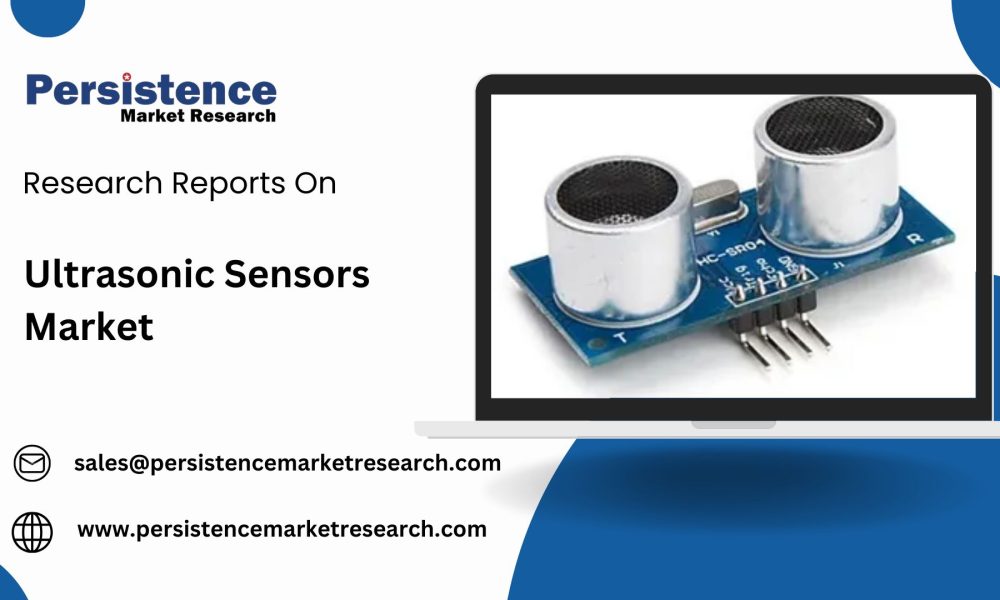
The global ultrasonic sensors market is projected to grow significantly in the coming years, reflecting rapid technological evolution and the growing integration of sensing technologies across various industries. According to Persistence Market Research, the market is expected to rise from US$ 6.3 billion in 2025 to US$ 12.4 billion by 2032, registering a strong compound annual growth rate (CAGR) of 10.2%.
This steady expansion is attributed to the increasing adoption of autonomous and electric vehicles, the proliferation of industrial automation and robotics, and the widespread use of ultrasonic sensors in healthcare, smart manufacturing, and consumer electronics. As demand for precision, efficiency, and safety continues to rise across industries, ultrasonic sensors have become a crucial component in the global digital transformation landscape.
Understanding Ultrasonic Sensors: Technology and Applications
Ultrasonic sensors operate on the principle of sound wave reflection, using high-frequency sound waves (typically above 20 kHz) to detect objects, measure distances, and monitor movement. These sensors emit sound pulses and measure the time it takes for the echo to return, allowing precise distance calculations even in challenging environmental conditions such as dust, humidity, or darkness.
The versatility of ultrasonic sensors makes them indispensable in multiple industries. In automotive systems, they are used for parking assistance, blind-spot detection, and collision avoidance. In industrial automation, they help with liquid level detection, robotic navigation, and object profiling. Meanwhile, in healthcare, ultrasonic technology powers medical imaging systems, flow measurement devices, and non-invasive monitoring tools.
Their contactless and accurate sensing capabilities, coupled with affordability and low maintenance, position ultrasonic sensors as a preferred choice for a growing number of modern applications.
Market Overview and Growth Drivers
- Growing Demand for Autonomous and Electric Vehicles
The automotive industry represents one of the largest consumers of ultrasonic sensors, and its ongoing transformation toward electrification and autonomy is significantly boosting demand. Advanced driver-assistance systems (ADAS) rely heavily on ultrasonic sensors for proximity detection, parking automation, and obstacle avoidance.
With electric vehicles (EVs) and autonomous cars becoming more mainstream, manufacturers are integrating a larger number of sensors per vehicle. For instance, EV models from Tesla, BMW, and Mercedes-Benz use arrays of ultrasonic sensors to enhance 360-degree environmental awareness. As global EV sales continue to surge and regulatory authorities push for safer mobility systems, the integration of ultrasonic sensors in smart automotive architectures will continue to expand.
- Rising Industrial Automation and Robotics
Industries are increasingly adopting automation and robotics to improve productivity, accuracy, and safety. Ultrasonic sensors are vital components in automated manufacturing lines, robotic arms, and material handling systems, enabling machines to detect objects, avoid collisions, and perform precise movements.
As Industry 4.0 advances, factories are becoming smarter and more connected. This transformation fuels demand for reliable non-contact sensors that can operate effectively in rugged environments. Ultrasonic sensors, with their immunity to dust and light interference, are ideal for such conditions. Moreover, their use in liquid level measurement, conveyor systems, and packaging equipment further enhances production efficiency.
According to industrial reports, the adoption of automation technologies across manufacturing and logistics sectors is expected to drive a substantial portion of the ultrasonic sensor market’s revenue growth by 2032.
- Expansion in the Healthcare Sector
The healthcare industry has embraced ultrasonic technology for a wide range of applications—from diagnostic imaging and surgical guidance to flow and distance measurement in medical devices. Ultrasound-based systems offer a non-invasive and radiation-free way to visualize internal organs and tissues, making them critical for medical diagnostics and patient monitoring.
In addition to traditional uses, ultrasonic sensors are also finding roles in wearable medical devices, smart prosthetics, and remote patient monitoring systems, driven by advancements in miniaturization and wireless communication.
As healthcare systems across the globe digitize and expand access to advanced diagnostic tools, the demand for compact and high-precision ultrasonic sensors is expected to grow exponentially.
Market Segmentation Analysis
The ultrasonic sensors market can be segmented based on type, application, industry vertical, and region.
By Type
- Proximity Sensors: Used for object detection and distance measurement, especially in automotive and robotics applications.
- Retro-Reflective Sensors: Effective in industrial automation for identifying the presence or absence of objects.
- Through-beam Sensors: Commonly deployed for high-accuracy detection in packaging and material handling.
By Application
- Level Measurement: Utilized in oil & gas, water treatment, and chemical industries.
- Distance Measurement: Integral to automotive safety systems and industrial automation.
- Object and Obstacle Detection: Key component in robotics, drones, and vehicle systems.
By Industry Vertical
- Automotive – Dominates the market due to ADAS and EV integration.
- Industrial Automation – Rapidly growing segment driven by smart manufacturing.
- Healthcare – Increasing adoption in diagnostic and therapeutic devices.
- Consumer Electronics – Growing use in smart home devices and security systems.
By Region
- North America leads with technological innovation and strong adoption in automotive and industrial sectors.
- Europe remains a major market, driven by EV production and stringent safety regulations.
- Asia-Pacific is expected to witness the fastest growth due to rapid industrialization, expanding automotive production, and increasing investments in smart city infrastructure.
- Latin America and the Middle East & Africa are emerging markets, gradually adopting automation and healthcare technologies that leverage ultrasonic sensing.
Elevate your business strategy with comprehensive market data. Request a sample report now: https://www.persistencemarketresearch.com/samples/33663
Key Market Trends Shaping the Future
- Integration with IoT and Smart Systems
The combination of ultrasonic sensors with the Internet of Things (IoT) is revolutionizing monitoring and automation. Smart factories, connected vehicles, and intelligent infrastructure now rely on real-time sensor data to make predictive decisions.
IoT-enabled ultrasonic sensors can transmit continuous feedback about fluid levels, object proximity, and motion, enhancing efficiency in industrial and consumer applications. This trend aligns with the global movement toward data-driven operational intelligence, fostering more proactive and adaptive systems.
- Miniaturization and Energy Efficiency
Technological advancements are enabling the development of smaller, lighter, and more energy-efficient sensors. The miniaturization trend is particularly important for applications in wearable healthcare devices, drones, and compact robotic systems.
Manufacturers are focusing on reducing power consumption while maintaining accuracy and detection range, ensuring that sensors can be easily integrated into portable or battery-operated devices.
- Growth in Smart City and Infrastructure Projects
Ultrasonic sensors are increasingly being deployed in smart city applications, such as traffic management, parking assistance, waste level detection, and public safety systems. They enable city authorities to optimize operations and resource utilization through real-time monitoring.
As governments and municipalities invest in smart infrastructure to improve sustainability and efficiency, ultrasonic sensor demand from the public sector is expected to rise considerably.
- Increasing Focus on Safety and Security
The push toward enhanced safety and security systems in industrial, automotive, and commercial environments is fueling ultrasonic sensor adoption. Their ability to provide reliable detection even under adverse environmental conditions makes them ideal for intrusion detection, collision avoidance, and emergency monitoring.
In addition, ultrasonic sensors are becoming an integral part of autonomous mobile robots (AMRs) and collaborative robots (cobots), ensuring safe interaction between humans and machines in industrial settings.
Regional Insights: Where the Growth Lies
North America
The North American market is driven by the strong presence of automotive OEMs, industrial automation leaders, and technology innovators. The U.S. in particular leads in R&D investments for autonomous driving and robotics. Healthcare applications also contribute significantly, with major medical device manufacturers adopting ultrasonic sensing technologies for enhanced diagnostics.
Europe
Europe maintains a robust position in the ultrasonic sensors market due to its stringent vehicle safety regulations, which have accelerated ADAS adoption. Countries like Germany, France, and the UK are home to key automotive and industrial technology companies actively deploying advanced sensing solutions. Moreover, the European Union’s commitment to sustainability and clean energy initiatives supports the use of sensors in renewable energy and smart city systems.
Asia-Pacific
The Asia-Pacific region is expected to record the fastest growth through 2032. The region’s expanding automotive manufacturing base, rapid urbanization, and massive investments in industrial automation and consumer electronics are major growth enablers. China, Japan, South Korea, and India are key markets driving innovation in sensor technology and large-scale deployment across industries.
Latin America and Middle East & Africa
While smaller in size, these regions are emerging as potential growth frontiers. With the expansion of the automotive sector in Brazil and Mexico and increasing smart city initiatives in the UAE and Saudi Arabia, demand for ultrasonic sensors is gradually gaining momentum. Moreover, growing awareness about automation and industrial efficiency is expected to open new opportunities in the coming decade.
Competitive Landscape
The global ultrasonic sensors market is highly competitive and innovation-driven. Leading players are focusing on technological differentiation, strategic partnerships, and mergers & acquisitions to strengthen their market positions.
Prominent companies include:
- Siemens AG
- Honeywell International Inc.
- Rockwell Automation, Inc.
- Omron Corporation
- Pepperl+Fuchs AG
- Baumer Group
- Keyence Corporation
- Murata Manufacturing Co., Ltd.
These players are investing in next-generation sensing technologies and expanding their product portfolios to serve diverse sectors, from automotive and healthcare to industrial manufacturing and consumer electronics.
Furthermore, startups and mid-sized companies are entering the market with innovative low-cost and application-specific ultrasonic sensors, driving healthy competition and accelerating technology democratization.
Future Outlook and Opportunities
Looking ahead, the ultrasonic sensors market will continue to evolve as industries push toward automation, connectivity, and sustainability. The growing adoption of autonomous systems, smart factories, and digital healthcare solutions will keep demand robust.
The future of ultrasonic sensing technology lies in:
- AI and machine learning integration for intelligent data interpretation.
- Wireless and battery-free designs for remote sensing.
- Cross-industry collaboration to develop standardized solutions.
- Environmentally sustainable manufacturing of sensor components.
By 2032, ultrasonic sensors are expected to play a key role not only in industrial and automotive applications but also in emerging fields such as smart agriculture, logistics automation, and environmental monitoring.
Conclusion
The global ultrasonic sensors market is on a transformative growth path, projected to reach US$ 12.4 billion by 2032, expanding at a CAGR of 10.2%. This growth is underpinned by a confluence of technological innovation, automation trends, and the expanding use of smart sensing across industries.
From enabling autonomous vehicles and intelligent factories to enhancing medical diagnostics and smart infrastructure, ultrasonic sensors are becoming a cornerstone of the modern digital ecosystem. As the world moves deeper into an era of connectivity and precision, the role of ultrasonic sensors will only become more pivotal in driving progress across industries.
Related Reports:




