
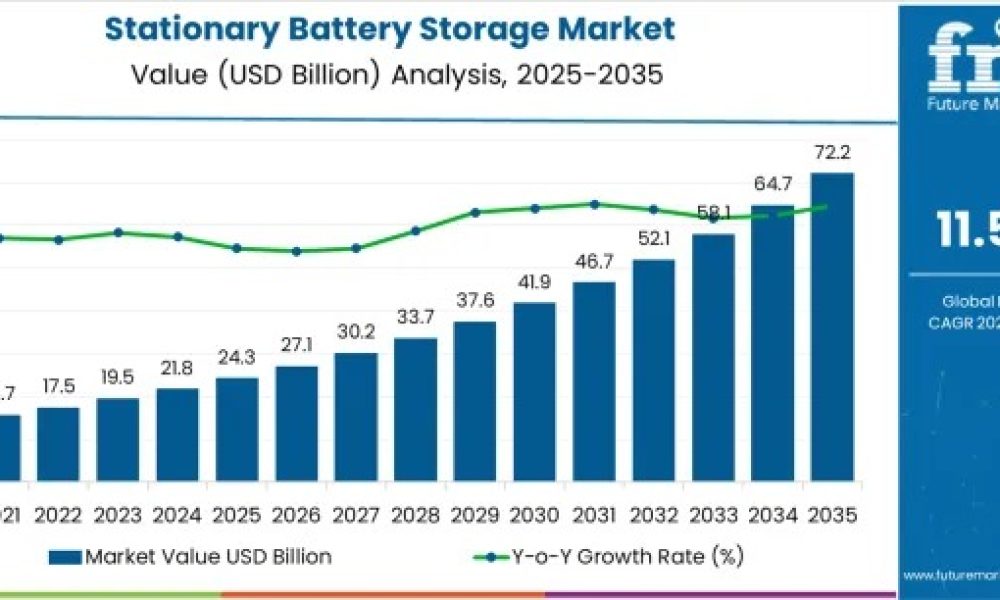
The global stationary battery storage market is set to experience unprecedented growth over the next decade, expanding from USD 24.3 billion in 2025 to USD 72.2 billion by 2035, registering a CAGR of 11.5%. This surge is driven by the rapid global transition toward renewable energy integration, grid modernization, and decentralized power management. As solar and wind penetration increases, stationary storage systems have become essential for grid stability, reliability, and resilience, balancing intermittent energy supply and ensuring continuous power delivery.
In the first half of the decade (2025–2030), market adoption is expected to accelerate, supported by utilities and government-backed investments in large-scale storage parks and renewable-linked projects. Cost reductions in lithium-ion technology, coupled with favorable policy frameworks, are enabling deployment across residential, commercial, and industrial sectors. By the second half (2030–2035), the market will increasingly focus on technological maturity, as innovations in solid-state and flow batteries expand performance, lifecycle efficiency, and safety across the energy ecosystem.
Subscribe for Year-Round Insights → Stay ahead with quarterly and annual data updates:
India, United States, and Europe Lead Global Growth
India: Fastest-Growing Market at 15.6% CAGR
India is emerging as the fastest-growing stationary battery storage market, with annual growth of 15.6% from 2025 to 2035. National renewable energy missions and solar-plus-storage tenders under the MNRE are catalyzing adoption. Key projects in Rajasthan, Gujarat, and Karnataka illustrate how energy storage is being embedded in major solar and wind clusters.
- Domestic manufacturing incentives and public-private partnerships strengthen the supply chain.
- State-level policies encourage distributed storage, microgrids, and grid loss reduction.
- Solar+storage integration is accelerating residential and industrial adoption, enhancing grid reliability.
United States: Policy-Driven Leadership
The U.S. market is projected to grow at 12.8% CAGR, fueled by strong policy incentives, including the Inflation Reduction Act (IRA) and state-level storage mandates. Major installations across California, Texas (ERCOT), and New York ISO demonstrate robust demand for grid-scale battery parks, frequency regulation, and renewable integration.
- The market is shifting toward gigawatt-hour-scale projects, combining solar, wind, and standalone storage.
- Mature wholesale markets and proven investment frameworks support long-term deployment.
- Utilities are increasingly adopting energy trading platforms and virtual power plant (VPP) strategies.
Europe: Technology and Prosumer Integration
Europe continues to be a hub of energy innovation, with market growth from USD 7.1B in 2025 to USD 20.5B in 2035 (CAGR 11.2%). Germany leads with prosumer-driven residential systems, France focuses on solar-plus-nuclear-flex integration, and the UK pioneers frequency response applications linked to offshore wind.
- Policy-backed grid flexibility programs ensure stability and efficiency.
- Advanced ancillary service markets integrate storage for decarbonization and renewable management.
- Europe prioritizes smart, modular solutions for both residential and utility-scale deployments.
Technology Trends: Lithium-Ion Dominates, LFP Leads
Lithium-ion batteries continue to dominate, holding over 92% market share in 2025. Within this category, LFP (Lithium Iron Phosphate) batteries account for 59% due to their thermal stability, long cycle life, and safety performance, making them ideal for utility-scale applications.
- NMC (Nickel Manganese Cobalt) batteries hold 33% of the market, preferred for high energy density in constrained installations.
- Emerging technologies—solid-state, sodium-ion, and flow batteries—are gaining attention for scalability and extended discharge capabilities.
These advancements signal the next innovation cycle for stationary energy storage, combining high reliability, enhanced safety, and longer lifecycle performance.
Applications: Grid Services Lead
The grid services segment dominates with 64% share, as utilities deploy storage for:
- Frequency regulation
- Peak load shifting
- Renewable curtailment reduction
Behind-the-meter installations represent 28% of the market, expanding among commercial and industrial users for:
- Energy cost savings
- Demand charge management
- Enhanced resilience during outages
Off-grid and remote applications, though smaller at 8%, are vital for isolated communities and industrial sites requiring independent power reliability.
Regional Dynamics and Capacity Trends
By system size, 1.1–10 MWh installations lead with 44% share, reflecting the growing adoption of utility substation-scale and large commercial systems across Asia-Pacific and North America. Smaller systems (251 kWh–1 MWh) dominate the commercial and industrial segment, while utility-scale systems exceeding 10 MWh are central to national grid projects in Australia, China, and the UK.
- Containerized systems are favored for rapid deployment and optimal economics.
- Larger installations enhance grid-scale integration and renewable capacity management.
Competitive Landscape
The market is shaped by technology integration, project execution, and digital optimization. Leading players—Tesla Energy, LG Energy Solution, BYD, CATL, Panasonic—account for over 55% of total revenue, leveraging:
- Advanced cell chemistry and integrated energy management solutions
- AI-driven dispatch software and lifecycle services
Other key companies—Samsung SDI, Fluence (Siemens-AES), Saft (TotalEnergies), Sungrow, Hitachi Energy—are expanding through strategic partnerships and digital platforms to enhance system performance and longevity.
Outlook: Transitioning from Deployment to Digital Optimization
The stationary battery storage market is evolving from deployment-led growth to technology-driven value creation. Integration with AI-based grid optimization, energy trading platforms, and second-life battery reuse will enhance efficiency, resilience, and sustainability. As renewable generation outpaces traditional sources, stationary storage systems are set to become the backbone of modern energy infrastructure, bridging supply and demand, stabilizing grids, and helping nations meet clean energy targets.
Get data that aligns with your strategic priorities — ask for report customization today:
Have a specific Requirements and Need Assistant on Report Pricing or Limited Budget please contact us – [email protected]
About Future Market Insights (FMI)
Future Market Insights, Inc. (FMI) is an ESOMAR-certified, ISO 9001:2015 market research and consulting organization, trusted by Fortune 500 clients and global enterprises. With operations in the U.S., UK, India, and Dubai, FMI provides data-backed insights and strategic intelligence across 30+ industries and 1200 markets worldwide.
Contact Us:
Future Market Insights Inc.
Christiana Corporate, 200 Continental Drive,
Suite 401, Newark, Delaware – 19713, USA
T: +1-347-918-3531



