
Definition
Pollination Service refers to the commercial provisioning of managed pollinators—primarily Apis mellifera (European honey bees) and increasingly Bombus spp. (bumblebees) and other specialist insects—contracted by farms, orchards, and greenhouse operations. Unlike incidental visits from wild bees, pollination services involve strategic hive placement, relocation, and husbandry in alignment with crop bloom cycles.
The service encompasses:
- Traditional Hive Leasing – seasonal honeybee colony rentals priced per hive or per acre.
- Precision Pollination Platforms – IoT-enabled smart hives that monitor health, microclimate, and foraging data.
- Alternative Pollinator Deployment – bumblebee mini-hives for greenhouses, stingless bees for tropical crops, solitary-bee hotels for almonds.
- Integrated Pollination Management (IPM) – bundled services including habitat restoration, floral supplementation, and pesticide–pollinator conflict management.
FAO estimates that 35% of global agricultural volume depends on pollinators, highlighting why managed pollination has shifted from a marginal input to a core agronomic service measured in ROI per kilogram of yield.
Recent Developments
The pollination services market is experiencing significant growth, driven by a combination of factors including the rising demand for high-quality crops, the decline of wild pollinator populations, and increasing awareness of the critical role pollinators play in food security. A key development is the growing adoption of managed pollination services, which involve the strategic use of pollinators, particularly bees, in commercial agriculture. This trend is fueled by the need for more reliable and efficient pollination, especially for high-value crops like almonds and certain fruits and vegetables. Additionally, there’s a movement towards more sustainable and environmentally friendly pollination practices. Innovation is also a major driver, with research focusing on advanced technologies such as automated pollination systems and the use of data analytics to optimize pollination strategies for specific crops.
Major Distribution
The distribution of pollination services is heavily concentrated in regions with large-scale, intensive agricultural production, where high crop yields are critical. North America and Europe are currently the leading markets, largely due to their well-established agricultural sectors and high adoption rates of managed pollination techniques. Within the United States, for instance, California’s almond industry is a massive driver, with a significant portion of the country’s commercial bee colonies being transported there annually for the almond bloom. While these regions dominate, the market is expanding globally. Emerging economies in Asia-Pacific and South America are projected to see rapid growth as they intensify their agricultural practices and increasingly adopt modern farming techniques to meet rising food demand. The primary distribution channel is direct contact between beekeepers and farmers, often arranged through contracts for migratory beekeeping services to specific crops during their bloom periods.
Market Size
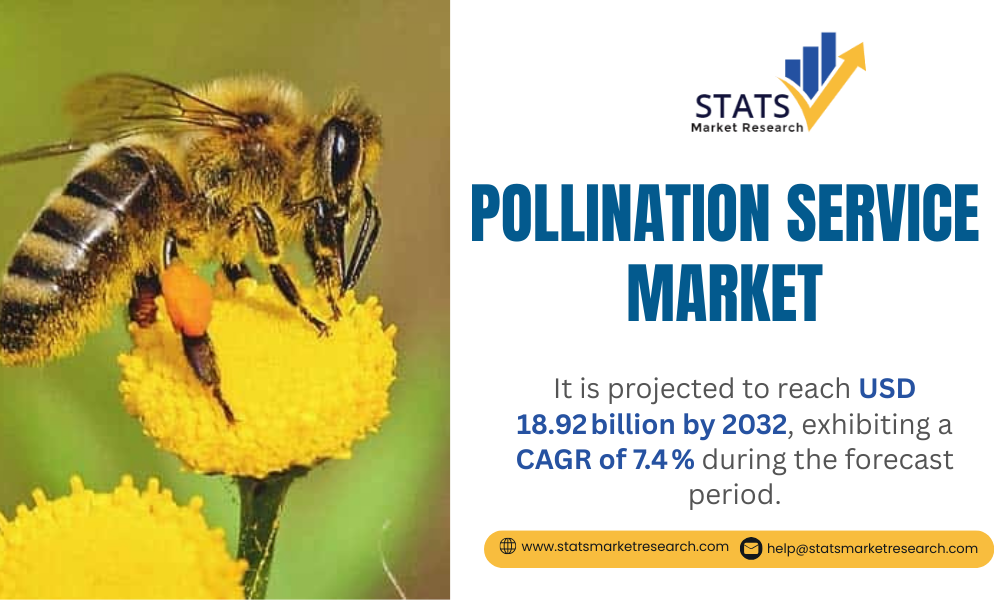
The global pollination service market reached US$ 12.34 billion in 2024, projected to grow to US$ 18.92 billion by 2030, representing a 7.4% CAGR.
- United States leads as the single largest market, valued at US$ 3.45 billion in 2024, projected at US$ 5.12 billion by 2030 (CAGR 6.8%).
- Asia-Pacific is the fastest-growing region (8.2% CAGR), driven by demand from China’s blueberry boom and India’s hybrid-seed initiatives.
Historical Growth (2018–2024):
- Almond Megabloom Effect: California almonds exceeded 1.6 million acres in 2023, requiring 2.8 million hives—88% of US colonies—pushing hive rental fees from US$ 190 (2018) to US$ 240 (2024).
- Acreage Expansion: Managed pollination reached 25 million acres worldwide in 2023. Fruits account for 45% of demand, with berries and oilseeds rising fastest.
- Precision Pollination Uptake: IoT-based services saw 35% YoY adoption in 2023 as growers sought data-driven efficiency.
Forward Catalysts (2024–2030):
- Climate-induced bloom volatility requires mobile fleets.
- Diversification into avocados, berries, and nuts expands addressable acreage.
- Policy incentives like EU CAP eco-schemes and the US Farm Bill promote pollinator integration.
- AI, telemetry, and robotic pollination tools will increase service value per acre.
By 2030, North America will retain ~37% share, while Asia-Pacific posts the highest CAGR.
Download FREE Sample of this Report @ https://www.statsmarketresearch.com/download-free-sample/8019664/global-pollination-service-market
Market Dynamics (Drivers, Restraints, Opportunities, and Challenges)
Drivers
- Yield Premium Economics: Studies from UC show almonds yield +17% with optimal hive density.
- Pollinator Decline: Wild-bee loss drives reliance on guaranteed pollination contracts.
- Precision Agriculture Integration: Savings on variable inputs create budget space for pollination.
- Sustainability Pressure: Food brands demand pollinator-friendly certifications (e.g., Bee Better Certified).
Restraints
- Colony Health Issues: Varroa mites, CCD, and queen losses disrupt supply.
- Pesticide Conflicts: Sprays reduce pollinator effectiveness, creating disputes.
- Logistics Complexity: Hive transport faces rising fuel and biosecurity hurdles.
Opportunities
- Alternative Pollinators: Bumblebees, mason bees, and stingless bees for niche crops.
- Digital Twin Farms: Real-time bloom maps, weather, and hive telemetry as upsell analytics.
- Carbon & Biodiversity Credits: Pollinator habitats bundled with pollination contracts.
Challenges
- Regulatory Scrutiny: Import restrictions on bees tighten supply flows.
- Insurance Gaps: Few crop-loss insurance products tied to pollinator failure.
- Tech Disruption Risks: Robotic drones and lab-grown pollination could disrupt traditional services.
Regional Analysis
- North America: Largest market, anchored by California almonds and greenhouse operations. Heavy reliance on migratory beekeeping fleets creates both scale and risk.
- Europe: Strong greenhouse bumblebee market (tomatoes, cucumbers) and CAP subsidies supporting integrated pollination.
- Asia-Pacific: Fastest-growing, driven by China (blueberries, hybrid rice pollination) and India (government-backed beekeeping).
- Latin America: Brazil and Chile leverage ecosystems for year-round hive supply; avocados are a major pollinator-dependent crop.
- Middle East & Africa: Growing citrus and date-palm sectors are beginning to adopt structured pollination contracts.
Competitor Analysis
The market is moderately concentrated in greenhouse pollination, fragmented in open-field honey-bee leasing.
- Koppert: Leader with Natupol® bumblebee systems and HiveGuard sensors.
- Biobest Group: Combines pollination with biological pest control, strong European presence.
- BioBee: Specialist in Mediterranean orchards; pioneers in low-temperature bumblebee strains.
- BeeHero & The Bee Corp (US startups): Data-driven hive optimization with pollination efficacy scoring.
- MasonBeesForRent™: Niche provider for Pacific Northwest orchards.
Recent M&A trends include Syngenta Biologicals investing in Bee Vectoring Technologies, signaling convergence between biologicals and pollination logistics.
Get the Complete Report & TOC @ https://www.statsmarketresearch.com/global-pollination-service-market-8019664
Global Pollination Service: Market Segmentation Analysis
This report provides a deep insight into the global Pollination Service, covering all its essential aspects. This ranges from a macro overview of the market to micro details of the market size, competitive landscape, development trend, niche market, key market drivers and challenges, SWOT analysis, value chain analysis, etc.
The analysis helps the reader to shape the competition within the industries and strategies for the competitive environment to enhance the potential profit. Furthermore, it provides a simple framework for evaluating and assessing the position of the business organization. The report structure also focuses on the competitive landscape of the Global Pollination Service. This report introduces in detail the market share, market performance, product situation, operation situation, etc., of the main players, which helps the readers in the industry to identify the main competitors and deeply understand the competition pattern of the market.
In a word, this report is a must-read for industry players, investors, researchers, consultants, business strategists, and all those who have any kind of stake or are planning to foray into the Pollination Service in any manner.
Market Segmentation (by Application)
- Vegetables
- Fruit
- Cash Crop
- Other
Market Segmentation (by Type)
- Bumblebee
- Other
Key Company
- Koppert
- Biobest Group
- BioBee
Geographic Segmentation
- North America (United States, Canada, Mexico)
- Europe (Germany, France, United Kingdom, Italy, Spain, Rest of Europe)
- Asia-Pacific (China, India, Japan, South Korea, Australia, Rest of APAC)
- The Middle East and Africa (Middle East, Africa)
- South and Central America (Brazil, Argentina, Rest of SCA)
FAQ Section
Q1. What is the current market size of the Pollination Service Market?
The global market was valued at US$ 12.34 billion in 2024 and is projected to reach US$ 18.92 billion by 2030.
Q2. Which are the key companies operating in the Pollination Service Market?
Major companies include Koppert, Biobest Group, BioBee, along with emerging players like BeeHero, The Bee Corp, and MasonBeesForRent™.
Q3. What are the key growth drivers in the Pollination Service Market?
Drivers include yield premiums, pollinator decline, precision-ag integration, and sustainability certifications.
Q4. Which regions dominate the Pollination Service Market?
North America currently leads (~37% share), while Asia-Pacific is the fastest-growing region with an 8.2% CAGR.
Q5. What are the emerging trends in the Pollination Service Market?
Key trends include IoT-enabled precision pollination, alternative pollinator adoption, carbon/biodiversity credit integration, and early adoption of AI-driven analytics.
About Us
☎️ International: +1 (332) 2424 294
📄 Website: www.statsmarketresearch.com
Join us on LinkedIn:- https://www.linkedin.com/company/statsmarketresearch




