
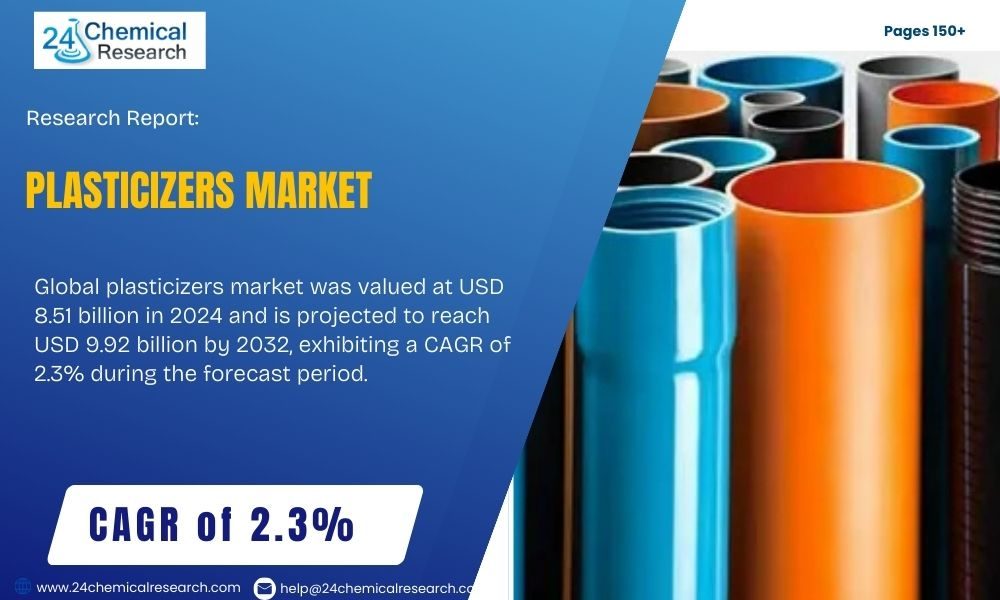
Global Plasticizers Market continues to demonstrate steady demand, with its valuation reaching USD 8.51 billion in 2024. According to comprehensive industry analysis, the market is projected to grow at a CAGR of 2.3%, reaching approximately USD 9.92 billion by 2032. While facing regulatory pressures in developed markets, growth persists due to essential applications in PVC products and the construction sector, particularly in rapidly urbanizing Asian economies where infrastructure development continues unabated.
Plasticizers are chemical additives that increase the flexibility and workability of polymers, primarily polyvinyl chloride (PVC). These compounds play a crucial role in manufacturing everything from wire insulation to medical tubing, offering durability benefits that are difficult to replicate with alternative materials. The industry currently faces a pivotal transition as sustainability concerns drive innovation in bio-based alternatives, though conventional phthalates still account for the majority of market volume.
Download FREE Sample Report: https://www.24chemicalresearch.com/download-sample/297683/global-plasticizers-forecast-market-2032-71
Market Overview & Regional Analysis
Asia-Pacific commands the global plasticizers market with a dominant 58% consumption share, centered around China’s massive manufacturing sector. The country’s construction boom and expanding automotive production create relentless demand for flexible PVC applications. Neighboring markets like India and Southeast Asia follow similar trajectories, with urbanization rates exceeding 3% annually in developing nations.
Europe maintains its position as the second-largest market, where stringent EU regulations accelerate the adoption of non-phthalate alternatives. North America’s mature market shows modest growth, tempered by environmental concerns but sustained by infrastructure renewal projects. Emerging regions demonstrate potential, with Latin American countries prioritizing housing solutions and Middle Eastern nations investing in commercial construction.
Key Recent Developments & Product Innovations
- New non‑phthalate and bio‑based plasticizer launches
- Perstorp introduced Pevalen Pro 100 in January 2024: a non-phthalate plasticizer made entirely from renewable carbon via mass-balance methods. It claims ~80% lower carbon footprint compared to fossil‑derived plasticizers.
- BASF launched Ecoflex EL‑1165 in March 2023: low-odor, low-migration non-phthalate plasticizer suited for sensitive applications (food packaging, toys, medical devices).
- Aekyung Petrochemical (South Korea) was involved in acquiring a stake in VPCHEM (LG Chem’s Vietnam‑based subsidiary) to strengthen production/sales of plasticizers, including non‑phthalate varieties.
- Performance improvements
- Focus on matching or improving upon phthalate plasticizers in terms of thermal stability, migration (leaching), odor/volatility, durability etc. Developers are working to close the performance gap.
- Adipates are showing up as one of the fastest‑growing types of non‑phthalate plasticizers because they provide good low‑temperature flexibility and durability.
- Capacity expansion and investment
- Manufacturers are investing to scale up production of non‑phthalate plasticizers to meet growing demand. For example, Perstorp’s new product, improved R&D efforts by major players.
- There is also construction of new facilities: e.g., KLJ Group facility in Bharuch (India)—investment of $145 million.
- Regulatory & Sustainability Driven Moves
- Non‑phthalate plasticizers are increasingly promoted under regulatory and environmental compliance schemes. Players are seeking certifications and compliance with food contact, medical grade, low migration etc.
- Eco‑friendly (bio‑based, non‑phthalate) plasticizers are increasingly favoured in building, automotive, packaging, and medical sectors due to tighter regulations on phthalates.
Market & Regulatory Trends
- Shift from phthalates to non‑phthalates
- Due to health/environmental concerns (e.g. endocrine disruption, leaching), many jurisdictions are tightening limits or banning some phthalates in sensitive applications (toys, medical devices, food contact, children’s articles).
- This shift is driving growth in non‑phthalate plasticizers: growing CAGR in non‑phthalate segment (often higher than for the total plasticizer market).
- Regulations & standards tightening
- Europe’s REACH has been restricting substances; several phthalates are now classified as Substances of Very High Concern (SVHC). Expansion of Annex XVII, etc.
- In the U.S., laws such as CPSIA (Consumer Product Safety Improvement Act), TSCA modifications, plus state‑level measures (e.g. California Proposition 65) are influencing allowable plasticizer content.
- In Asia‑Pacific, countries like China and India are increasingly under pressure to limit phthalates (for exports, for health) and are tilting toward non‐phthalate alternatives.
- Rise in eco‑friendly / bio‑based plasticizers
- Bio‑based, renewable feedstocks (vegetable oils, citrate esters, epoxidized oils) are more in focus.
- Sustainability considerations: carbon footprint, biodegradability, renewable carbon content etc. These are now selling points. Eg. Pevalen Pro 100 with renewable carbon.
- Cost & performance challenges remain
- Non‑phthalate plasticizers generally are more expensive, may have limitations (higher migration under extreme conditions, maybe lower plasticizing efficiency in some cases). These are still barriers.
- Raw material (bio‑feedstock) volatility, supply chain issues (e.g. for bio‑based sources) are still concerns.
- Segment / Application where shifts are strongest
- Medical devices and food‑contact applications are among the fastest to adopt non‑phthalate options because of safety and regulatory pressure.
- Flooring and wallcoverings: needs low VOC, low odor, indoor air quality compliance.
- Automotive interiors: odor, emissions, regulatory compliance for cabin materials.
Notable Market Numbers & Forecasts
- The non‑phthalate plasticizers market was valued at around USD 980‑1,000 million in 2024; it is expected to grow to approx USD 1,550‑1,600 million by 2032 (CAGR ~5.9%) under some forecasts.
- In “eco‑friendly plasticizers” segment the value was about USD 5.03 billion in 2024, projected to reach ~USD 7.55 billion by 2030 (CAGR ~7.0%) in one report.
- The overall phthalate + non‑phthalate plasticizers market is also forecast to grow, though with variation: some sources forecast ~4.8% CAGR through 2033/2035.
Emerging Issues / Challenges
- Regulatory fragmentation: Different countries / regions have different regulation timelines, thresholds, banned substances etc. This creates complexity for manufacturers who sell globally. Reformulation for one market may not satisfy another.
- Performance trade‑offs: Achieving equivalent properties (flexibility, low temp behavior, migration, durability) is still challenging in some uses, especially under harsh environmental conditions. Some non‑phthalate alternatives may not yet fully match phthalates for every application.
- Cost sensitivity: Non‑phthalate / bio‑based plasticizers tend to cost more, both due to feedstock cost and production / R&D. Adoption in cost‑sensitive markets (or where regulation is lax) lags.
- Supply of bio feedstocks: Availability, sustainability of feedstocks (e.g. for epoxidized oils, citrate esters) can fluctuate; plus there may be environmental tradeoffs in large scale bio‑resources.
Trend Snapshot
- Increasing demand for low migration, low odor, high thermal stability, and biocompatible plasticizers.
- Bio‑based plasticizers are rising in prominence; marketing and regulatory credentials (renewable content, biodegradability, lower carbon footprint) are becoming as important as technical performance.
- “Non‑phthalate from day‑one” formulations: new products being designed from the start without phthalates rather than reformulated after the fact.
- Consumers and end‑users are increasingly aware and demanding transparency: phthalate content disclosure, safer material claims, labels (e.g. “phthalate‑free”) are used as competitive differentiators.
- OEMs (in medical, automotive, toys, packaging) are specifying non‑phthalate standards; supply chain compliance is becoming critical.
Key Market Drivers and Opportunities
The market thrives on three core demand drivers: expanding construction activities, automotive sector requirements, and packaging innovations. Construction applications alone account for over 40% of plasticizer usage, with PVC’s weather resistance making it indispensable for roofing, flooring, and piping. The automotive industry contributes significantly through interior components, where lightweight materials help meet fuel efficiency standards.
Emerging opportunities include medical-grade plasticizers for devices requiring flexibility and biocompatibility, along with specialized formulations for wire and cable insulation in renewable energy projects. The shift toward sustainable plasticizers presents both challenge and opportunity, with leading chemical companies investing heavily in plant-based and high-performance alternatives.
Challenges & Restraints
Regulatory hurdles present the most significant challenge, with phthalate restrictions expanding across North America and Europe. REACH regulation updates and consumer safety concerns force manufacturers to reformulate products, often at substantial R&D cost. Price volatility in crude oil derivatives adds unpredictability, as many plasticizers originate from petrochemical feedstocks.
Technological limitations of alternative plasticizers in demanding applications create adoption barriers, while developing markets struggle with inconsistent standards enforcement. These factors combine to create a complex landscape where regional strategies require careful calibration to market-specific conditions.
Market Segmentation by Type
- Phthalates
- Non-Phthalates
- Bio-based Plasticizers
Market Segmentation by Application
- Flooring & Wall Coverings
- Wires & Cables
- Films & Sheets
- Coated Fabrics
- Consumer Goods
- Automotive Components
- Medical Devices
Market Segmentation by Key Players
- UPC Group
- Nan Ya Plastics
- ExxonMobil Chemical
- BASF SE
- Eastman Chemical
- Evonik Industries
- LG Chem
- Arkema
- DIC Corporation
- Bluesail Chemical
- Aekyung Petrochemical
- Henan Qing’an Chemical
- Hongxin Chemical
- Sinopec Jinling
- Perstorp Group
Report Scope
This report presents a comprehensive analysis of the global and regional markets for Plasticizers, covering the period from 2024 to 2032. It includes detailed insights into the current market status and outlook across various regions and countries, with specific focus on:
- Sales, sales volume, and revenue forecasts
- Detailed segmentation by type and application
In addition, the report offers in-depth profiles of key industry players, including:
- Company profiles
- Product specifications
- Production capacity and sales
- Revenue, pricing, gross margins
- Sales performance
It further examines the competitive landscape, highlighting the major vendors and identifying the critical factors expected to challenge market growth.
As part of this research, we surveyed Plasticizer manufacturers, suppliers, distributors, and industry experts. The survey covered various aspects, including:
- Revenue and demand trends
- Product types and recent developments
- Strategic plans and market drivers
- Industry challenges, obstacles, and potential risks
Get Full Report Here: https://www.24chemicalresearch.com/reports/297683/global-plasticizers-forecast-market-2032-71
Founded in 2015, 24chemicalresearch has rapidly established itself as a leader in chemical market intelligence, serving clients including over 30 Fortune 500 companies. We provide data-driven insights through rigorous research methodologies, addressing key industry factors such as government policy, emerging technologies, and competitive landscapes.
- Plant-level capacity tracking
- Real-time price monitoring
- Techno-economic feasibility studies
With a dedicated team of researchers possessing over a decade of experience, we focus on delivering actionable, timely, and high-quality reports to help clients achieve their strategic goals. Our mission is to be the most trusted resource for market insights in the chemical and materials industries.
Website: https://www.24chemicalresearch.com/




