
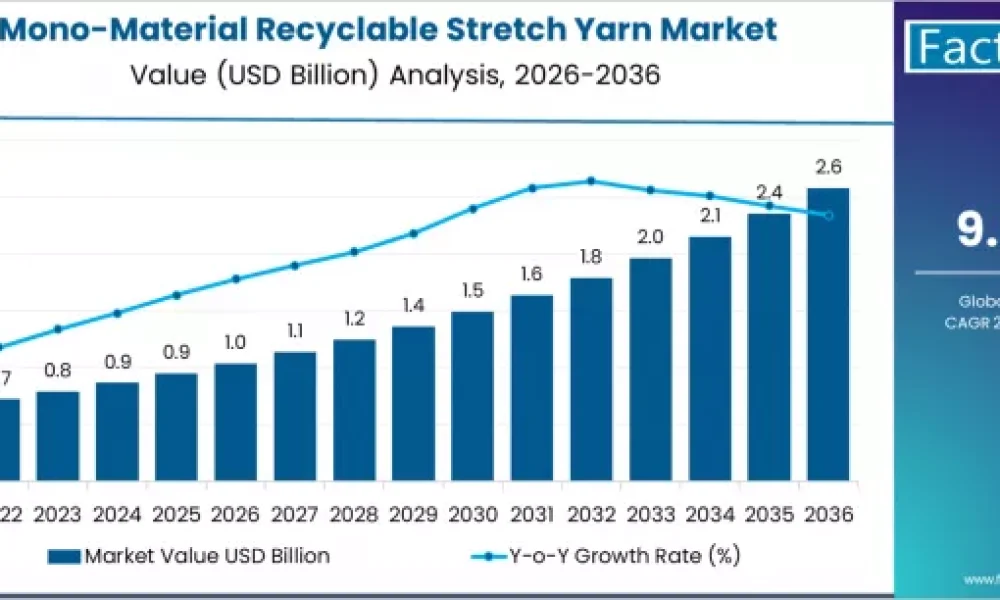
The global mono-material recyclable stretch yarn market is set for strong expansion, fueled by rising sustainability mandates, circular fashion initiatives, and growing adoption of recyclable textiles across apparel and industrial applications. According to Fact.MR, the market is projected to grow from USD 1.04 billion in 2026 to USD 2.15 billion by 2036, registering a robust CAGR of 9.5% during the forecast period. This reflects a total market growth of 106.7% over the decade.
Mono-material recyclable stretch yarns—engineered using a single polymer type such as polyester or polyamide—enable easier recycling while maintaining elasticity, durability, and performance. These properties position them as a key enabler in the transition toward sustainable and closed-loop textile systems.
To access the complete data tables and in-depth insights, request a Discount On The Report here: https://www.factmr.com/connectus/sample?flag=S&rep_id=12729
Key Market Drivers
Sustainability Regulations and Circular Economy Push
Global textile regulations and brand-level sustainability commitments are driving demand for recyclable yarns that simplify end-of-life processing. Mono-material stretch yarns eliminate the recycling challenges posed by multi-material blends, supporting circular economy goals across apparel and home textiles.
Rising Demand from Apparel and Athleisure Segments
The rapid growth of sportswear, athleisure, innerwear, and performance apparel is significantly boosting consumption of stretch yarns. Brands are increasingly shifting toward mono-material solutions to align performance wear with recyclability and eco-design standards.
Brand Commitments to Recyclable and Low-Impact Textiles
Leading fashion and textile brands are pledging to use recyclable or mono-material fabrics in upcoming collections. This has accelerated R&D investments in recyclable stretch yarns that meet both sustainability and high-performance criteria.
Technological Advancements in Yarn Engineering
Innovations in polymer science and spinning technologies are enhancing elasticity, recovery, and strength of mono-material stretch yarns, making them competitive alternatives to conventional elastane-blended yarns.
Regional Growth Highlights
Europe: Sustainability-Led Market Leadership
Europe remains a key growth hub due to strict environmental regulations, extended producer responsibility (EPR) frameworks, and strong adoption of circular textiles by premium fashion brands.
North America: Brand-Led Adoption
The U.S. and Canada are witnessing rising uptake driven by apparel brands committing to recyclable materials and growing consumer demand for sustainable clothing.
Asia-Pacific: Manufacturing and Volume Growth Engine
Countries such as China, India, Japan, and South Korea are expanding production capacities. The region benefits from strong textile manufacturing infrastructure and increasing investments in sustainable yarn technologies.
Latin America & Middle East: Emerging Opportunities
Growing awareness of eco-textiles and gradual adoption by regional apparel manufacturers are opening new growth avenues in these markets.
Market Segmentation Insights
By Material Type
- Polyester-Based Mono-Material Stretch Yarn – Dominates due to recyclability, durability, and cost efficiency
- Polyamide-Based Mono-Material Stretch Yarn – Preferred in premium and high-performance applications
By Application
- Apparel & Athleisure – Largest and fastest-growing segment
- Innerwear & Hosiery – Increasing shift toward recyclable stretch fabrics
- Home Textiles – Curtains, upholstery, and furnishings adopting sustainable yarns
- Industrial & Technical Textiles – Niche but expanding applications
Market Challenges
Despite strong growth prospects, the market faces certain hurdles:
- Higher Production Costs compared to conventional blended stretch yarns
- Performance Parity Challenges with elastane-blended materials in some applications
- Limited Awareness among small and mid-sized textile manufacturers
- Recycling Infrastructure Gaps in developing regions
Competitive Landscape
The mono-material recyclable stretch yarn market is moderately competitive, with players focusing on sustainable material innovation, strategic partnerships, and capacity expansion. Companies are investing in recyclable polymer development and collaborating with apparel brands to accelerate adoption.
Prominent Companies Include:
- Hyosung TNC
- Toray Industries
- Asahi Kasei
- Indorama Ventures
- Teijin Limited
- Far Eastern New Century
- Fulgar S.p.A.
These companies are actively developing next-generation recyclable stretch yarns to meet evolving sustainability standards.
Future Outlook: Enabling the Next Generation of Circular Textiles
Over the next decade, mono-material recyclable stretch yarns will become a cornerstone of sustainable textile innovation. As regulations tighten and brands intensify circularity commitments, demand for recyclable, high-performance stretch yarns will continue to rise.
Manufacturers that invest in material innovation, scalable recycling compatibility, and strategic brand collaborations will be best positioned to capitalize on the market’s rapid growth trajectory.
Have a specific Requirements and Need Assistant on Report Pricing or Limited Budget please contact us – [email protected]
About Fact.MR
Fact.MR is a global market research and consulting firm, trusted by Fortune 500 companies and emerging businesses for reliable insights and strategic intelligence. With a presence across the U.S., UK, India, and Dubai, we deliver data-driven research and tailored consulting solutions across 30+ industries and 1,000+ markets. Backed by deep expertise and advanced analytics, Fact.MR helps organizations uncover opportunities, reduce risks, and make informed decisions for sustainable growth.



