
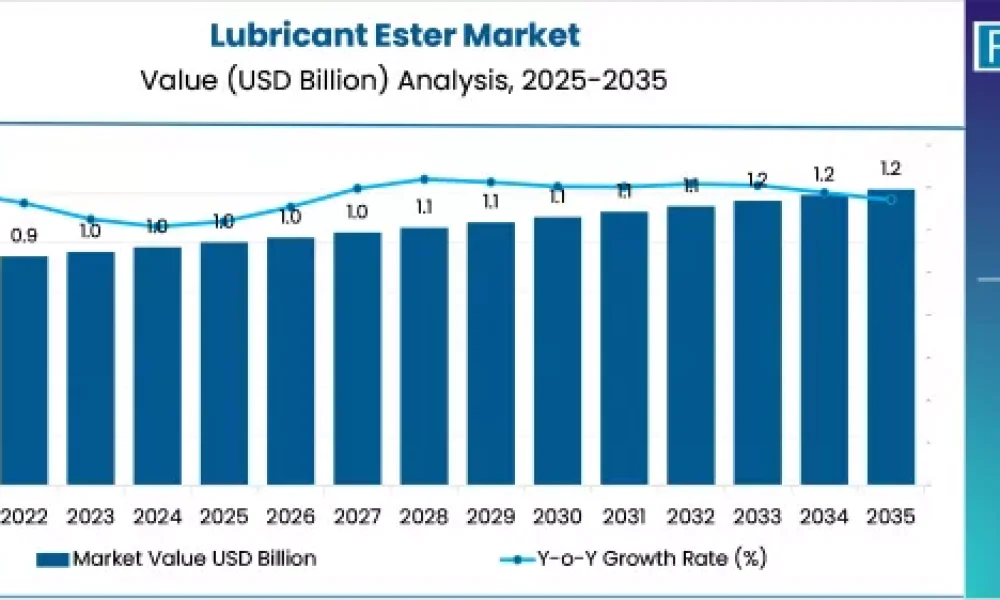
The global lubricant ester market has entered a pivotal phase of realignment this year, as industrial sectors transition from traditional mineral-based formulations toward high-performance, sustainable alternatives. Valued at approximately $9.27 billion at the start of 2026, the market is projected to maintain a steady compound annual growth rate (CAGR) of 5.5% through 2034, fueled by stringent environmental mandates and the rapid evolution of electric vehicle (EV) architectures.
Addressing the Industry Shift: Who, What, and Why
As of early 2026, the “”Who”” of the market remains a mix of chemical giants and specialty innovators. Leading entities such as BASF SE, ExxonMobil, NYCO S.A., and Perstorp (a subsidiary of PETRONAS Chemicals Group) are currently spearheading the “”What””—a systemic shift toward saturated synthetic polyol esters and bio-derived lubricants.
The “”Why”” behind this momentum is two-fold. First, the global manufacturing sector, which saw a 4.1% increase in value-added growth over the past year, is increasingly adopting Industry 4.0 technologies. These high-precision systems require lubricants that offer superior thermal stability and oxidative resistance beyond the capabilities of conventional oils. Second, the “”Where”” is concentrated heavily in the Asia-Pacific region, which now commands roughly 46% of the global market share, driven by massive industrial output in China and India.
Request for Sample Report | Customize Report |purchase Full Report – https://www.factmr.com/connectus/sample?flag=S&rep_id=8913
Data-Backed Insights: Sustainability as a Market Catalyst
The 2026 market landscape is defined by the convergence of performance and policy. Environmental regulations, including the EU Ecolabel and the U.S. EPA’s Vessel General Permit (VGP), have transitioned from optional certifications to market-entry requirements. This has propelled the demand for Environmentally Acceptable Lubricants (EALs), a segment now valued at nearly $910 million.
“”We are seeing a clear move away from ‘compliance-only’ adoption,”” notes industry analyst data. “”Ester-based lubricants are now being selected for their technical superiority—specifically their high viscosity index and biodegradability—rather than just their green credentials.””
Sector Analysis: Aerospace, Automotive, and the EV Transition
The lubricant ester market is currently navigating a complex period of cross-sector disruption:
- Aerospace & Aviation: This remains a dominant high-value segment. The demand for synthetic polyol esters is rising as Boeing and other aerospace leaders increase production rates, requiring engine oils that can withstand extreme temperature fluctuations.
- The EV Pivot: While the transition to electric mobility has reduced the volume of traditional engine oils, it has created a sophisticated niche for esters. 2026 has seen a surge in “”e-fluids””—specialized ester formulations designed for battery thermal management and high-speed electric motor gearboxes.
- Industrial Automation: As smart factories integrate more robotics, the demand for high-performance hydraulic and compressor oils has grown by a CAGR of 6.8%, prioritizing moisture management and long-term film protection.
Regional Growth: The Dominance of Asia-Pacific
While North America remains the primary hub for aerospace-grade esters, the Asia-Pacific region is the engine of volume growth. China’s goal to reach 35 million automobile units by 2025 has set a high floor for lubricant demand in 2026. Furthermore, India’s accelerating industrialization has positioned it as the fastest-growing regional market, with significant investments in wind energy and power generation infrastructure requiring specialized turbine lubricants.
Strategic Competitive Landscape
Market competition in 2026 is characterized by “”specialization over scale.”” Companies are moving beyond commodity esters to offer tailored solutions:
- Perstorp recently launched a new range of saturated synthetic polyol esters specifically for extreme-pressure environments.
- Cargill and Oleon have strengthened their positions in the oleochemical space, capitalizing on the volatility of petrochemical feedstocks by offering stable, plant-based alternatives.
- Evonik continues to dominate the additives segment, integrating esters to improve fuel economy and machinery durability.
Looking Ahead: The 2030 Outlook
Investors and analysts expect the lubricant ester market to remain resilient against raw material price volatility. The integration of AI-driven supply chain optimization and enzymatic synthesis is expected to lower production costs and improve the purity of bio-based esters over the next four years. By 2034, the broader esters market is forecasted to reach $14.65 billion, confirming that the current shifts in 2026 are not merely trends, but the foundation of the next industrial era.
About the Lubricant Ester Market Report: This summary is based on a synthesis of 2025-2026 market intelligence reports, focusing on synthetic and bio-based ester trends across the automotive, aerospace, and industrial sectors.
Related Reports
Lubricants Market
“



