
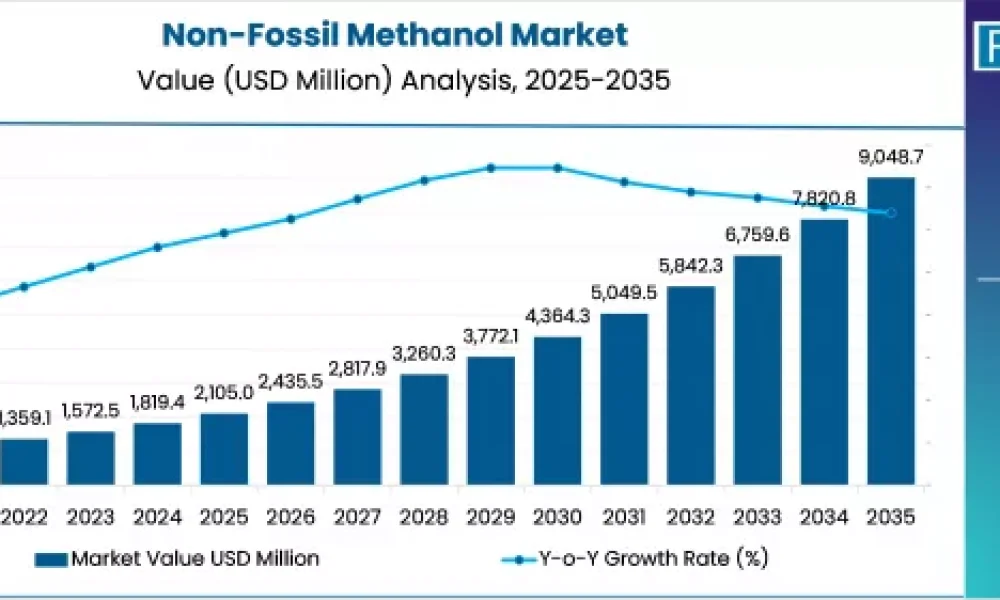
The global non-fossil methanol market is entering a decisive phase of industrial scaling. Valued at approximately $3.54 billion in 2026, the sector is projected to maintain a compound annual growth rate (CAGR) of over 34% through 2034. This rapid expansion is being driven by a structural shift in the maritime and chemical industries, as global mandates for decarbonization transition from voluntary targets to enforceable regulatory requirements.
Answering the Sectoral Pivot: Who, What, and Why
As of early 2026, the primary catalysts for this growth are international shipping conglomerates, chemical manufacturers, and institutional investors. The “”what”” involves a transition from traditional gray methanol—derived from natural gas and coal—to bio-methanol and e-methanol (synthetic methanol produced from green hydrogen and captured carbon).
The urgency is fueled by the International Maritime Organization’s (IMO) revised greenhouse gas strategy and the European Union’s “”Fit for 55″” package. With the maritime sector responsible for nearly 3% of global CO2 emissions, non-fossil methanol has emerged as the most viable, energy-dense alternative for long-haul shipping. Industry leaders like A.P. Moller – Maersk and OCI Global have already operationalized dual-fuel vessels, signaling that the “”methanol economy”” is no longer a pilot concept but a commercial reality.
Strategic Market Context: Regional Growth and Capacity
The landscape of non-fossil methanol production is diversifying geographically. While Europe remains a regulatory pioneer, the Asia-Pacific region is rapidly becoming the world’s production powerhouse.
- China’s Dominance: In 2025, China commenced operations of several full-cycle commercial green methanol projects, including major facilities by Shanghai Electric and LONGi Green Energy. These projects leverage the country’s vast renewable energy infrastructure to lower the levelized cost of e-methanol.
- North American Incentives: In the United States, the Inflation Reduction Act (IRA)—specifically the Section 45V and 45Z tax credits—has significantly de-risked investments. These credits have unlocked billions in capital for projects like SunGas Renewables’ $2 billion facility in Louisiana, aimed at serving the surging demand for low-carbon marine fuels.
- European Infrastructure: Denmark and Germany have solidified their roles as regional hubs, with Europe’s largest green methanol facility now supplying not only the shipping sector but also major industrial players like LEGO and Novo Nordisk.
Technological Maturation: Bio-Methanol vs. E-Methanol
Data-backed insights indicate that while bio-methanol currently holds the majority of the market share due to its established feedstock pathways (agricultural and municipal waste), e-methanol is tracking a higher CAGR of over 44%.
The “”power-to-liquid”” pathway, which utilizes renewable electricity to electrolyze water for hydrogen, is benefiting from falling electrolyzer costs and improved carbon capture efficiency. As industrial hubs integrate carbon capture at the source, the cost-parity gap between fossil-based and non-fossil methanol is narrowing, particularly in “”Green Shipping Corridors”” between major global ports.
Investor Perspective and Industry Relevance
“”The transition to non-fossil methanol is fundamentally a supply-chain evolution,”” states one industry analyst. “”We are seeing a move away from volatile fossil fuel prices toward long-term, fixed-price offtake agreements for green fuels. This stability is highly attractive to institutional investors who are increasingly wary of carbon-intensive assets.””
Currently, the market tracks over 130 active projects globally, with total projected capacity expected to reach 19.5 million metric tons by 2028. However, challenges remain, specifically regarding infrastructure. While the technology for methanol-ready engines is proven, the global bunkering network requires significant capital to ensure widespread availability at scale.
Request for Sample Report | Customize Report |purchase Full Report – https://www.factmr.com/connectus/sample?flag=S&rep_id=10859
Future Outlook: Scaling Toward 2030
The next four years will be critical for infrastructure deployment. Analysts suggest that for the market to reach its projected $36.8 billion valuation by 2034, public-private partnerships must focus on “”fuel hubs””—centralized locations where production, storage, and consumption are geographically aligned to minimize logistics costs.
The non-fossil methanol market is no longer a niche segment of the specialty chemicals industry. It is the cornerstone of a broader movement to decouple global trade from carbon emissions.
About the Industry Report: This press release summarizes the latest 2026 market intelligence regarding green and renewable methanol. It reflects data synthesized from global project databases, regulatory filings, and industrial capacity announcements.
Related Reports



