
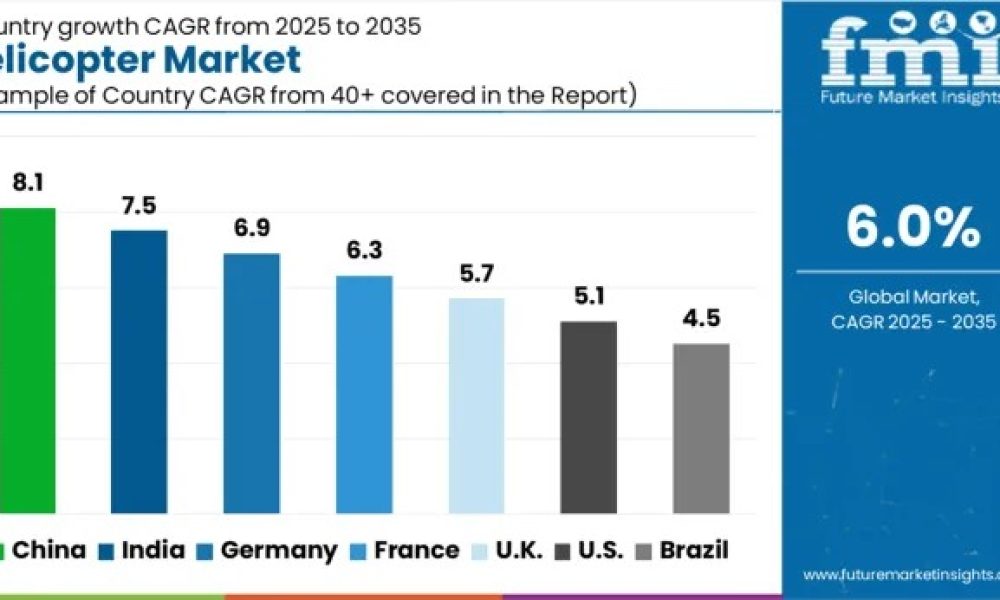
The global helicopter market is entering a decisive growth phase, underpinned by expanding demand across defense, emergency services, commercial aviation, offshore operations, and emerging urban air mobility applications. Valued at USD 34.8 billion in 2025, the market is projected to reach USD 62.3 billion by 2035, registering a compound annual growth rate (CAGR) of 6.0% over the forecast period. This trajectory reflects the helicopter’s enduring strategic relevance as a versatile vertical-lift platform capable of operating in environments inaccessible to fixed-wing aircraft.
Between 2021 and 2025, the market expanded steadily from USD 26.0 billion to USD 34.8 billion, supported by consistent procurement across defense, emergency medical services (EMS), oil and gas, and tourism sectors. During this phase, helicopter demand demonstrated a strong correlation with macroeconomic indicators such as defense budgets, energy prices, and global economic stability. As economies stabilized post-pandemic, fleet utilization improved and deferred procurement cycles resumed, setting the foundation for the next stage of growth.
From 2026 to 2030, the helicopter market is expected to accelerate from USD 34.8 billion to USD 49.3 billion, driven by increased air travel, recovery in offshore energy activity, and the widening adoption of helicopters for commercial transport and specialized missions. Rising disposable incomes, particularly in Asia-Pacific and parts of Europe, are supporting demand for private and commercial helicopter services, while governments continue to invest in fleet modernization and multi-mission platforms. This period marks a transition from cyclical recovery to structurally driven growth.
The momentum intensifies between 2031 and 2035, with the market forecast to reach USD 62.3 billion. Growth during this phase remains closely linked to GDP expansion, defense spending patterns, and energy sector investment, particularly in emerging economies. Increasing requirements for surveillance, border security, disaster response, and rapid mobility are reinforcing helicopter procurement across both public and private operators.
Get access to comprehensive data tables and detailed market insights — request your sample report today!
https://www.futuremarketinsights.com/reports/sample/rep-gb-25738
Broad-Based Demand Across End-Use Sectors
The helicopter market benefits from a diversified demand base. The aerospace and defense sector represents the largest contributor, accounting for approximately 40–45% of total market value. Helicopters remain indispensable for military surveillance, reconnaissance, troop transport, combat support, and search-and-rescue missions, ensuring sustained procurement even during periods of economic uncertainty.
The commercial aviation segment contributes around 25–30%, encompassing passenger transport, tourism, air ambulance services, and corporate travel. Helicopters are particularly critical in regions with challenging terrain or limited airport infrastructure. The oil and gas sector, contributing 15–20%, continues to rely on helicopters for offshore crew transport and logistics, while emergency services account for 10–12%, reflecting growing investments in air ambulance, firefighting, and disaster response capabilities. The tourism and leisure segment, at 8–10%, is expanding steadily as demand for premium travel experiences rises.
Technology and Modernization Fuel Market Growth
Market growth is increasingly shaped by technological advancement and fleet modernization. Manufacturers are integrating advanced avionics, digital flight control systems, and lightweight composite materials to enhance safety, performance, and operational efficiency. Improvements in fuel efficiency, reduced noise footprints, and lower emissions are aligning helicopter development with evolving environmental and regulatory expectations.
Defense modernization programs across developed and emerging economies are further strengthening demand for versatile rotary-wing platforms. At the same time, helicopters are gaining relevance in urban air mobility (UAM) concepts, where vertical takeoff and landing capabilities offer solutions to congestion and accessibility challenges. While UAM remains an emerging application, it is already influencing long-term design and investment strategies.
Segmental Insights Highlight Structural Strength
By component, the aerostructures and airframe segment is projected to account for 28.5% of market revenue in 2025, making it the leading category. Continuous innovation in composite materials, carbon fiber structures, and titanium alloys is enabling lighter, stronger, and more corrosion-resistant airframes. These advancements improve payload capacity, fuel efficiency, and survivability, reinforcing the segment’s leadership as regulatory standards for airworthiness and crashworthiness tighten globally.
From a sales channel perspective, OEMs dominate with a 55.6% revenue share in 2025, reflecting strong demand for new helicopters equipped with integrated avionics, propulsion systems, and mission-specific configurations. Large-scale fleet renewal programs, particularly in defense and emergency services, continue to favor OEM procurement over secondary channels.
By engine type, twin-engine helicopters lead the market with a 49.2% share, driven by superior safety, redundancy, and performance in demanding environments. These platforms are widely preferred for offshore operations, firefighting, EMS, and defense missions, where reliability and regulatory compliance are critical.
Drive Your Business Growth Strategy: Checkout the Report for Key Insights
https://www.futuremarketinsights.com/checkout/25738
Regional Growth Patterns Signal Opportunity
Regionally, North America, Asia-Pacific, and Europe remain the primary growth engines. China leads country-level growth with a projected CAGR of 8.1%, supported by expanding defense capabilities, infrastructure development, and rising commercial helicopter usage. India follows closely at 7.5% CAGR, driven by demand for connectivity in remote areas, disaster management, and defense operations. European markets such as Germany, France, and the UK continue to benefit from strong aerospace ecosystems, EMS demand, and increasing focus on urban air mobility. The United States, while more mature, maintains steady growth at 5.1% CAGR, anchored in defense, law enforcement, and commercial services.
Competitive Landscape and Market Outlook
The competitive landscape is characterized by a focus on performance, reliability, and lifecycle value. Leading players including Babcock International Group PLC, Airbus Helicopters SAS, Bell Helicopter, Robinson Helicopter Company, and Kawasaki Heavy Industries are differentiating through advanced technology integration, mission-specific platforms, and comprehensive support offerings. Strategic emphasis on autonomous flight capabilities, advanced materials, and fuel-efficient designs is reshaping competition and long-term positioning.
Looking ahead, the helicopter market is positioned for sustained, technology-driven growth. While challenges such as high operating costs, regulatory complexity, and maintenance intensity persist, opportunities in electric and hybrid propulsion, autonomous systems, and unmanned aerial integration are expanding the market’s future potential. As global security requirements evolve and commercial applications diversify, helicopters are set to remain a cornerstone of vertical mobility, making the sector an increasingly compelling focus for strategic investment and long-term planning.
Why Choose FMI: Empowering Decisions that Drive Real-World Outcomes: https://www.futuremarketinsights.com/why-fmi
About Future Market Insights (FMI)
Future Market Insights, Inc. (FMI) is an ESOMAR-certified, ISO 9001:2015 market research and consulting organization, trusted by Fortune 500 clients and global enterprises. With operations in the U.S., UK, India, and Dubai, FMI provides data-backed insights and strategic intelligence across 30+ industries and 1200 markets worldwide.



