
Clear Overview of Legitimate Routes to Parallel Legal Statuses Through Citizenship, Residency, Disclosure Compliance, and Verified Government Records
WASHINGTON, DC, June 18, 2026
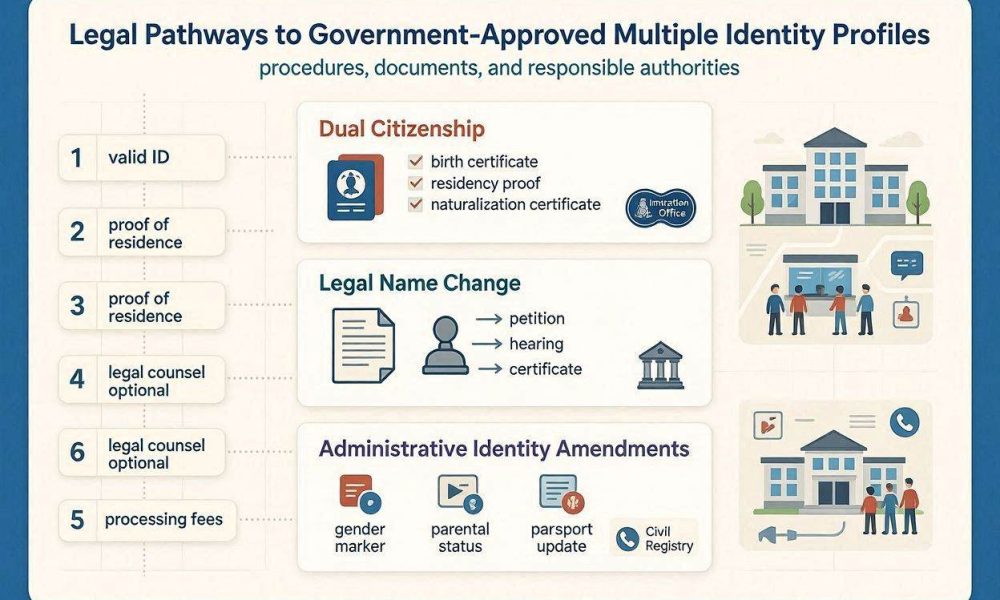
Legal pathways to government-approved multiple identity profiles begin with a careful distinction between lawful status diversification and unlawful identity fabrication, because modern governments, banks, border systems, and tax authorities increasingly compare records across jurisdictions.
A person may lawfully hold more than one citizenship, maintain residence rights in several countries, use a legally changed name, and operate through documented financial profiles, but those statuses must connect to one truthful person.
The compliant objective is not to create hidden personas, misleading biographies, or disconnected identities, because durable international privacy depends on official documents, accurate disclosure, verified personal records, and consistent treatment across banking, tax, and immigration systems.
Multiple legal identities should mean multiple legal statuses.
The phrase multiple identities is often misunderstood because lawful international planning does not permit a person to invent separate personas, conceal prior obligations, or use government documents inconsistently to mislead institutions.
A compliant framework treats multiple legal identities as multiple recognized legal statuses, including second citizenship, dual nationality, residence permits, tax registrations, legal name records, and official documents issued by competent authorities.
Those statuses can create greater mobility, safer relocation options, improved family planning, broader market access, and stronger financial resilience when properly integrated into a coherent profile.
The strongest approach keeps every status verifiable through official channels, ensuring that banks, immigration authorities, tax advisers, and trustees can understand the client without encountering contradictions.
Citizenship by investment remains one lawful route.
Citizenship by investment is a government-approved pathway in certain countries, where qualified applicants may receive citizenship after making an approved contribution or investment and passing required due diligence checks.
These programs are not document purchases because reputable CBI jurisdictions require identity checks, source-of-funds reviews, background screenings, family documentation, authorized agents, and government approval before citizenship is granted.
For example, the official St. Kitts and Nevis Citizenship by Investment Unit describes rigorous due diligence in its program, and applicants are expected to meet legal requirements before obtaining citizenship.
Clients considering citizenship by investment should treat the process as a formal government application, not a shortcut to anonymity, because false statements or concealed facts can lead to refusal, revocation, and reputational damage.
Residency-to-citizenship programs offer a longer path.
Residency-to-citizenship programs may allow a person to become a citizen after maintaining lawful residence, meeting physical presence requirements, complying with local rules, and satisfying language, integration, or good-character standards where applicable.
This route can be attractive for entrepreneurs, investors, retirees, and families who want stronger ties to a country before seeking citizenship, rather than obtaining nationality through a direct investment program.
Residency pathways may involve investment residence, employment residence, family reunification, long-term residence, entrepreneur visas, skilled migration, or retirement status, depending on the country’s immigration framework.
The key requirement is authenticity, because residence claims should reflect actual legal permission, documented presence, accurate address records, and tax analysis rather than artificial ties created only for appearance.
Citizenship by descent is increasingly relevant.
Citizenship by descent is another lawful pathway where a person qualifies for nationality through parents, grandparents, or other ancestry rules recognized by a particular country.
Recent Reuters reporting on expanded Canadian citizenship eligibility shows how changes in nationality law can create new interest among people who may qualify through family connections.
Descent-based citizenship can be powerful because it often rests on family history rather than investment, but applicants must still prove the lineage through official birth, marriage, naturalization, and identity records.
A citizenship-by-descent file should be prepared carefully because small inconsistencies in names, dates, translations, or family records can delay approval and raise broader identity questions during later banking or travel.
Naturalization remains the traditional route.
Naturalization is the classic government-approved route to citizenship, usually requiring lawful residence, good conduct, language or civic knowledge, integration, tax compliance, and a period of physical presence.
Although it is slower than some investment-based pathways, naturalization can create a stronger factual connection to the issuing country because the applicant has usually lived there, contributed economically, and built local records.
Naturalization also tends to create a clear personal history file, because residence permits, tax records, employment history, leases, utility records, and local registrations support the applicant’s connection to the country.
For clients seeking long-term credibility, naturalization can be valuable because it produces a lawful identity profile grounded in real-life circumstances rather than in transactional eligibility alone.
Legal name changes must remain transparent.
A legal name change may create a new official identity record, but it does not erase the person’s history, obligations, prior citizenships, tax records, or banking responsibilities.
People may change names for marriage, divorce, personal safety, cultural reasons, professional reasons, or other lawful grounds recognized by the relevant jurisdiction.
The name change must be supported by official orders, updated passports, tax records, bank notifications, residence files, insurance documents, and corporate records, where applicable.
A lawful name change supports privacy only when it establishes documented continuity between old and new records, because unsupported name changes often attract more scrutiny than the client expected.
Government documents are the foundation.
Any government-approved identity profile must begin with official documents issued by the correct authority, including passports, citizenship certificates, birth records, naturalization certificates, residence permits, national identity cards, and legal name change orders.
Private letters, adviser explanations, and banking summaries can support the profile, but they cannot replace the official government records that establish status and identity.
The U.S. government’s guidance on dual citizenship shows why nationality status must be understood through official rules rather than casual assumptions about passport use or dual status.
Clients should verify every document before use, ensuring that names, dates, places of birth, document numbers, issue dates, and translations match across banking, immigration, and travel records.
Parallel legal personas should not become contradictory identities.
A person may lawfully maintain a professional profile in one country, a residence profile in another, and a citizenship profile connected to a different nationality, but those profiles should not contradict each other.
The same person may have several lawful roles, including entrepreneur, investor, beneficiary, director, trustee, resident, taxpayer, and citizen, but each role should connect to the same verifiable identity history.
Problems begin when one bank receives one explanation, another government receives a different address story, and a tax adviser receives incomplete citizenship information.
A coherent master profile prevents those contradictions by consolidating all status, documents, addresses, tax positions, and roles into a single, organized record.
Disclosure requirements vary by country and institution.
Disclosure requirements differ widely because each country has its own rules for dual citizenship, tax residency, immigration registration, foreign account reporting, beneficial ownership, and name-change recognition.
Some countries permit dual citizenship broadly; some restrict it; some require notification; some may not recognize another nationality; and some impose special rules on passport use when entering or leaving.
Banks may also require disclosure beyond what a passport office requests, including tax residence, source of wealth, beneficial ownership, political exposure, sanctions screening, and family structure connected to accounts.
Clients should compare disclosure requirements before applying for citizenship or residence, because a status that is lawful in one country may still create reporting duties or practical complications elsewhere.
Citizenship does not automatically determine tax residence.
One of the most common planning errors is assuming that a second passport automatically changes where the holder pays tax or reports financial accounts.
Tax residence may depend on physical presence, permanent home, center of vital interests, business control, domicile, citizenship rules, treaty provisions, family location, and economic ties.
The role of documented tax identity is reflected in guidance on how a universal tax identification number works, because banks require accurate links between identity, accounts, and reporting classifications.
A client with multiple legal statuses should obtain qualified tax advice before opening accounts, relocating, restructuring assets or presenting a new citizenship profile to financial institutions.
Banking passports help organize the full profile.
A banking passport can organize multiple legal statuses into a coherent compliance file by connecting passports, residence permits, tax identifiers, source-of-wealth evidence, entity charts, and professional references.
This file helps banks understand why the client holds more than one nationality, where the client is resident, how wealth was created, and which accounts support legitimate objectives.
The banking passport should never conceal material facts from institutions entitled to know them, because its purpose is to ensure controlled disclosure through accurate and organized records.
When properly maintained, it reduces unnecessary document circulation while making legitimate review easier for private banks, trustees, custodians, and investment platforms.
CBI programs require due diligence.
Citizenship by investment applicants should expect government due diligence, including identity verification, source-of-funds review, background checks, family documentation, police certificates, and screening through authorized channels.
Official program materials in leading Caribbean jurisdictions emphasize due diligence because governments must protect the integrity of citizenship and avoid admitting applicants who engage in financial crime, violate sanctions, or pose reputational risk.
Applicants should prepare bank statements, tax records, business records, proof of investment, professional references, and identity documents before applying, rather than trying to assemble explanations under deadline pressure.
The strongest application is not the most polished story, but the most verifiable file, because due diligence rewards truth, consistency, and a documented source of funds.
Residency programs require real ties.
Residency programs may require physical presence, investment maintenance, property ownership or rental, local registration, medical insurance, financial self-sufficiency, employment activity, or ongoing renewal obligations.
A client should not treat residence as a paper-only status unless the program explicitly allows minimal presence and the client’s tax advisers confirm the implications.
Real ties should be documented through leases, utility bills, residence cards, tax registrations, school records, medical insurance, bank accounts, and local adviser contacts, where applicable.
A residence profile passes scrutiny when the documents align with the client’s actual life, and the client can explain why the country is part of the broader strategy.
Official verification should happen before travel or banking use.
Once citizenship or residency is granted, clients should verify that all documents are accurate before using them for travel, banking, relocation, or investment onboarding.
Passports should be checked for spelling, dates, nationality, place of birth, validity period, and machine-readable consistency, while citizenship certificates and residence permits should match supporting records.
Resources explaining electronic passport security show why modern identity documents should be treated as verifiable data instruments rather than simple paper credentials.
Using incorrect or unverified documents can create avoidable complications, especially when banks, airlines, border systems, and immigration authorities compare data across records.
Country comparisons should focus on compliance, not secrecy.
Clients often ask which country offers the most privacy, but the better question is which country offers a lawful status that fits the client’s mobility, tax, banking, family, and business profile.
A country that permits dual citizenship may still require tax reporting, beneficial ownership disclosure, or accurate bank declarations, while a country with attractive travel access may not fit the client’s long-term residence needs.
Comparisons should review due diligence standards, source-of-funds requirements, family eligibility, physical presence, tax implications, document verification, passport renewal rules, and revocation provisions.
The safest program is not the one that asks the fewest questions, but the one that produces a lawful status capable of surviving banking, travel, and regulatory scrutiny.
Family members require coordinated disclosure.
Multiple legal statuses become more complex when spouses, children, parents, or dependents are included in citizenship, residence, or banking planning.
Family files should include birth records, marriage certificates, custody documents where applicable, school records, passports, residence permits, medical records, and evidence of financial dependency when programs require it.
Each family member may have different citizenship, residence, and tax considerations, especially when children study abroad or spouses maintain separate professional lives.
The family profile should be coordinated so one member’s status does not create contradictions for another member’s immigration, tax, or banking records.
Corporate roles must be integrated.
Entrepreneurs and investors often hold directorships, shareholdings, trust roles, foundation positions, partnership interests, or authorized signatory authority in several countries.
Those corporate roles must be integrated with citizenship and residence profiles because banks and beneficial ownership registries may compare personal identity records against company filings.
A person who receives second citizenship should update corporate records where required, especially if passports, addresses, tax residence, or legal names change.
This integration prevents confusion when an institution asks whether the same person is associated with multiple entities under different citizenship documents or address records.
Disclosure to banks should be complete and controlled.
Banks require accurate identity, tax, source-of-wealth, and beneficial ownership information, and clients should not attempt to use multiple citizenships to confuse or limit that review.
Controlled disclosure means the bank receives the information it needs through secure channels, while unnecessary parties do not receive sensitive documents.
A client should be prepared to explain why they hold more than one citizenship, where they are tax-resident, which accounts are needed, and how funds will move.
This approach protects privacy because a complete file often reduces the need for repeated document requests, while incomplete disclosure usually invites broader review.
Travel rules should be reviewed before using a passport.
Clients with multiple citizenships should understand which passport to use for specific countries, whether visas are required, whether residence permits are linked to a single passport, and whether the destination has special dual-national rules.
A traveler should not casually switch passports to create confusion, as airlines, immigration systems, and border authorities may compare identity records.
The lawful strategy is to use the appropriate passport for each route, maintain consistent booking records, and carry supporting documents when a name change, residence permit, or dual status requires explanation.
Proper passport use supports privacy because credible movement usually attracts less scrutiny than inconsistent document behavior.
Revocation risk should be understood.
Citizenship or residence obtained through false statements, concealed facts, improper payments, or failure to satisfy program conditions may be refused, revoked, or challenged, depending on the country’s law.
This risk is especially important in investment migration because governments are under pressure to maintain program integrity and international confidence.
Applicants should therefore avoid advisers who promise secrecy, guaranteed approval, fabricated histories, or shortcuts around due diligence.
A lawful status is valuable precisely because it is durable, and durability depends on truthful applications, documented eligibility, and compliance with continuing obligations.
Parallel identity profiles need an annual review.
A client with multiple legal statuses should review the profile at least annually because passports expire, tax residence changes, addresses move, bank records become outdated, and family members gain or lose eligibility.
The review should confirm that official records, banking files, corporate documents, trust records, tax forms, and evidence of residence remain consistent.
It should also check whether any country has introduced new disclosure rules, renewal requirements, travel restrictions, or reporting obligations that affect the client’s status.
An annual review prevents small inconsistencies from accumulating into larger credibility problems during bank, tax, or immigration reviews.
Legal advisers are essential.
Multiple legal statuses affect immigration, tax, banking, estate planning, corporate governance, family law, asset protection, and travel compliance, making qualified professional advice essential.
A citizenship adviser may understand program rules, but a tax lawyer, private banker, corporate counsel, or trustee may identify consequences that the citizenship process alone does not address.
The client should coordinate advisers using a single approved factual profile so that every professional works from the same names, dates, addresses, tax details, and family information.
This reduces the risk that one adviser submits accurate information while another unknowingly relies on outdated or incomplete records.
Government-approved identities are strongest when verifiable.
The value of a government-approved identity profile lies in its verifiability, as banks and border systems trust documents that can be verified through official channels.
A lawful second citizenship, residence permit, or name change should make the client easier to verify, not harder to understand.
The safest profile has official documents, real timelines, clear tax records, consistent banking files, and source-of-wealth evidence that supports every major claim.
If the profile depends on ambiguity, secrecy, or selective disclosure to institutions entitled to the truth, it is not a legal pathway but a long-term risk.
The future is compliant status diversification.
Legal pathways to government-approved multiple identity profiles are best understood as compliant status diversification rather than the creation of hidden personas.
Citizenship by investment, residency-to-citizenship programs, descent-based citizenship, naturalization, and legal name changes can all create lawful layers of identity when processed through official channels.
The client must carefully compare disclosure requirements, integrate tax and banking records, verify documents, and maintain a coherent personal history across all jurisdictions.
In an era of electronic passports, financial transparency, and digital border systems, multiple legal statuses can provide mobility and privacy only when they are built on truth, maintained with discipline, and disclosed properly wherever the law requires.




