
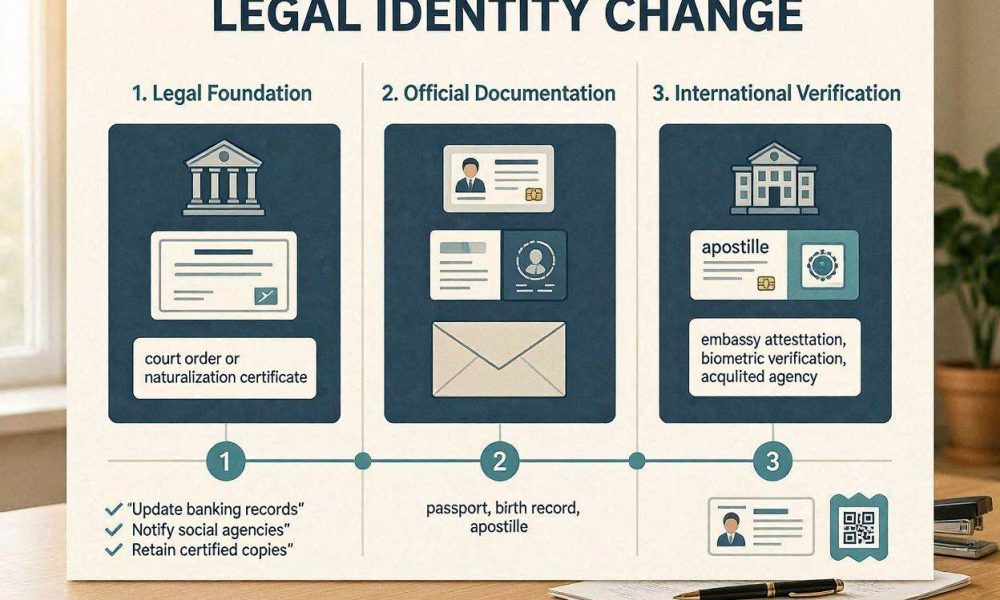
Practical Compliance Steps for Second Citizenship, Legal Name Records, Verified Documents, and Globally Consistent Personal History Files
WASHINGTON, DC, June 17, 2026
Establishing a lawful second identity profile that passes international scrutiny requires careful distinction between legitimate identity planning and unlawful identity fabrication, because modern banks, border systems, tax authorities, and immigration agencies are designed to detect contradictions.
A second identity profile should never mean a false persona, an invented biography, a fabricated birthplace, forged documents, or selective disclosure designed to mislead institutions, because such tactics can lead to criminal, immigration, banking, and reputational consequences.
The lawful approach is different because second citizenship, legal name changes, residence permits, tax registrations, and verified government records can support international mobility when every document reflects real rights, accurate history, and consistent disclosure.
Lawful identity planning starts with truth, not invention.
A person may lawfully hold more than one citizenship, use a legally changed name, maintain residence rights in several countries, and operate through different financial profiles connected to tax status, family structure, or business activity.
Those lawful tools do not create permission to invent background facts, hide prior obligations, misstate citizenship, mislead immigration officers, omit beneficial ownership information, or create inconsistent records across banks and governments.
International scrutiny now depends heavily on consistency, because passports, tax forms, bank files, residence permits, immigration records, corporate registers, and digital identity systems increasingly interact through compliance reviews.
A lawful second identity profile should therefore be built from verified facts, official documents, and professional records that can be explained clearly if a bank, border officer, trustee, tax adviser, or immigration authority asks legitimate questions.
Second citizenship can create a layer of lawful identity.
Second citizenship may provide mobility, residency options, consular access, property rights, family security, and banking flexibility, especially for clients whose lives and investments span multiple jurisdictions.
However, citizenship must be based on a recognized legal basis, such as birth, descent, naturalization, marriage, restoration, investment, or another pathway authorized by the issuing country.
The U.S. State Department’s guidance on dual nationality demonstrates why passport use must remain country-specific and lawful, especially because some countries require their citizens to use that country’s passport when entering or leaving.
A second passport should therefore be treated as an additional lawful status, not as an interchangeable mask, because passport choices must respect the rules of every country involved in the journey.
Government documents must come first.
A lawful identity profile begins with government-issued documents because private explanations, adviser letters, and banking profiles cannot replace official recognition by the relevant state authority.
Required documents may include passports, citizenship certificates, birth records, naturalization certificates, residence permits, national identity cards, tax registration letters, legal name change orders, and, where relevant, marriage or divorce records.
Each document should be obtained through official channels, verified for accuracy, and stored securely before it is used in banking, immigration, investment, or relocation planning.
If an official record contains an error, the correction should be handled through the issuing authority rather than patched informally, because informal inconsistencies can become serious problems during international review.
A legal name change must be synchronized everywhere.
Some clients may lawfully change names after marriage, divorce, personal safety concerns, cultural reasons, professional transitions or other recognized legal grounds.
A legal name change can support privacy and personal continuity, but it must be synchronized across passports, residence permits, tax records, banking files, corporate records, insurance policies, property titles, and estate planning documents.
The strongest approach maintains a clear bridge between old and new records, including the official name-change document and evidence of when institutions were notified.
This bridge protects the client because legitimate history remains explainable, while unsupported name differences may appear suspicious when banks or border systems compare records.
Consistent personal history records should document real facts.
Building consistent personal history records does not mean creating a fictional life story, because the purpose is to organize real history in a way that institutions can verify.
A complete profile may include birthplace records, citizenship history, residence history, education records, professional licenses, employment history, business ownership, tax residency, family status, and source-of-wealth documentation.
These records should tell one coherent story across jurisdictions, showing how the client became eligible for citizenship, why residence changed, where wealth originated, and which institutions received updated information.
If parts of the history are complex, the solution is a professional explanation supported by documents, not a simplified false narrative that may fail under routine scrutiny.
Tax identity is central to international verification.
Tax identity is one of the most important parts of a lawful second identity profile because banks and investment platforms must connect accounts, beneficial owners, and reporting classifications to identifiable taxpayers.
The role of tax documentation is reflected in guidance on how a universal tax identification number works, because financial institutions rely on tax records to understand account ownership and reporting obligations.
A client with second citizenship, multiple residences, or a legal name change should confirm that tax identification numbers, residency evidence, and bank forms remain accurate across all relevant relationships.
Tax records should not be adjusted casually, because inconsistent tax identity can trigger enhanced due diligence, account delays, and wider document requests that reduce privacy rather than strengthen it.
Residence records must match actual life.
A lawful identity profile often includes residence rights in one or more countries, but residence claims should reflect actual physical presence, legal authorization, housing arrangements, and tax advice, where applicable.
Clients should avoid artificial address claims, informal mail-only arrangements presented as a residence, or contradictory statements that lead one institution to believe the client lives somewhere another institution cannot verify.
Residence evidence may include leases, property records, residence permits, utility bills, local registrations, tax filings, school records, insurance policies, and professional adviser confirmations.
A defensible residence file protects privacy because the client can provide accurate proof when required without exposing unnecessary family or location details to parties outside the formal process.
Banking records should support the identity profile.
A lawful second identity profile must be consistent with banking records because private banks, brokers, trustees, and custodians will ask how identity, tax status, source of wealth, and account purpose are connected.
A banking passport can organize passports, proof of residence, tax identification records, source-of-wealth documents, account purposes, entity charts, and professional references into a single, coherent compliance file.
This does not eliminate due diligence, but it allows the client to present accurate information in a controlled format rather than responding to each bank request through rushed document sharing.
The result is stronger privacy and smoother onboarding because the client remains transparent to the institution while limiting unnecessary circulation of sensitive records.
Electronic passports raise the standard for consistency.
Modern identity verification increasingly relies on electronic passports, chip data, machine-readable zones, biometric systems, scanned documents, and automated screening tools that compare information across systems.
Resources explaining electronic passport security show why identity documents now operate inside a broader verification environment that rewards accuracy and punishes inconsistency.
A client should ensure that dates, names, passport numbers, nationality records, signatures, and biographical details are consistent across travel bookings, banking files, immigration forms, and residence applications.
Minor errors should be corrected promptly because repeated discrepancies can lead institutions to question whether the documents reflect a single lawful person or an attempted identity separation.
International scrutiny is becoming more digital.
Governments continue expanding digital border and identity systems, making consistent documentation more important for travelers, dual citizens, and globally mobile clients.
Reuters reported that the European Union began a gradual rollout of a digital border system designed to create electronic entry and exit records and address overstays and identity fraud, underscoring why modern border checks increasingly rely on document and identity consistency.
This trend does not prevent lawful second citizenship or legal identity changes, but it means clients should assume that unexplained differences may be noticed more quickly than in the past.
A second identity profile that passes scrutiny is therefore one that can be verified through official records, not one that depends on gaps between systems.
Official verification should be completed before use.
Every major identity element should be verified before use for travel, banking, residence, or investment activities, because premature use of incomplete records can create inconsistencies.
Passports should be checked for correct names and dates; citizenship records should match issuing authority files; residence permits should reflect lawful status; and tax numbers should be recorded accurately.
Where apostilles, legalizations, certified translations, or notarized copies are required, those should be obtained through proper channels before institutions request them urgently.
Verification in advance reduces privacy exposure by preventing repeated resubmissions, corrections, and explanatory emails that can scatter sensitive documents across multiple parties.
Personal history should support the source of wealth.
For internationally scrutinized clients, identity and financial history are closely linked because banks often need to understand how the client earned, inherited, invested, or transferred wealth.
A strong profile should include business sale agreements, employment records, investment statements, property sale contracts, inheritance documents, tax returns, and professional references where appropriate.
These documents should align with the client’s citizenship, residence, and banking timeline so institutions can understand why funds moved and why accounts were opened.
A lawful identity profile is stronger when it explains both who the client is and how the client’s financial life developed over time.
Second citizenship should be integrated with travel rules.
Clients with more than one nationality should understand which passport to use in specific situations, as some countries impose strict rules on their citizens entering or leaving.
A traveler may lawfully carry more than one passport, but passport use should be carefully planned so that ticket names, visas, residence permits, insurance records, and banking documents do not conflict.
Travel planning should include a document review before departure, especially when a trip involves countries where the client has citizenship, residence rights, tax ties, or business obligations.
The goal is controlled mobility, not ambiguity, because lawful travel privacy depends on credibility at every official checkpoint.
Legal identity tools should not create disconnected personas.
Legal identity tools may include citizenship, legal name changes, residence permits, tax registrations, family trusts, holding entities, and professional banking profiles.
Those tools should support one coherent personal record rather than several disconnected personas that tell different stories to different institutions.
A disconnected approach can create problems when banks request source-of-funds documents, immigration authorities compare passport use, or tax advisers reconcile residence declarations.
The compliant approach is to maintain one master record that explains every lawful identity element and shows how each document fits into the client’s real life.
Privacy comes from controlled disclosure.
A second identity profile can improve privacy only when information is shared carefully, accurately, and with the right parties.
Banks, tax advisers, trustees, immigration counsel, and government authorities may need complete records, while vendors, casual contacts, public platforms, and unnecessary intermediaries usually do not.
Controlled disclosure protects privacy because the client does not overshare sensitive documents while still giving required institutions the truth.
This is the opposite of concealment, because the client’s records remain accurate and reviewable even though public visibility is reduced.
Document storage must be professional.
Identity records should be treated as high-value assets because passports, tax numbers, residence permits, name change orders, citizenship certificates, and banking files can be misused if exposed.
Clients should maintain encrypted digital storage, secure physical copies, controlled access permissions, verified backups, and clear procedures for replacing expired or lost documents.
Advisers should not casually circulate identity files via unsecured email threads or shared folders with broad access.
A robust storage system supports scrutiny by enabling the client to produce accurate documents quickly, without increasing exposure through repeated document searches.
Entities and accounts must reflect the same facts.
If a client uses companies, trusts, foundations, or family office structures, those records must reflect the same identity, residence, and tax facts as the client’s personal profile.
Directors, trustees, beneficiaries, shareholders, authorized signers, and controlling persons should be clearly documented and updated when their names, addresses, passports, or tax status change.
Banks may compare entity records with personal identity files, and contradictions can lead to enhanced review even when the structure itself is lawful.
A second identity profile passes scrutiny when personal records and entity records reinforce each other rather than creating unexplained differences.
Professional advisers should coordinate the file.
A lawful identity profile often involves immigration counsel, tax advisers, private bankers, trustees, corporate lawyers, accountants, family office staff, and document specialists.
Those advisers should work from one approved factual record so that one professional does not submit an outdated address while another uses a new passport or tax classification.
The client should define which adviser controls each document category, who may update records, and how institutions are notified after material changes.
Coordination is essential because identity problems often arise not from fraud but from unmanaged fragments across several professional relationships.
Stress testing should be part of the process.
Before relying on a lawful second identity profile for travel, banking, or relocation, clients should stress test the file against realistic institutional questions.
A bank may ask why a second passport exists, when residence changed, how wealth was created, which tax number applies, and who controls an entity receiving funds.
An immigration authority may ask which passport is appropriate, whether a visa is required, where the person resides, and whether documents match travel records.
A well-prepared client can answer through official documents and consistent explanations, while an unprepared client may appear evasive simply because the file is incomplete.
Updates are required after every material change.
An identity profile should be updated after a new citizenship, passport renewal, legal name change, move of residence, marriage, divorce, change in tax residency, company formation, trust appointment, or major banking transition.
Old documents should not disappear, because historical continuity may be needed, but outdated records should be clearly separated from current active records.
The update process should include banks, tax advisers, immigration counsel, trustees, insurers, and any institution relying on the client’s identity information.
A profile that was once accurate can become risky if it is not maintained, especially when old addresses or expired passports remain in active files.
Legal scrutiny rewards consistency, not complexity.
Some clients assume that a complex identity structure is more private, but complexity without consistency often leads to greater exposure because institutions ask more questions.
A simple, lawful structure with accurate citizenship records, a clean tax identity, verified evidence of residence, and organized banking documentation is stronger than a complicated profile filled with contradictions.
International scrutiny is not defeated by complexity, because modern review focuses on whether documents, behavior, and financial activity match.
The best second identity profile is therefore the one that is easy for the proper institution to verify and difficult for unnecessary audiences to access.
The lawful path is verification, documentation, and discipline.
A second identity profile that passes international scrutiny can be built only through lawful eligibility, official government documents, consistent personal history records, and verified financial identity.
Clients should identify the required documents, confirm them through official channels, align tax and residency records, update banks and advisers, and maintain a banking passport that coherently links the profile.
The purpose is not to create an alternate persona; it is to provide a globally mobile person with lawful options while preserving credibility, privacy, and compliance.
In a world of electronic passports, digital border systems, and financial due diligence, the identity profile that survives scrutiny is the one built on truth, maintained with discipline, and supported by records that can be verified whenever legitimacy matters.




