
Current Trends and Demand Drivers for Second Citizenship, Residence Rights, Legal Name Records, and Compliant Global Privacy Planning
WASHINGTON, DC, June 19, 2026
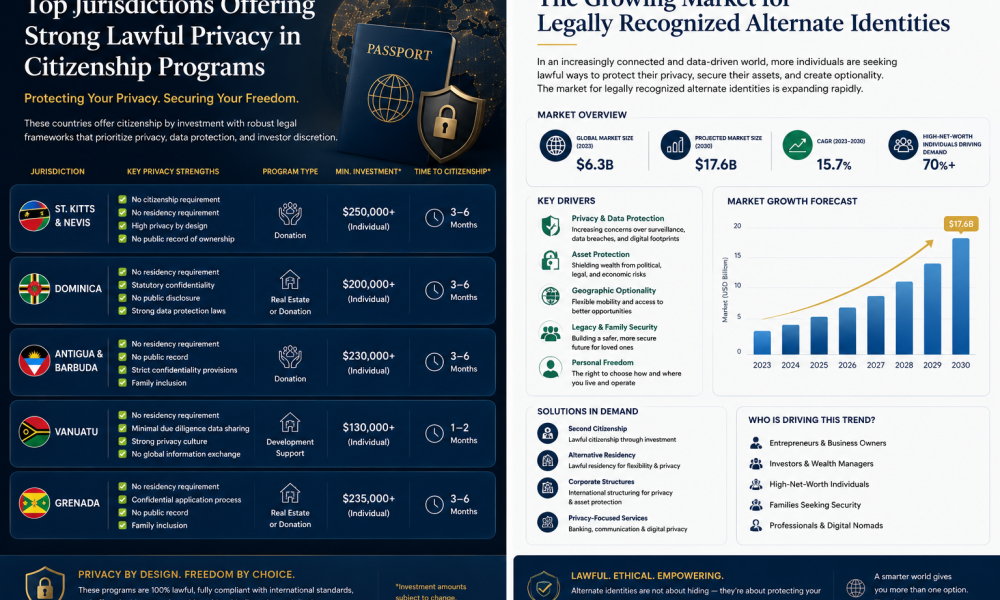
The growing market for legally recognized alternate identity profiles reflects a major shift among high-net-worth individuals, entrepreneurs, family offices, and globally mobile professionals who want privacy, mobility, and resilience without relying on false identities or unlawful concealment.
In modern international planning, an alternate identity profile should not entail a fabricated persona, an invented professional history, or an undisclosed second life, because lawful identity diversification depends on government-approved citizenship, residency rights, legal name records, tax identity, and verified documentation.
The demand is being driven by global privacy concerns, political uncertainty, data exposure, banking friction, business continuity needs, and the desire to reduce single-jurisdiction dependency while remaining fully compliant with border, tax, banking, and disclosure rules.
The market is growing because privacy risk has changed.
Privacy concerns have moved from luxury planning into mainstream risk management because personal information now circulates through data brokers, apps, payment platforms, property records, social media, travel systems, corporate registries, and financial institutions across multiple countries.
The U.S. Federal Trade Commission has warned data brokers about legal obligations concerning sensitive personal data, including rules restricting access by foreign adversaries, demonstrating why data broker regulation has become a serious privacy and national security issue.
For high-net-worth individuals, the concern is not only unwanted marketing, because exposed records can reveal home addresses, children’s schools, business interests, travel habits, political concerns, property holdings, and family relationships.
Legally recognized identity profiles appeal because they allow clients to organize official records, reduce unnecessary public exposure, and build lawful options before personal data, political risk, or mobility restrictions create urgent pressure.
Alternate identity profiles must remain lawful and verifiable.
A lawful alternate identity profile may include second citizenship, dual nationality, permanent residence, legal name changes, residence permits, professional identity records, and tax registrations issued through legitimate government channels.
Those statuses must connect to the same truthful person, because international scrutiny increasingly compares passports, bank files, tax forms, immigration records, corporate filings, electronic travel records, and beneficial ownership declarations.
The lawful market is therefore different from the underground market for false documents, because reputable planning is built around official approval, source-of-funds evidence, due diligence, secure document handling, and consistent disclosure where required.
A second citizenship or legal name change can improve privacy and mobility, but it should make it easier for the right institutions to verify, not harder for banks, governments, and advisers to understand.
Demand is rising among globally mobile clients.
Demand for second citizenship and residence planning is increasing as more wealthy families live, invest, study, bank, and operate businesses across several countries simultaneously.
Recent reporting on growing American interest in citizenship and residence options abroad shows that affluent applicants are increasingly seeking multi-jurisdictional portfolios that combine mobility, security, and long-term planning rather than relying on a single national base.
That trend matters because clients are not merely buying travel convenience, but many are building legal resilience against political instability, banking restrictions, tax uncertainty, family security concerns, and regional economic disruption.
A recognized second status can support lawful movement, additional residency options, access to local opportunities, and a more flexible family plan when one jurisdiction becomes unpredictable.
High-net-worth individuals want controlled visibility.
The market is expanding because wealthy clients increasingly understand that total invisibility is unrealistic, but controlled visibility remains possible when records are managed properly.
Controlled visibility means governments, banks, tax advisers, trustees, and regulated institutions receive accurate information, while unnecessary parties such as vendors, data brokers, casual contacts, and public platforms receive far less.
This distinction is important because privacy fails when clients try to hide from institutions entitled to information, but privacy becomes stronger when sensitive documents are shared selectively through secure and lawful channels.
The best alternate identity profile, therefore, protects the client from unnecessary exposure while maintaining a complete and verifiable record for legitimate scrutiny.
Second citizenship is the strongest recognized layer of identity.
Second citizenship remains one of the most powerful lawful identity layers because it is issued by a sovereign government and can provide nationality rights, passport access, consular protection, and mobility benefits.
A second passport may support business travel, family relocation, emergency planning, market access, and long-term residence options, depending on the country’s rules and the client’s personal circumstances.
However, second citizenship does not erase prior identity, tax obligations, criminal history, banking records, or disclosure duties, and it should never be used to create contradictory personal narratives.
A second citizenship works best when integrated into a documented profile that includes tax identity, banking records, evidence of residence, professional history, and source-of-wealth documentation.
Residence rights are another major driver of demand.
Many clients do not immediately need citizenship because residence rights, long-term visas, investor residence, entrepreneur residence, and permanent residence may provide the flexibility required for business and family planning.
Residence programs can help clients establish lawful presence, access local banking, enroll children in schools, build family continuity, and create a pathway to citizenship if the country’s rules allow naturalization later.
The privacy value of residence planning depends on accurate records, because artificial address claims or paper-only arrangements can create tax, banking, and immigration problems if the facts do not match the application.
A properly documented residence profile helps clients live discreetly while maintaining proof of lawful status, physical presence, address history, and official permission to remain in the country.
Legal name changes remain a specialized privacy tool.
Legal name changes can support privacy in appropriate circumstances, including marriage, divorce, personal safety, cultural transition, professional branding, or other lawful reasons recognized by the relevant jurisdiction.
The market for name-change planning is specialized because the change must be synchronized across passports, banking records, tax files, residence permits, corporate documents, insurance policies, and estate planning records.
The objective is continuity, not erasure, because a lawful name change should preserve a clear bridge between old and new records, allowing legitimate institutions to verify the person without confusion.
When handled properly, legal name documentation can reduce unnecessary exposure while keeping history accurate, but when handled poorly, it can trigger deeper scrutiny by banks and government agencies.
Entrepreneurs see identity planning as business continuity.
Entrepreneurs are adopting second citizenship and residence strategies because modern companies depend on founder mobility, cross-border banking, investor meetings, intellectual property control, and access to regional markets.
A founder with lawful status in more than one country may be better positioned to travel quickly, inspect operations, meet partners, open compliant banking relationships, and protect family continuity during disruption.
Identity planning can also support intellectual property protection by enabling founders to operate in stable jurisdictions, coordinate with legal advisers, and manage confidential business records through secure systems.
The advantage is not secrecy, because founders still need transparent banking and tax records, but resilience, because business leaders gain more lawful options when one jurisdiction becomes restrictive.
Family offices are driving institutional demand.
Family offices increasingly treat second citizenship, residence rights, and verified identity profiles as part of governance rather than personal preference, because family wealth often spans several countries and generations.
A family office may need citizenship planning for founders, spouses, children, dependent parents, trustees, directors, and beneficiaries, each with different travel, education, healthcare, tax, and succession needs.
The identity profile serves as a family continuity tool when passports, residence permits, school documents, banking records, trust files, and emergency contacts are securely organized and consistently updated.
This institutional demand is likely to grow because multi-generational families require privacy systems that survive relocation, inheritance, divorce, incapacity, political change, and bank review.
Data exposure has become a personal security concern.
For high-net-worth clients, identity planning is increasingly tied to personal security because exposed addresses, travel routines, family records, and financial associations can pose real-world risks.
Data brokers, social platforms, public property registers, leaked databases, and commercial tracking systems can make it easier for criminals, hostile litigants, scammers, or extortionists to identify patterns around wealthy individuals.
A legally recognized alternate identity profile cannot remove every record, but it can help clients reduce unnecessary public exposure and separate personal life administration from business-facing visibility.
The privacy benefit comes from disciplined record management, secure communication, careful address handling, and lawful use of official status, not from pretending official records do not exist.
Banking compatibility is central to the market.
Clients want alternate identity profiles that can pass banking review because second citizenship or residence rights have limited value if banks cannot understand the client’s tax status, source of wealth, and beneficial ownership.
The role of documented tax identity is reflected in guidance on how a universal tax identification number works, because financial institutions need reliable links between passports, accounts, tax classifications, and controlling persons.
A banking passport can organize identity documents, proof of residence, tax records, source-of-wealth evidence, entity charts, and professional references into one coherent file for institutional review.
This documentation makes identity planning more valuable because banks can verify clients efficiently, while clients reduce unnecessary repetition and the uncontrolled circulation of sensitive documents.
Traditional privacy methods are losing effectiveness.
Older privacy methods often relied on informal offshore accounts, personal banker relationships, nominee arrangements, private mailing addresses, or low-profile asset ownership without a coherent documentation framework.
Those methods are increasingly fragile because banks, tax authorities, and government systems now expect stronger beneficial ownership records, source-of-funds support, tax classification, and identity consistency across jurisdictions.
Modern clients are therefore moving toward lawful identity profiles that can be verified through official channels while still reducing unnecessary public exposure.
The market is growing because serious clients understand that compliance-ready privacy is more durable than privacy that depends on silence, ambiguity, or outdated assumptions about offshore secrecy.
Real-world use case: the mobile entrepreneur.
A technology founder may seek second citizenship and residence rights because customers, investors, suppliers, and development teams operate across different regions, making travel access and banking flexibility essential.
The founder may maintain one citizenship by birth, another through naturalization or investment, a residence permit in a business hub, and banking relationships that support multi-currency operations.
The profile remains lawful when tax status, company ownership, intellectual property rights, sources of funds, and travel documents are consistent across all relevant institutions.
This use case shows why the market is expanding among entrepreneurs who view identity planning as infrastructure for business access rather than a tool for hiding who they are.
Real-world use case: the family office principal.
A family office principal may want a second citizenship profile because family members live in different countries, children attend schools abroad, and investment assets are held through trusts, companies, and private banks.
The principal’s privacy needs may include protecting the address, secure document sharing, controlled disclosure of family records, and emergency relocation options if political or personal security risks increase.
The family office can manage those needs through second citizenship, residence planning, banking passports, secure archives, and documented governance that defines who may access sensitive records.
This use case demonstrates why high-net-worth clients often need privacy across generations, not merely an additional passport for personal travel.
Real-world use case: the retiring business owner.
A business owner who sells a company may use citizenship and residence planning to facilitate lawful mobility, diversify banking relationships, and protect the privacy of the sale proceeds following a public transaction.
The sale may produce significant records, including acquisition agreements, tax filings, bank transfers, investment statements, and source-of-wealth documents that must be organized before new accounts are opened.
A legally recognized identity profile allows the client to relocate, invest, obtain residence rights, and build a new financial structure without creating contradictions between past and present records.
This use case is common because liquidity events often increase privacy risk precisely when clients become more visible to banks, vendors, advisers, and public databases.
Digital identity systems increase demand for consistency.
The market for legal identity planning is also growing because digital identity systems make inconsistencies easier to detect and harder to explain.
Electronic passports, secure onboarding portals, biometric systems, machine-readable travel documents, automated screening, and bank verification tools compare personal information across records with increasing speed.
Resources explaining electronic passport security show why modern passports operate within a broader verification environment in which names, dates, document numbers, and nationality records must remain consistent.
Clients who understand this reality are more likely to seek professional identity planning before problems arise, because correcting inconsistencies later can be expensive, intrusive, and disruptive.
Privacy benefits depend on official verification.
The strongest benefit of legally recognized identity profiles is that they can be verified through official channels, which makes them more stable than informal privacy arrangements.
A second citizenship certificate, residence permit, legal name order, or tax registration has value because it is issued by a competent authority and can be presented to banks, advisers, and governments when required.
The profile should include certified copies, translations, apostilles where needed, renewal schedules, and secure storage procedures so documents remain usable over time.
Verification protects the client because a lawful profile can answer legitimate questions quickly, while a weak profile invites more review and broader exposure.
High-net-worth benefits include mobility and optionality.
High-net-worth individuals benefit from identity planning because optionality has value even when it is not used every day.
A second citizenship or residency right can help a client relocate amid political instability, access healthcare, educate children abroad, attend business meetings, diversify banking, or move family members safely as circumstances change.
This optionality should be planned for before a crisis, because citizenship, residency, banking, and tax records cannot usually be established responsibly overnight.
The market is growing because wealthy clients increasingly see second status as insurance against uncertainty, even as they continue to live primarily in their original country.
High-net-worth benefits include privacy across assets.
Clients with significant wealth often hold property, operating businesses, securities, private funds, trusts, digital assets, and philanthropic structures across several jurisdictions.
A lawful identity profile can help organize how those assets relate to the client, which institutions require disclosure to, and which records should remain private from unnecessary audiences.
The benefit is not concealment, because beneficial ownership and tax obligations must remain accurate, but reduced exposure through controlled information flows and better document discipline.
High-net-worth clients value this because fragmented records can unnecessarily expose family wealth, while organized profiles help banks and advisers understand the structure without expanding document circulation.
High-net-worth benefits include succession planning.
Multiple legal statuses can support succession planning because families may need residence rights, citizenship options and banking continuity across generations.
Children may study abroad, spouses may hold different passports, trustees may operate in another jurisdiction, and beneficiaries may eventually inherit assets across several countries.
A verified identity profile can help the family office maintain records showing citizenship, residence, tax status, family relationships, trust participation, and authority to act.
This becomes especially valuable at death, during incapacity, in the event of divorce, or during generational transition because privacy and continuity depend on accurate records available to the right people.
Legal boundaries must remain visible.
The market for alternative identity profiles will continue to grow, but legal boundaries must remain clear, as false documents, invented histories, hidden ownership, and misleading disclosures can destroy the value of legitimate planning.
Clients should disclose required information to banks, tax advisers, trustees, immigration authorities, and governments, even while limiting unnecessary exposure to vendors, platforms, and the public.
A second citizenship or legal name change should never become a disconnected persona used to avoid obligations, because those contradictions are increasingly likely to surface during institutional review.
The safest strategy is lawful status diversification, in which every document has official support and every profile remains part of a single truthful personal history.
Professional advisers are becoming gatekeepers.
Lawyers, tax advisers, immigration professionals, private bankers, trustees, and family office administrators are increasingly important because they help clients separate lawful privacy from risky identity manipulation.
A qualified adviser can identify which citizenship or residence options are available, what disclosures are required, how tax residence may be affected, and whether banking records must be updated.
Advisers also help protect the client from providers promising anonymous passports, guaranteed acceptance, fabricated histories, or secrecy from institutions entitled to accurate information.
The growing market is therefore not only a consumer trend but a professional compliance trend that requires stronger screening, documentation, and ethical boundaries.
The market will reward credibility.
The future of legally recognized alternate identity profiles will favor jurisdictions, advisers, and clients that can demonstrate credibility, official verification, and compliance-ready documentation.
Programs associated with weak screening, poor due diligence, or unrealistic claims of anonymity may attract scrutiny that diminishes their usefulness for serious high-net-worth planning.
Clients will increasingly prefer statuses that support banking, travel, tax review, and family governance without creating reputational problems.
Credibility is becoming the new privacy advantage because a profile that banks and governments can verify smoothly usually creates fewer intrusive questions than one that appears opaque.
The future is lawful identity diversification.
The growing market for legally recognized alternate identity profiles is driven by real privacy concerns, mobility needs, data exposure, business risk, and the desire for long-term jurisdictional resilience.
Second citizenship, residence rights, legal name records, and banking passports can provide meaningful benefits for high-net-worth individuals when they are official, accurate, verified, and integrated into one coherent personal record.
The strongest clients are not trying to disappear because they are building controlled visibility that protects personal information from unnecessary exposure while remaining fully transparent where the law requires it.
In a world of data brokers, electronic passports, global banking reviews, and political uncertainty, lawful identity diversification is becoming a serious wealth-planning tool for clients who want privacy with credibility.




