
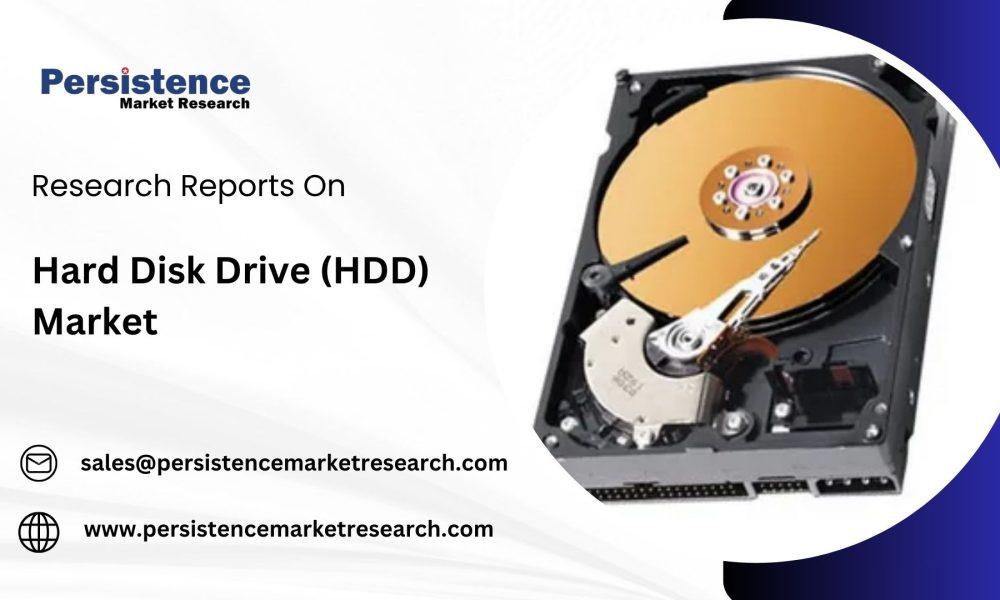
The global Hard Disk Drive (HDD) market is projected to expand steadily, reaching US$ 63.7 billion in 2032 from US$ 41.7 billion in 2025, registering a compound annual growth rate (CAGR) of 6.3% during the forecast period between 2025 and 2032. Despite an industry-wide tilt toward flash-based storage technologies such as Solid-State Drives (SSDs), HDDs continue to maintain relevance—especially in hyperscale and enterprise environments.
The continued demand is driven by large-scale data storage needs in cloud infrastructure, data centers, and enterprise applications. These use cases demand high-capacity, cost-effective solutions—an area where HDDs continue to outperform SSDs in terms of price per gigabyte. Recent industry updates from leaders such as Seagate and Western Digital highlight this resilience, underscoring how enterprise-grade HDDs remain a cornerstone of digital storage infrastructure.
HDDs in a Shifting Storage Landscape
The broader storage ecosystem has been experiencing a fundamental transition in recent years. With SSDs offering faster read/write speeds, energy efficiency, and compact form factors, consumer preference has increasingly leaned toward solid-state solutions. However, the HDD sector has strategically repositioned itself.
Why HDDs Still Matter:
- Cost Efficiency for High-Capacity Needs
- HDDs remain significantly more cost-effective than SSDs when it comes to storing petabytes of data.
- Enterprises prioritizing bulk storage capacity still view HDDs as the optimal solution.
- Scalability in Data Centers
- Hyperscale operators rely on nearline HDDs to balance performance with cost efficiency.
- HDDs allow data centers to scale up while controlling operational expenses.
- Technological Innovation in HDDs
- Introduction of energy-assisted recording technologies (such as HAMR and MAMR) has extended HDD relevance.
- Manufacturers are delivering drives with 20TB+ capacity, addressing the exponential growth of data.
This strategic pivot has ensured that HDDs are not obsolete but rather specialized and enterprise-driven in today’s market.
Elevate your business strategy with comprehensive market data. Request a sample report now: https://www.persistencemarketresearch.com/samples/35308
Key Industry Developments
- Seagate’s Enterprise-Driven Performance
In calendar Q2 2024, Seagate reported HDD revenue of US$ 1.727 billion, with Mass Capacity HDDs contributing 83% of total revenue. Notably, 79% of Seagate’s HDDs were shipped directly to OEMs, reflecting strong traction in the B2B space. These figures confirm Seagate’s pivot toward enterprise-grade and hyperscale deployments rather than consumer markets.
- Western Digital’s Growth Momentum
Western Digital reported a 12% quarter-over-quarter increase in total HDD exabyte shipments, highlighting robust enterprise adoption. Out of this, 125 exabytes (EB) were attributed to nearline storage alone, demonstrating the growing importance of HDDs in supporting cloud and data center workloads.
Together, these industry updates show that while consumer HDD shipments decline, enterprise adoption remains strong, ensuring a steady trajectory for the HDD market over the coming decade.
Market Growth Drivers
Several underlying factors are fueling the HDD market’s resilience and growth potential:
- Exponential Data Growth
- The world generates over 120 zettabytes of data annually, and this figure continues to rise.
- Big data analytics, IoT, 5G, AI, and video streaming are primary contributors to this surge.
- HDDs serve as a cost-efficient medium for long-term and large-scale data storage.
- Cloud Infrastructure Expansion
- Global hyperscale operators like Amazon AWS, Microsoft Azure, and Google Cloud rely heavily on HDDs for scalable storage.
- Nearline HDDs play a critical role in managing massive storage pools for cloud-native applications.
- Enterprise Digital Transformation
- Industries including healthcare, finance, and retail are digitizing operations.
- Enterprise HDDs provide secure, bulk storage for critical applications such as medical imaging, transaction records, and customer data archives.
- Archival and Backup Demand
- HDDs remain the preferred choice for archival storage due to their cost-effectiveness and reliability.
- Enterprises favor HDD-based solutions for cold storage and backup needs.
- Technological Innovation
- Helium-filled drives reduce friction and power consumption while allowing higher storage densities.
- Energy-assisted magnetic recording technologies (HAMR and MAMR) are extending the lifespan and capacity of HDDs.
Market Challenges
The HDD market also faces significant challenges that may temper its growth trajectory:
- Consumer Shift to SSDs
- For laptops, PCs, and gaming devices, SSDs dominate due to their speed and durability.
- HDDs have largely ceded this space, impacting consumer-driven revenue streams.
- Competition from Flash Storage in Enterprises
- Enterprises are increasingly adopting all-flash arrays for performance-intensive workloads.
- Hybrid storage solutions are reducing reliance on HDDs for certain applications.
- Energy and Sustainability Concerns
- HDDs consume more power compared to SSDs, raising questions in energy-sensitive data centers.
- The push for green data centers may require HDD makers to innovate on efficiency.
- Pricing Volatility
- Market pricing of HDDs can fluctuate due to supply chain challenges and raw material costs, affecting adoption cycles.
Segmentation Analysis
The HDD market can be segmented across multiple categories to better understand its dynamics:
By Drive Type
- Desktop HDDs – Declining due to SSD adoption.
- Mobile HDDs – Nearly obsolete in consumer markets.
- Enterprise HDDs – Growing steadily; backbone of hyperscale environments.
- Nearline HDDs – Critical for cloud storage and bulk enterprise data.
By Capacity
- <1TB HDDs – Declining sharply.
- 1–6TB HDDs – Still used in consumer and small business applications.
- >10TB HDDs – Strong growth segment for hyperscale and enterprise storage.
By Application
- Consumer Electronics – Shrinking share due to SSD adoption.
- Data Centers – Largest growth driver.
- Enterprises – Increasing demand for backup, archival, and transactional data storage.
Regional Insights
- North America
- Home to major cloud providers (AWS, Azure, Google Cloud).
- High concentration of data centers drives HDD adoption.
- Europe
- Strong adoption in enterprise IT, financial services, and government sectors.
- GDPR regulations necessitate large-scale, secure data storage.
- Asia-Pacific
- Fastest-growing market, led by China, India, and Southeast Asia.
- Rapid digitization, smartphone penetration, and e-commerce growth fuel demand.
- Latin America
- Emerging growth, particularly in Brazil and Mexico.
- Data center expansion projects driving adoption.
- Middle East & Africa
- Increasing cloud adoption and government digitization projects.
- Investments in local data centers boosting HDD demand.
Competitive Landscape
The HDD market is dominated by a few major players, each competing on capacity, cost efficiency, and enterprise partnerships:
- Seagate Technology – Leader in mass-capacity drives and enterprise solutions.
- Western Digital – Strong enterprise positioning with innovations in nearline HDDs.
- Toshiba – Smaller market share but focusing on enterprise-class HDDs.
These players are heavily investing in R&D for next-gen HDD technologies, ensuring the medium remains competitive against flash-based alternatives.
Future Opportunities
The HDD market is likely to evolve further, with several opportunities on the horizon:
- Integration with Cloud-First Strategies
- As enterprises move workloads to the cloud, demand for high-density nearline HDDs will rise.
- Sustainability-Driven Innovation
- Development of energy-efficient HDDs could mitigate environmental concerns.
- Hybrid Storage Solutions
- HDDs paired with SSDs in hybrid arrays can deliver both cost savings and performance.
- AI and Big Data Analytics
- Growth in AI-driven analytics requires bulk storage, making HDDs a crucial enabler.
- Emerging Markets
- Expansion of digital infrastructure in Asia, Africa, and Latin America will fuel demand for affordable storage.
Conclusion
While consumer preference continues to drift toward SSDs, the global HDD market proves resilient, adapting to its core strengths in enterprise, hyperscale, and archival storage. With the market projected to grow from US$ 41.7 billion in 2025 to US$ 63.7 billion by 2032, HDDs remain vital to managing the world’s ever-expanding data footprint.
The future of HDDs lies in innovation, enterprise focus, and cost-efficient scalability. Far from being phased out, HDDs are being redefined as essential infrastructure for the cloud-driven, data-heavy digital economy.
Related Reports:




