
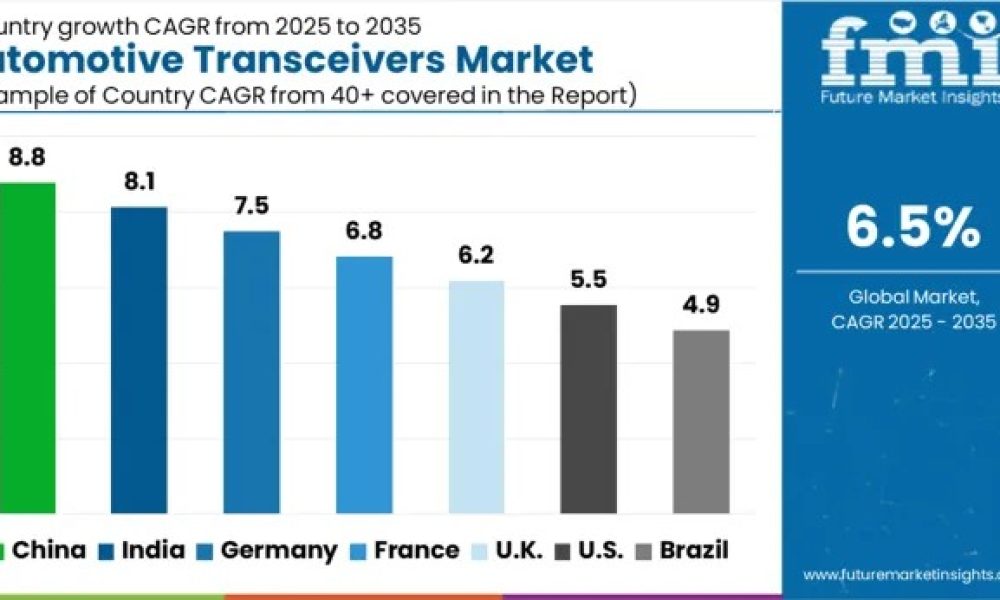
The global automotive transceivers market is entering a decisive growth phase as vehicles rapidly evolve into software-driven, data-intensive mobility platforms. In 2025, the market is valued at USD 7.4 billion and is projected to reach USD 14.0 billion by 2035, expanding at a compound annual growth rate (CAGR) of 6.5%. This growth represents a value multiplication of approximately 1.89x over the forecast period, underscoring the strategic importance of in-vehicle communication technologies in next-generation automotive architectures.
Market behavior analysis indicates a clear S-curve trajectory, reflecting a transition from early adoption to accelerated penetration and, ultimately, market maturation. Between 2025 and 2028, adoption remains steady but moderate, driven primarily by the integration of transceivers into advanced driver-assistance systems (ADAS), infotainment networks, and safety-critical electronics in premium and mid-range vehicles. During this phase, automotive OEMs increasingly prioritize reliable, low-latency communication to support growing electronic complexity.
From 2028 to 2032, the market enters a rapid expansion phase as transceivers are deployed across a broader spectrum of vehicles, including electric and hybrid models. Advances in high-data-rate transceivers, enhanced electromagnetic compatibility, and low-power designs significantly improve network performance and system reliability. At the same time, the expansion of connected vehicle ecosystems, vehicle-to-everything (V2X) communication, and smart mobility platforms accelerates demand across both passenger and commercial vehicle segments.
By 2032 to 2035, the market curve begins to stabilize as advanced transceiver integration becomes standard across most new vehicles. Incremental growth during this period is increasingly driven by system upgrades, retrofits, and higher-value communication features, reflecting a shift from penetration-led growth to value-led expansion. This progression highlights the long-term resilience of the automotive transceivers market, supported by continuous innovation and evolving vehicle architectures.
Market Structure Anchored by OEM and Semiconductor Demand
Automotive OEMs represent the largest upstream contributor, accounting for approximately 39% of total market demand, as transceivers form the backbone of in-vehicle communication networks supporting safety, infotainment, diagnostics, and autonomous functions. Semiconductor and chipset manufacturers contribute around 27%, supplying CAN, LIN, FlexRay, and Ethernet transceiver ICs that enable reliable data exchange between electronic control units (ECUs).
Electronic component suppliers account for roughly 16%, delivering connectors, cables, and interface modules, while software and system integrators represent about 11%, focusing on communication protocols, diagnostics, and control systems. The remaining 7% is attributed to aftermarket and service providers supporting vehicle retrofits, upgrades, and long-term maintenance.
Notably, automotive Ethernet transceivers now account for more than 35% of new implementations, reflecting the industry’s shift toward high-speed, data-intensive applications. CAN and LIN protocols remain dominant in body and powertrain networks, with a combined adoption of approximately 55% in 2024, highlighting their continued relevance due to cost efficiency, robustness, and scalability.
Get access to comprehensive data tables and detailed market insights — request your sample report today!
https://www.futuremarketinsights.com/reports/sample/rep-gb-25602
CAN Protocol and Body Electronics Lead Segment Adoption
By protocol, Controller Area Network (CAN) remains the leading segment, accounting for 38.6% of market revenue in 2025. CAN’s deterministic communication, proven reliability, and standardized architecture make it indispensable for powertrain control, safety systems, and diagnostics. The introduction of CAN FD (Flexible Data-rate) has further strengthened its position by enabling higher throughput without sacrificing cost advantages, ensuring sustained relevance even as higher-bandwidth protocols emerge.
From an application perspective, body electronics dominate the market, representing 42.8% of total revenue in 2025. Rising deployment of electronic systems such as lighting control, climate management, central locking, and seat adjustment continues to drive demand. Increasing consumer expectations for comfort, personalization, and safety—combined with regulatory requirements for automated lighting and sensor-based assistance—are reinforcing the importance of transceivers in body electronics across both mass-market and premium vehicles.
Electrification, ADAS, and Connectivity Drive Growth Momentum
The accelerating shift toward connected, electric, and autonomous vehicles is a primary catalyst for market expansion. Connected vehicles already account for nearly 45% of transceiver deployments, while autonomous driving applications are expected to increase adoption by more than 10% annually. Electric vehicles, in particular, rely heavily on high-speed, low-latency communication for battery management systems, power electronics, and real-time diagnostics.
Technological improvements are delivering tangible performance gains. Enhanced electromagnetic compatibility has reduced communication errors by 10–12%, while energy-efficient transceiver designs are lowering power consumption by 5–7% per vehicle network. These improvements are critical as vehicles incorporate a growing number of ECUs and sensor nodes.
Regional Growth Patterns Highlight Asia-Pacific Momentum
Geographically, Asia-Pacific is emerging as the fastest-growing region, accounting for approximately 40% of global demand. China leads with a projected 8.8% CAGR, driven by rapid adoption of electric vehicles, smart mobility initiatives, and strong domestic automotive production. India follows closely at 8.1% CAGR, supported by rising vehicle sales, expanding EV penetration, and increased localization of automotive electronics manufacturing.
In Europe, Germany stands out with a 7.5% CAGR, reflecting its leadership in premium automotive engineering, ADAS integration, and electric vehicle development. France and the UK show stable growth as regulatory pressure and urban mobility initiatives drive selective adoption. The United States, while growing at a more moderate 5.5% CAGR, continues to benefit from investments in EVs, telematics, and autonomous vehicle trials.
Drive Your Business Growth Strategy: Checkout the Report for Key Insights
https://www.futuremarketinsights.com/checkout/25602
Competitive Landscape Defined by Innovation and Integration
The automotive transceivers market is characterized by intense competition among global semiconductor leaders. Infineon Technologies AG, NXP Semiconductors, Texas Instruments, STMicroelectronics, and Renesas Electronics Corporation maintain strong positions through broad portfolios of automotive-grade transceivers optimized for safety, reliability, and power efficiency. Companies such as Analog Devices, Microchip Technology, and Broadcom are strengthening their presence with high-speed solutions tailored for next-generation vehicle architectures and electric mobility platforms.
Outlook
As vehicles continue their transformation into intelligent, connected systems, automotive transceivers are becoming mission-critical components rather than supporting hardware. The convergence of electrification, connectivity, and software-defined vehicle architectures positions the market for sustained, technology-led growth through 2035. Detailed insights into protocol evolution, regional opportunities, and competitive strategies further underscore the strategic value embedded within the full market analysis.
Why Choose FMI: Empowering Decisions that Drive Real-World Outcomes: https://www.futuremarketinsights.com/why-fmi
About Future Market Insights (FMI)
Future Market Insights, Inc. (FMI) is an ESOMAR-certified, ISO 9001:2015 market research and consulting organization, trusted by Fortune 500 clients and global enterprises. With operations in the U.S., UK, India, and Dubai, FMI provides data-backed insights and strategic intelligence across 30+ industries and 1200 markets worldwide.



