
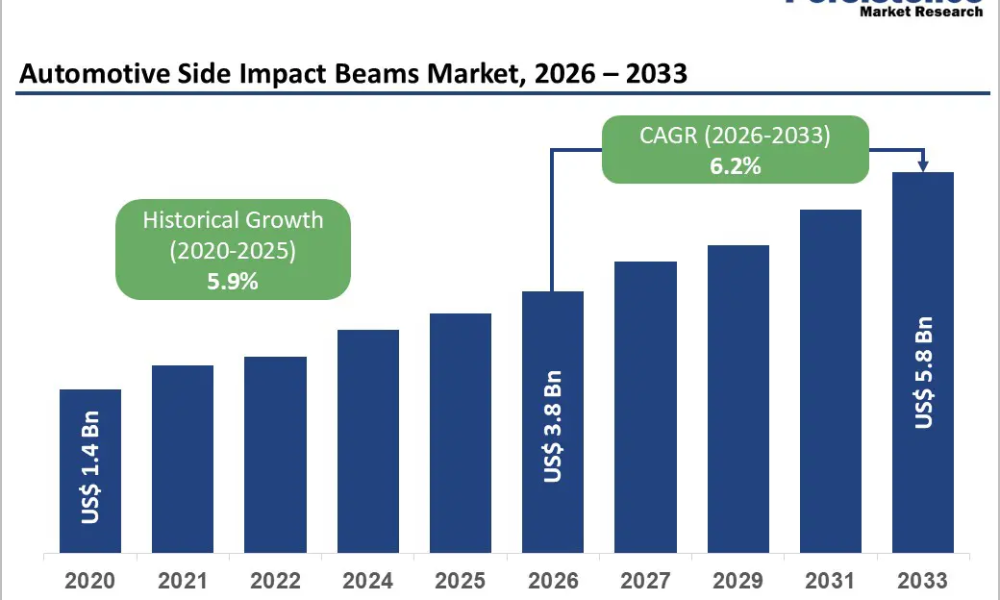
The global automotive side impact beams market is experiencing significant growth, driven by the increasing focus on vehicle safety and the evolving needs of the automotive industry. Side impact beams, which are essential components in vehicle doors and provide structural reinforcement during side collisions, are becoming more critical as safety regulations tighten worldwide. The market’s growth is also influenced by the rising production of electric vehicles (EVs), which require specialized reinforcement structures to protect their floor-mounted battery packs. According to Persistence Market Research, the global automotive side impact beams market is expected to be valued at US$ 3.8 billion by 2026, growing at a compound annual growth rate (CAGR) of 6.2%, and is projected to reach US$ 5.8 billion by 2033.
Several key factors are contributing to the growth of the automotive side impact beams market. Increasing vehicular safety mandates, such as side-impact crash tests and regulations related to crash safety, are driving automakers to enhance vehicle structure and design. Additionally, the growing shift towards lightweighting to meet carbon emission reduction goals is pushing the development of advanced materials and designs for side impact beams. With the rise of electric vehicles, manufacturers are investing in innovative solutions to ensure these vehicles meet the required safety standards while maintaining battery protection.
Get Your FREE Sample Report Instantly Click Now: https://www.persistencemarketresearch.com/samples/25735
The key players studied in the report include:
- BENTELER Automotive
- Kirchhoff Automotive
- Gestamp Automocion
- Magna International
- Tower International
- Aisin Takaoka
- Sango Co.
- Tata Autocomp Systems
- Motherson Sumi Systems
- Endurance Technologies
- Minth Group
- Yanfeng Automotive Interiors
- GNS America
- H-One Co. Ltd
- Flex-N-Gate (U.S.)
- Hwashin
- MARELLI
Key Highlights from the Report
➤ The global automotive side impact beams market is expected to grow at a CAGR of 6.2% from 2026 to 2033.
➤ The market is projected to reach US$ 5.8 billion by 2033, up from US$ 3.8 billion in 2026.
➤ Increasing vehicular safety mandates and the rising production of electric vehicles are the primary growth drivers.
➤ The shift towards lightweighting is accelerating the adoption of advanced materials for side impact beams.
➤ The EV segment is expected to demand more specialized side impact beams to protect battery packs.
➤ North America and Europe are the leading regions for the automotive side impact beams market due to stringent safety regulations and a high volume of vehicle production.
Market Segmentation
By Vehicle Type
- Passenger Car
- Commercial Vehicle
- Electric Vehicle
By Material Type
- Steel
- Aluminum
By Sales Channel
- OEM
- Aftermarket
By Application
- Front Door
- Rear Door
By Region
- North America
- Europe
- East Asia
- South Asia & Oceania
- Latin America
- Middle East & Africa
Customize This Report for Your Exact Requirements: https://www.persistencemarketresearch.com/request-customization/25735
Regional Insights
The automotive side impact beams market is experiencing strong growth in North America and Europe, regions that are home to stringent safety regulations and high vehicle production volumes. In these markets, vehicle manufacturers are focusing on developing advanced safety features to meet regulations such as the European NCAP and the U.S. NHTSA crash safety standards. The demand for side impact beams in these regions is driven by both OEM production and aftermarket replacement.
In the Asia-Pacific region, countries such as China, Japan, and India are witnessing rapid growth in the automotive sector, contributing to an increase in demand for side impact beams. The rise of electric vehicles in this region, particularly in China, is also expected to drive market growth, as automakers look for innovative solutions to improve safety standards and protect battery systems in EVs.
Market Drivers
The primary driver of the automotive side impact beams market is the increasing stringency of global vehicular safety mandates. Regulatory bodies across regions are setting higher standards for crash safety, particularly in side-impact collisions. The introduction of side-impact crash tests and new safety standards has led to the need for enhanced structural reinforcement in vehicles, driving demand for side impact beams. As automakers strive to meet these requirements, they are investing in research and development to design and manufacture more effective side impact beams.
Another significant driver is the growing production and adoption of electric vehicles. As the EV market expands, the demand for specialized structural components, including side impact beams, increases. EVs, which often feature floor-mounted battery packs, require additional reinforcement to protect these batteries in the event of a side collision. This trend is particularly relevant in regions like Europe and North America, where EV adoption is growing rapidly.
Market Restraints
Despite the positive outlook, the automotive side impact beams market faces a few challenges. One of the main restraints is the cost associated with the development and production of advanced lightweight materials, such as composites and aluminum. While these materials offer significant benefits in terms of weight reduction and safety, their higher cost can limit their widespread adoption, particularly in cost-sensitive vehicle segments.
Additionally, the complexity of designing side impact beams that can provide optimal protection while maintaining lightweight and cost-effective characteristics presents challenges. Manufacturers must balance safety requirements, material costs, and vehicle design constraints, which can slow the adoption of more advanced solutions, especially in mid- and low-cost vehicle segments.
Market Opportunities
The growing shift toward lightweight materials presents significant opportunities in the automotive side impact beams market. As automakers strive to meet carbon emission reduction targets and improve fuel efficiency, there is increasing interest in using lightweight materials such as aluminum, plastics, and composites. These materials offer the potential to reduce vehicle weight without sacrificing strength or safety, presenting a major opportunity for manufacturers of side impact beams to innovate and capture market share.
Another opportunity lies in the rising production of electric vehicles. As the adoption of EVs increases, manufacturers are looking for ways to ensure that these vehicles meet the required safety standards while maintaining structural integrity. This creates a growing demand for specialized side impact beams that can provide enhanced protection for EV battery packs. As the market for electric vehicles continues to expand, so too will the need for innovative solutions to protect these high-value components.
Frequently Asked Questions
➤ What are the main factors influencing the Automotive Side Impact Beams Market between 2025 and 2032?
➤ Which companies are the major sources in the Automotive Side Impact Beams Market?
➤ What are the market’s opportunities, risks, and general structure?
➤ Which of the top Automotive Side Impact Beams Market companies compare in terms of sales, revenue, and prices?
➤ How are market types and applications explored in terms of deals, revenue, and value?
Ready to Dive Deep? Buy Full Report Today: https://www.persistencemarketresearch.com/checkout/25735
Recent Developments:
- February 2023: Magna International announced the launch of a new lightweight side impact beam designed to improve crash safety in electric vehicles.
- January 2023: BASF SE introduced an advanced composite material for side impact beams, offering enhanced strength while reducing weight.
Future Opportunities and Growth Prospects
The automotive side impact beams market is set for steady growth over the next decade. With the rise of electric vehicles, the increasing focus on lightweighting, and the tightening of safety regulations, there are significant opportunities for manufacturers to innovate and expand their product offerings. The demand for specialized side impact beams for EVs will continue to rise, while advancements in lightweight materials and manufacturing technologies will help drive down costs and improve safety. As vehicle safety standards continue to evolve, the automotive side impact beams market will play a crucial role in ensuring the structural integrity and safety of modern vehicles.




