
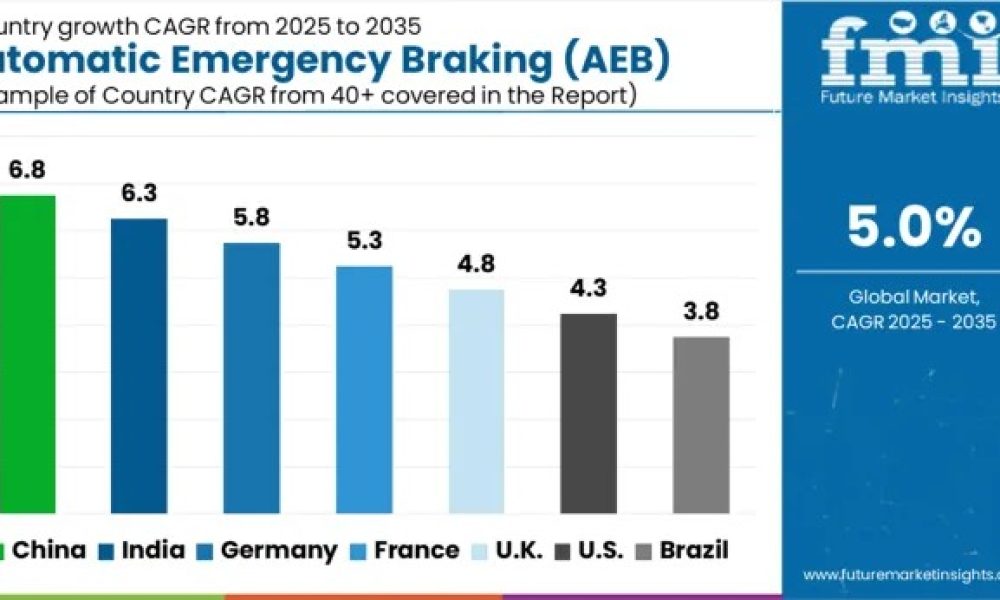
The global automatic emergency braking (AEB) market is projected to expand from an estimated USD 70.1 billion in 2025 to USD 114.2 billion by 2035, registering a CAGR of 5.0%. This steady growth reflects widespread adoption across passenger cars, commercial vehicles, and electric vehicles, driven by rising safety regulations, fleet modernization, and increasing consumer awareness of collision mitigation technologies.
Regulatory frameworks in North America, Europe, and Asia are compelling automakers to incorporate AEB as standard or optional safety equipment, while safety ratings from organizations such as Euro NCAP, IIHS, and NHTSA further encourage adoption. Fleet operators, logistics providers, and ride-sharing companies are specifying AEB-equipped vehicles to minimize accident-related costs and liability exposure. Additionally, aftermarket and retrofit solutions are creating incremental revenue opportunities, enabling older vehicles to benefit from advanced collision avoidance technologies.
Market Dynamics and Key Drivers
- Passenger Vehicles Lead Demand: Passenger cars account for 40% of the AEB market, driven by OEM integration for safety compliance and enhanced crash-test ratings.
- Commercial Vehicles and Fleet Modernization: Commercial fleets contribute 25%, with operators prioritizing collision mitigation, liability reduction, and insurance benefits.
- Electric Vehicles & ADAS Integration: EVs hold a 15% share, as automakers bundle AEB within advanced driver-assistance systems (ADAS) to enhance safety and differentiate models.
- Urban Safety Focus: Low-speed AEB systems, which represent 39.4% of market revenue in 2025, are increasingly adopted for urban driving, pedestrian, and cyclist protection.
- Radar-Based Technology Dominates: Radar-based AEB systems lead the market with 41.8% revenue share in 2025 due to reliable object detection under varied conditions and cost efficiency for mass-market vehicles.
- Disc Brakes for Performance: Disc brakes account for 66.5% of AEB system installations, providing superior stopping power, consistent performance, and compatibility with advanced emergency braking systems.
Regional Growth Highlights
- China: CAGR of 6.8%, led by government mandates, fleet modernization, and integration of radar, lidar, and camera systems.
- India: CAGR of 6.3%, driven by road safety regulations, fleet expansion, and retrofitting opportunities.
- Europe: Germany (5.8%) and France (5.3%) are witnessing steady growth via regulatory compliance, digital AEB platforms, and fleet adoption.
- North America: US CAGR of 4.3%, supported by federal safety standards, fleet electrification, and insurance incentives.
Get access to comprehensive data tables and detailed market insights — request your sample report today!
Why is the Automotive Communication Protocol Market Growing?
The automotive communication protocol market is expanding in line with the increasing integration of electronic systems and software-driven functions in modern vehicles. Industry publications and OEM technology updates have emphasized the growing complexity of in-vehicle networks, which require reliable, high-speed, and secure communication frameworks to support advanced driver assistance systems (ADAS), infotainment, and powertrain control.
The transition toward connected and autonomous vehicles has accelerated demand for robust communication protocols that can handle large data volumes with minimal latency. Additionally, regulatory requirements for safety and emissions compliance have encouraged automakers to adopt standardized communication systems to streamline diagnostics and performance monitoring.
Collaborative development between automakers, semiconductor suppliers, and software developers has led to advancements in protocol efficiency, scalability, and cybersecurity. Over the coming years, growth is expected to be fueled by higher adoption of established protocols like CAN for cost-sensitive applications, increased deployment in passenger vehicles, and expanding infotainment system functionalities driven by consumer demand for connectivity and personalization.
Competitive Landscape
The AEB market is highly competitive, dominated by a mix of established OEM suppliers and emerging technology innovators. Leading players include Aisin Seiki Co., Ltd., Aptiv PLC, Autoliv Inc., BorgWarner Inc., Continental AG, Denso Corporation, Hella KGaA Hueck & Co., Mobileye (Intel), Nvidia Corporation, Tesla, and ZF Friedrichshafen AG. Companies differentiate through sensor accuracy, system reliability, software integration with ADAS, and advanced features like pedestrian detection, cyclist recognition, and emergency lane-keeping.
Outlook
The global AEB market is set for sustained expansion as regulatory mandates, consumer safety awareness, fleet modernization, and urban mobility challenges converge. With technological innovation and increased affordability, AEB is poised to become a standard safety feature across vehicles worldwide, reinforcing collision prevention and advancing autonomous driving readiness.
About Future Market Insights (FMI)
Future Market Insights, Inc. (FMI) is an ESOMAR-certified, ISO 9001:2015 market research and consulting organization, trusted by Fortune 500 clients and global enterprises. With operations in the U.S., UK, India, and Dubai, FMI provides data-backed insights and strategic intelligence across 30+ industries and 1200 markets worldwide.



