Market Overview and Dynamics
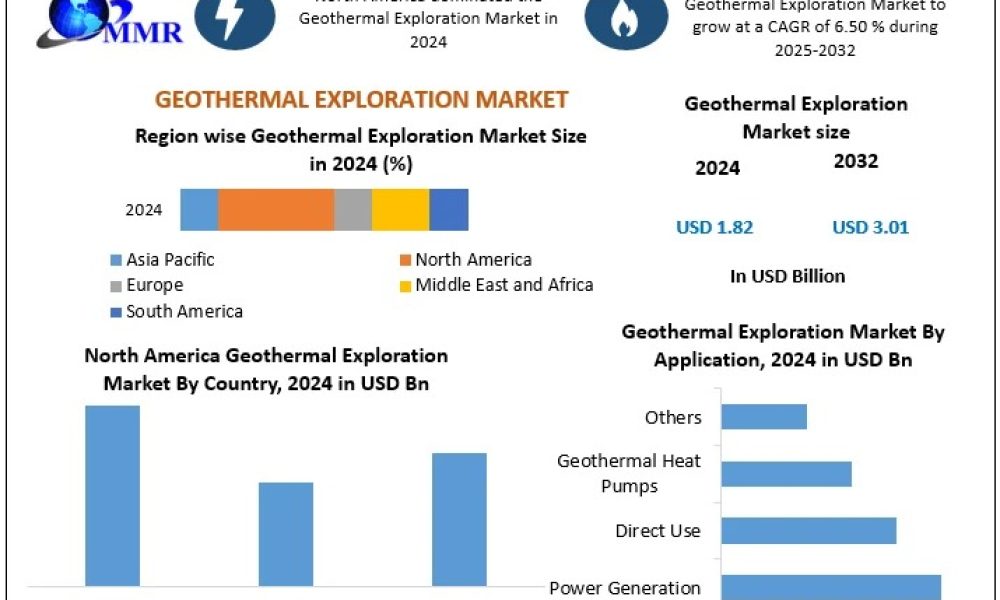
Geothermal Exploration Market is valued at USD 1.82 billion in 2024 and is expected to grow at a CAGR of 6.5%, reaching USD 3.01 billion by 2032. Geothermal exploration involves identifying and analyzing subsurface regions rich in geothermal resources, primarily for electricity generation and direct-use heating. Its growth is being fueled by the worldwide demand for renewable energy, carbon reduction policies, and technological advancements, with North America leading due to its strong infrastructure, investment, and supportive regulations.
- Geothermal exploration is central to harnessing subsurface heat for power generation, using disciplines like geochemistry, geophysics, geology, and engineering. As of 2024, geothermal power is active in just 32 countries, with an installed base of 16,318 MW across 198 geothermal fields and 673 power units—most of them flash or binary ORC systems. North America, particularly the United States, boasts the largest geothermal installed capacity and a robust pipeline of developing projects due to innovation, government support, and investments from both public and private sectors.
Several factors are driving geothermal exploration:
Global Clean Energy Push: Climate change concerns and net-zero commitments are spurring investments in low-carbon and renewable energy. Geothermal is attractive for its baseload power supply capabilities, low emissions, and land footprint.
Technological Innovation: Engineered Geothermal Systems (EGS) and advanced geophysical survey techniques (magnetotellurics, seismic imaging, resistivity mapping) are expanding the economic viability of geothermal energy even outside traditional high-enthalpy volcanic zones.
Rising Investments: The number of geothermal wells drilled globally is increasing, especially in North America, as traditional oil and gas companies diversify into geothermal, further accelerating technology transfer and market growth.
Segment Analysis
By Technique
Geophysical Techniques: Hold the largest market share (projected CAGR 6.51%), thanks to their pivotal role in accurately mapping subsurface structures, identifying heat reservoirs, and lowering exploration risk. Advancements in 3D modeling, imaging tools, and machine learning have made exploration more cost-effective and reliable.
Other Techniques: Geochemical analysis, borehole drilling for reservoir confirmation, and remote sensing for large-scale site screening remain vital.
By Application
Power Generation: Dominates market share, with geothermal systems primarily used to drive turbines and generate electricity in countries with high geothermal potential.
Direct Use and Geothermal Heat Pumps: Used for district heating, greenhouse agriculture, and industrial processes, especially in Europe and increasingly in urban areas worldwide as decarbonization of heating accelerates.
Regional Insights
North America: Holds the largest share (~32.8% in 2024), driven by robust economies, mature geothermal sectors, supportive regulations, and cutting-edge research. The U.S. leads in installed capacity and project pipeline, with record numbers of wells drilled and significant new developments underway.
Europe: Expected to see significant growth, especially in district heating. Countries like Iceland, Turkey, and Italy host large high-enthalpy resources; Germany, France, and Denmark focus on medium-to-low enthalpy direct-use applications. The EU’s green energy mandates and policy frameworks are rapidly advancing regional deployment.
Asia Pacific: Holds major producers like Indonesia, the Philippines, and New Zealand. Indonesia, with its 28.5 GW potential, is second only to the U.S. in installed capacity. Recent policy incentives and risk-mitigation programs are unlocking further development, while China accelerates investment in both conventional and EGS projects.
Other Regions: Kenya and other African countries are emerging geothermal leaders, with Kenya’s geothermally generated electricity already contributing over 30% to its national grid. South America is expanding in Chile, Costa Rica, and Nicaragua.
For full access to the data, request a sample report now :https://www.maximizemarketresearch.com/request-sample/69341/
Market Trends & Opportunities
Engineered Geothermal Systems (EGS): EGS is unlocking new potential by enabling electricity generation in previously uneconomic hot rock regions, expanding geothermal’s geographic reach.
Decarbonization and Electrification: The need for clean district heating and decarbonized power is pushing exploration into new areas, including urban and industrial direct-use applications.
Policy and Financing: Many barriers still exist in early-stage exploration—highest-risk, capital-intensive phase. More targeted support is needed, especially since 90% of public financing still goes to less risky, later-stage development.
Innovation: Big data, remote monitoring, machine learning-driven exploration, and collaborative government–industry–academic models are cutting costs and boosting project success.
Challenges
High Risk and Capital Requirement: Early-stage exploration is costly and risky, with uncertainty in successful well identification and confirmation, leading to hesitance in private investment.
Geographic Limitations: Despite EGS advances, most active projects remain in high-enthalpy regions—typically volcanic arcs—limiting wider global penetration in the near term.
Regulatory and Environmental Concerns: Complex regulations, land-use approvals, and social license can delay projects.
Competitive Landscape
Key players in the geothermal exploration market include SLB, Halliburton, Baker Hughes, Ormat Technologies, Enel Green Power, KenGen, Mitsubishi Power, Fervo Energy, Energy Development Corporation, and others. Companies are increasingly collaborating with start-ups and research institutions to accelerate technology development, improve success rates, and reduce exploration and drilling costs.
Outlook and Conclusion
With a projected CAGR of 6.5% through 2032, the geothermal exploration market’s future is shaped by a transition to clean energy, ongoing technology improvements, and rising investments in both new and emerging regions. North America is projected to remain the leader by market share, followed by strong growth in Europe and Asia Pacific—each fueled by unique policy environments, resource availability, and development incentives. As early-stage risks are reduced and economic barriers fall, geothermal will take an increasingly central role in the global energy transition, providing reliable, renewable, and sustainable power.




