
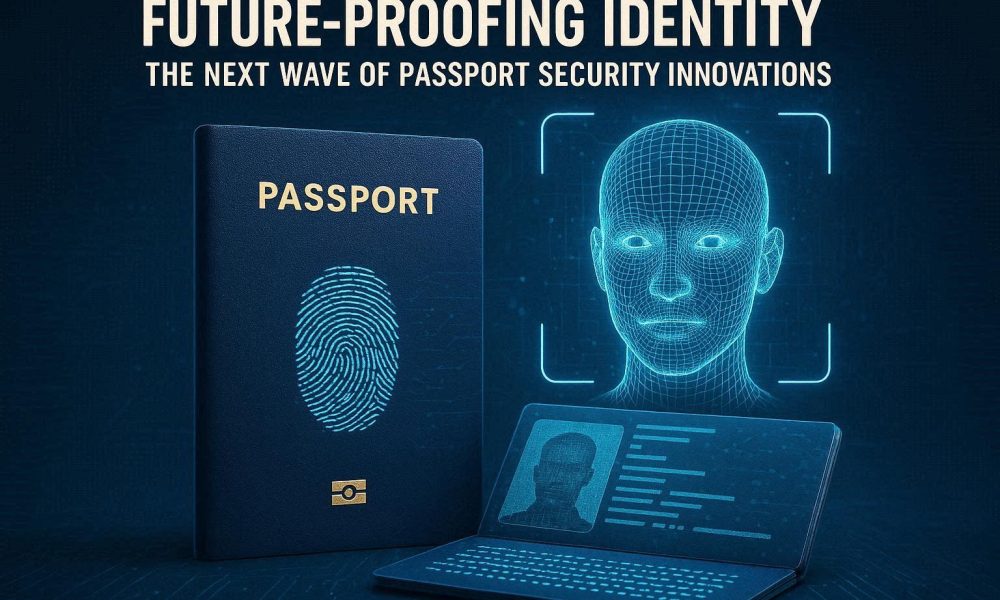
From UV-reactive magnetic fields to AI-driven verification, here is what comes next for the world’s most important document.
WASHINGTON, DC, May 9, 2026.
The passport is being rebuilt for a world where borders read faces, machines authenticate chips, governments exchange digital trust certificates, and travelers expect faster movement without weakening the identity controls that protect national security, financial systems, and lawful mobility.
What once looked like a paper booklet is becoming a layered security platform, combining polycarbonate, lasers, radio-frequency chips, biometric templates, magnetic pigments, ultraviolet reactions, mobile credentials, and artificial intelligence tools that can examine identity faster than any human officer working alone.
The passport is becoming a living security system rather than a static booklet.
For more than a century, passport security depended on visible features that officers could inspect manually, including paper quality, photographs, watermarks, ink stamps, signatures, page numbering, embossed seals, and the trained judgment of border officials under operational pressure.
That model has not disappeared, but it is now surrounded by invisible, machine-readable defenses that allow the document to prove its authenticity through material behavior, encrypted chip data, biometric comparison, public key infrastructure, and database-linked inspection.
The next wave of passport innovation will not be one dramatic replacement technology, because the future will come through dozens of coordinated upgrades that make the passport harder to forge, harder to alter, and harder to misuse with a stolen identity.
This matters because organized fraud networks no longer attack only the finished booklet, since they now target passport applications, civil registry records, breeder documents, courier systems, chip data, facial images, and identity databases that support the document.
Polycarbonate will remain the backbone of the next generation of passports.
The most secure passports of the coming decade will continue moving away from paper-based identity pages and toward polycarbonate data pages, where personal information can be laser-engraved into the material rather than printed on a vulnerable surface.
Polycarbonate matters because it turns the data page into a fused identity object, making name changes, portrait substitution, date alterations, and document-number manipulation far more difficult to carry out without leaving visible damage, optical distortion, or structural evidence of tampering.
The U.S. Department of Homeland Security explains that an e-passport contains an electronic chip with information printed on the data page, which shows how physical document security and electronic identity records now operate together.
Future versions of this technology will likely include more transparent windows, stronger laser-engraved portraits, layered ghost images, tactile data structures, and material features that react differently under ultraviolet, infrared, angled light, and forensic inspection.
UV-reactive magnetic inks could make passport artwork behave like evidence.
The next generation of visible and semi-visible passport artwork will increasingly rely on inks that change appearance under ultraviolet light, shift color when tilted, align under magnetic influence, or reveal hidden patterns when viewed with specialized inspection equipment.
Magnetic pigments can be oriented during printing to create effects that look ordinary to the traveler but behave predictably under light, motion, or magnification, giving officers another way to test whether a feature came from authorized secure production.
When paired with ultraviolet-reactive materials, these inks can create layered images that reveal national symbols, document numbers, hidden portraits, or patterned movement that ordinary scanners and counterfeit printing systems struggle to reproduce accurately.
The most important development is not that the ink looks dramatic, but that it exhibits a controlled physical signature, turning artwork into evidence confirming the passport was manufactured under secure conditions.
Future passports will use light as a defensive language.
Optically variable devices, Kinegram-style structures, color-shifting patches, transparent windows, and laser-generated images already enable passports to respond to movement, but future documents will make those responses more precise, measurable, and machine-verifiable.
A border officer may tilt a passport and see one effect, while an automated reader may examine the same feature with a camera, compare its behavior to a stored template, and decide whether the optical response matches authentic production.
This fusion of human-readable and machine-readable light effects will be important because counterfeiters can sometimes imitate appearance in a static photograph, but struggle to reproduce dynamic optical behavior across multiple angles, wavelengths, and magnification levels.
The passport of the future will therefore communicate through light, with features that reveal different layers depending on whether the viewer is a traveler, an officer, a kiosk, or a forensic laboratory.
AI-driven verification will become the border officer’s second set of eyes.
Artificial intelligence will not replace legal judgment at the border, but it will increasingly help inspection systems detect subtle anomalies that humans may miss during rushed document review, high-volume arrivals, fatigue, or visually convincing fraud attempts.
AI-assisted systems can compare passport templates, inspect portrait quality, evaluate optical features, detect tampering patterns, flag unusual chip behavior, identify document wear that is inconsistent with claimed use, and compare facial images with greater consistency than manual inspection alone.
The strongest use of AI will be as a decision-support layer, where the system highlights suspicious mismatches and officers decide whether the traveler should proceed, answer questions, or be referred to secondary inspection.
This matters because the future fraud environment will involve AI-assisted counterfeit preparation, synthetic identity documents, manipulated facial images, and digitally enhanced scans, meaning border authorities will need machine-speed tools to counter machine-assisted deception.
Facial biometrics will become more precise, but also more scrutinized.
The passport photograph will remain one of the most important security features because it connects the physical traveler to the chip, data page, application record, and live image captured at the border.
Future biometric systems will likely improve cross-age, lighting, facial hair, minor medical changes, and device variations, while also reducing false rejections that can inconvenience legitimate travelers and create operational bottlenecks.
The challenge will be governance, because biometric systems must be tested for accuracy, fairness, transparency, privacy protection, retention limits, and human review when automated comparison produces uncertainty or disagreement.
The face may become the fastest key at the border, but public confidence will depend on whether governments can prove that biometric identity checks are accurate, limited, accountable, and not expanded quietly beyond their stated purpose.
The passport chip will become harder to clone and easier to verify.
E-passport chips already store identity data and allow border systems to compare the electronic record with the printed page, but future chips will likely include stronger authentication, improved tamper resistance, and better integration with digital travel credentials.
The key challenge is not merely storing information, because the chip must prove that its data was signed by the issuing government, has not been altered, belongs to the physical document, and corresponds to the person presenting it.
Public key infrastructure will remain central to this process because it lets border systems verify that chip data was signed by a legitimate issuing authority, creating trust that can travel internationally without exposing government signing secrets.
As more automated gates rely on chip validation, countries that fail to maintain strong certificate exchange, software updates, inspection rules, and cryptographic verification could weaken the security value of even technically advanced passports.
Digital Travel Credentials will push passport data onto smartphones.
The most visible identity innovation for travelers may be the rise of Digital Travel Credentials, which allow a secure digital representation of passport data to be stored on a phone and shared before the traveler reaches the border.
These credentials are not ordinary passport photos saved in a camera roll, because a true digital credential must be cryptographically linked to the issuing authority, protected on the device, and capable of supporting trusted identity verification.
Reuters has reported on Europe’s shift toward biometric border records and digital modernization, with the EU’s Entry/Exit System rollout showing how physical stamping is being replaced by electronic identity events.
The smartphone will not immediately kill the passport, but it will increasingly serve as the interface through which travelers submit information, confirm identity, board aircraft, and interact with border systems before the physical booklet is opened.
Future passports will need to work with mobile wallets without losing legal authority.
A digital credential may make travel faster, but the physical passport will remain the legal root of trust for years because it works without batteries, app stores, internet access, device compatibility, or proprietary technology platforms.
The future will therefore be hybrid, with the booklet serving as the official anchor while the phone carries verified identity data that can be presented earlier, selectively disclosed, and checked before airport bottlenecks form.
This model can help airlines, airports, and border agencies move routine travelers faster, while reserving officer attention for mismatches, watchlist hits, damaged documents, biometric failures, or complicated immigration questions.
The danger is exclusion, because paperless travel systems must preserve alternatives for children, elderly travelers, refugees, privacy-conscious individuals, emergency evacuees, and people without compatible phones or reliable digital access.
AI will also reshape passport issuance before the document is printed.
Future passport security will not be limited to border inspection, because governments will increasingly use AI and data analytics to detect suspicious application patterns before a fraudulent document is ever issued.
Issuance systems may flag repeated use of the same supporting address, unusual clusters of applications, suspicious document scans, inconsistent civil registry data, manipulated images, high-risk intermediaries, or identity patterns associated with organized fraud.
This upstream defense is essential because the hardest fraud to detect is often the use of a genuine passport obtained under a false identity, since the finished document may have a valid chip, an authentic data page, and a properly signed electronic record.
The strongest passport system will therefore protect the entire identity chain, including application submission, document verification, biometric enrollment, staff access, personalization, delivery, revocation, and border inspection.
Privacy-preserving verification will become a competitive passport feature.
As passports become more digital, countries will face pressure to prove that they can verify identity without overexposing personal data, especially as travelers become more aware of biometric retention, data sharing, and surveillance risks.
Future systems may use selective disclosure, device-bound credentials, tokenized identity proof, stronger encryption, and privacy-preserving checks that confirm eligibility without revealing every detail contained on the passport data page.
This approach could allow a traveler to prove age, nationality category, document validity, or boarding eligibility without repeatedly handing over full passport scans to airlines, hotels, event operators, and third-party platforms.
The privacy competition will matter because citizens may eventually judge passports not only by visa-free access and physical security, but also by how responsibly governments protect digital identity data after issuance.
Sustainability will enter the passport-security conversation.
Passport manufacturing involves secure paper, plastic, chips, covers, inks, foils, shipping, waste destruction, and specialized production, which means governments will increasingly face pressure to modernize security while reducing environmental impact.
Future innovation may include longer-lasting passports, lower-impact materials, improved recycling of defective components, more efficient personalization processes, and digital services that reduce unnecessary renewals or in-person administrative journeys.
Security will remain the priority because passports are national documents, but sustainability will become harder to ignore as governments issue millions of booklets and citizens expect public systems to modernize responsibly.
The most credible future passport will be durable, secure, privacy-conscious, and environmentally aware, because a document designed for the next decade must respond to more than counterfeiting alone.
The future border will compare documents, faces, phones, and travel histories together.
Modern border control is moving toward layered verification, where the passport chip proves data integrity, the face proves personal continuity, the phone carries a digital credential, and the database confirms entry history, visas, alerts, and prior encounters.
This integrated model can make travel faster for low-risk passengers, but it can also create more immediate consequences when a name mismatch, an overstayed record, an expired document, a damaged chip, or an inconsistent identity trail is detected.
For travelers, the practical lesson is that documents must remain accurate across systems, because future border crossings will increasingly compare records automatically rather than relying solely on a single officer reading a single booklet.
The passport is becoming part of a wider identity web, and the traveler’s ability to move smoothly will depend on whether every record in that web tells the same story.
Lawful mobility planning must now account for next-generation verification.
For executives, expatriates, politically exposed individuals, high-net-worth families, and clients seeking lawful second citizenship or contingency planning, the next wave of passport security makes the integrity of documentation more important than ever.
A passport must do more than look valid; it must be electronically readable, cryptographically validated, match biometric records, align with tax documentation, support banking compliance, and withstand scrutiny from governments and financial institutions.
Professional advisory firms such as Amicus International Consulting monitor these developments because passport security, lawful identity restructuring, second citizenship, privacy planning, and cross-border financial access are becoming increasingly connected.
The future client question will not be whether a document can be obtained, but whether the entire identity profile can survive machine-readable verification, biometric comparison, due diligence review, and long-term legal use.
Second passport strategies will need stronger compliance foundations.
A lawful second passport can remain a powerful tool for mobility, access to banking, family relocation, political risk mitigation, and emergency planning, but it must be obtained through government-authorized channels and supported by coherent records.
As border systems become more automated, any inconsistency between passport data, biometric history, tax identification, residence claims, banking records, or prior travel activity can create delays, questions, or compliance failures.
This is why second passport advisory services increasingly focus on lawful eligibility, document integrity, identity continuity, tax records, and practical usability across modern border and banking systems.
The next generation of passport technology rewards legitimacy and punishes shortcuts because the document is no longer judged solely by its appearance but by how well it fits within a larger verification architecture.
The world’s most important document is becoming harder to fake and harder to misuse.
The next wave of passport security will combine visible artistry with invisible computation, producing documents that react to ultraviolet light, reveal magnetic ink behavior, authenticate chips, support mobile credentials, and guide AI-assisted inspection.
Those innovations will not end passport fraud entirely, because criminals will continue to target applications, stolen data, corrupt insiders, courier networks, synthetic identities, and weak civil registries before the document is issued.
They will, however, make the finished passport harder to alter, clone, substitute, or use fraudulently without triggering a mismatch somewhere in the inspection chain.
The passport of the future will still fit inside a pocket, but it will carry the logic of a cryptographic credential, the resilience of a secure identity card, the precision of biometric comparison, and the accountability of a government-issued legal record.
Future-proofing identity means accepting that the passport is no longer just a travel booklet, but a living security platform that must prove authenticity through plastic, light, magnetism, code, facial geometry, trusted records, and the lawful status of the person holding it.




