
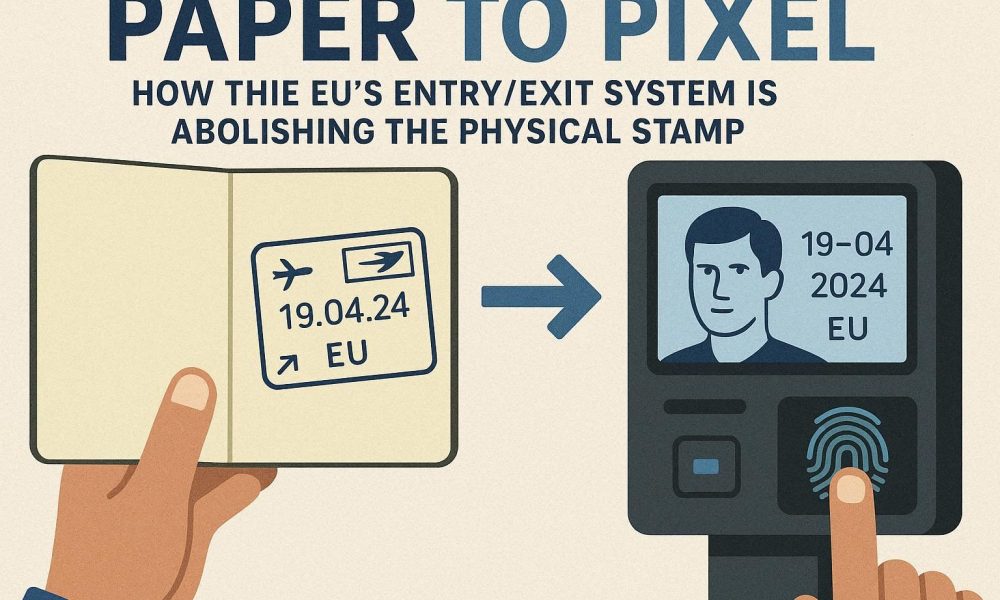
Starting in 2026, digital records are replacing traditional ink stamps at European borders, and travelers now face a new era of biometric accountability across the Schengen zone.
WASHINGTON, DC, May 9, 2026.
The old passport stamp, once a small romantic symbol of arrival, departure, adventure, delay, and bureaucratic proof, is being pushed aside by the European Union’s Entry/Exit System, a border technology shift that replaces ink with biometric records and automated stay calculations.
For travelers entering Europe from outside the Schengen zone, the change marks one of the most significant border-control transformations in decades, because the familiar rhythm of presenting a passport, receiving a stamp, and counting days manually is being replaced by a digital record tied to fingerprints, facial images, and travel-document data.
Europe’s border stamp is becoming a historical artifact.
The passport stamp played a powerful psychological role for generations of travelers, serving as visible proof of arrival, a souvenir of movement, a legal marker of entry, and a simple paper record that could be reviewed by officers and travelers alike.
That system was familiar, but it was also imperfect, because ink stamps could be missed, smudged, misread, placed on crowded pages, applied inconsistently, or misunderstood by travelers trying to calculate the strict 90-days-in-180-days Schengen rule.
The Entry/Exit System changes that model by moving the record into a centralized digital environment, where non-EU short-stay travelers are registered electronically at Schengen external borders, and their entries and exits can be tracked automatically rather than inferred from passport ink.
Travelers who once flipped through pages to prove when they arrived must now understand that the definitive record may no longer be visible in the booklet, because the real evidence of movement will reside in a border database.
The EU’s Entry/Exit System changes what happens at the border.
Under the new system, eligible non-EU travelers entering the Schengen area for short stays are registered with data from their travel document, a facial image, fingerprints where required, and the exact time and place of entry or exit.
The process is designed to replace manual passport stamping and support automatic identification of overstayers, meaning travelers who exceed their permitted short-stay period can be detected through electronic records rather than officer calculations or inconsistent page reviews.
For Americans and other visa-exempt travelers, U.S. diplomatic guidance on the new Entry/Exit System has emphasized that visitors should expect biometric and biographic data collection when entering participating European countries for short stays.
This means the border transaction is no longer limited to a physical passport check, as the traveler’s face, fingerprints, document number, nationality, entry and exit locations, and permitted stay are now part of a machine-readable travel history.
The system is meant to solve problems that ink could never handle reliably.
The Schengen area’s 90-days-in-180-days rule has always been difficult for travelers to calculate correctly, especially for frequent visitors who move between several countries, enter by air, leave by rail, return by ferry, or cross land borders without noticing each stamp.
Manual stamps were never designed for modern travel volumes because officers had to rely on readable ink, available passport pages, consistent stamping practices, and the traveler’s willingness or ability to accurately track prior visits.
The Entry/Exit System is intended to automate that problem, because the border record can calculate cumulative presence across participating countries and flag travelers who have overstayed or appear close to exhausting their authorized period.
For lawful travelers, this can reduce ambiguity, but it also removes the gray areas created by missed stamps, as a digital record may be more precise and less forgiving than a messy passport page.
The traveler’s face is now part of the border record.
The most visible change for many travelers will be biometric capture, as first-time registration under the system may require a facial image and fingerprints, creating a reusable identity record for future Schengen crossings.
This matters because the system is not merely recording a passport number; it also links the document to a biometric profile that can help authorities detect identity fraud, impostor travel, document misuse, and repeated entries under inconsistent identities.
A traveler who previously relied on the physical passport as the main proof of movement must now recognize that the border record may be tied to the body as well as the booklet, making identity verification more personal and more technical.
That biometric connection is precisely why governments view the system as a security upgrade, but it is also why privacy advocates and travelers continue to ask how long data will be stored, who may access it, and how errors will be corrected.
The digital record may be more accurate, but the rollout can be messy.
Large border technology projects rarely move from policy to pavement smoothly, because airports, ferry terminals, land crossings, rail stations, software vendors, police services, immigration authorities, and travelers must all adapt to new procedures simultaneously.
Reuters reported that the EU’s biometric border checks were introduced through a phased rollout before full implementation, with the system designed to replace passport stamping, collect fingerprints and facial images, and strengthen control over non-EU travelers entering and leaving the bloc.
Those changes may improve long-term efficiency, yet the short-term experience can include queues, confusion, inconsistent enforcement, equipment bottlenecks, signage problems, and travelers reaching inspection points without understanding what data will be collected.
The practical lesson is that paperless border control does not automatically mean frictionless travel, because the removal of ink can create new steps when biometric enrollment, kiosk use, or officer-assisted registration takes longer than expected.
Travelers should expect fewer stamps and more data checks.
The most immediate impact is that travelers may no longer receive the traditional Schengen entry or exit stamp that once served as a physical reminder of when the permitted stay began or ended.
Instead, the traveler’s entry and exit will be captured electronically, which means checking personal travel records, ticket histories, visa validity, and stay limits becomes more important than collecting visible proof inside the passport.
For frequent visitors, the change is especially important because a person who enters France, departs from Spain, returns through Germany, and later exits from Italy may now have those movements recorded in a shared system rather than as separate stamp impressions.
This can help prevent accidental overstays, but it also means travelers should keep their own records, because system errors, missed exits, data mismatches, or disputed entries may require evidence from boarding passes, reservations, emails, or carrier records.
The disappearance of stamps will affect travelers who love passport history.
For collectors, frequent flyers, students, expatriates, journalists, and families documenting international movement, the loss of passport stamps carries a cultural cost because stamps turned a government document into a visible travel diary.
Each stamp told a small story, showing the location, date, airport, border crossing, or route that marked a particular journey, even when the stamp’s legal function mattered more than its sentimental value.
Digital border systems replace that visible memory with invisible data, making the passport cleaner, more durable, and less crowded, but also less personal for those who viewed stamps as physical proof of where life had taken them.
The modern traveler may still carry the same booklet, but the journey increasingly takes place behind the scenes, within databases and inspection systems that leave fewer visible marks on paper.
The change also affects airlines, ferry operators, and rail terminals.
Carriers have a direct stake in the Entry/Exit System because border documentation problems can lead to missed flights, denied boarding, delayed departures, missed ferry connections, and disputes over whether passengers are admissible upon arrival.
Airlines and transport operators already check passports, visas, and entry requirements before departure, but the digital border environment adds pressure to ensure travelers understand biometric registration, passport validity, and stay rules before reaching the inspection point.
This is especially important at high-volume airports and juxtaposed border controls, where delays can cascade quickly if first-time registrations take longer than expected or if travelers are unfamiliar with kiosk procedures.
The result is that border modernization becomes as much an aviation and transport challenge as an immigration project, because the passenger journey depends on how smoothly digital identity checks are integrated into existing travel flows.
The system makes overstaying easier to detect.
One of the central goals of the Entry/Exit System is to identify overstayers more reliably, because digital records can compare authorized stay periods with actual entry and exit dates across the Schengen area.
Under the old stamp-based model, an officer might need to inspect multiple pages, interpret unclear stamps, identify missing entries, and manually calculate the rolling 180-day period for travelers with complicated histories.
A digital system can make that calculation faster and more consistent, allowing authorities to detect when someone has exceeded the 90-day short-stay allowance or when a prior exit does not appear in the record.
For travelers, that means casual or accidental overstays may become riskier, because the system’s purpose is not simply to collect data but to make stay-limit enforcement more systematic across participating countries.
The system also changes how identity fraud is investigated.
Passport fraud is no longer limited to counterfeit booklets, forged stamps, or altered data pages, because modern fraud often involves stolen identities, lookalike travel, synthetic records, fraudulent applications, or genuine documents used by the wrong person.
By linking entry and exit records to biometric data, the Entry/Exit System gives authorities another way to identify repeat fraud, detect inconsistent identities, and compare travelers against prior encounters under the same or similar document data.
That can make it harder for someone to exploit a stolen passport, shift between identities, or rely on weak manual stamping practices to create confusion about movement through the zone.
The security value depends on implementation quality, but the direction is clear, because the Schengen border is moving from document inspection alone toward identity continuity across multiple crossings.
Privacy concerns will follow the system for years.
Biometric border control raises serious privacy questions because fingerprints and facial images are sensitive personal data, and travelers have a legitimate interest in understanding storage periods, access controls, retention rules, correction processes, and accountability standards.
Supporters argue that the system strengthens security, reduces overstays, improves data accuracy, and helps identify fraud, while critics worry about data expansion, mission creep, database errors, algorithmic performance, and the normalization of biometric travel records.
Those concerns will not disappear simply because the system becomes routine, because travelers may accept faster border processing while still objecting to unclear data practices or limited remedies when records are wrong.
The success of the Entry/Exit System will depend partly on whether European authorities can maintain public confidence by explaining how information is used, protected, corrected, and deleted when retention periods expire.
The physical passport is still required, even as the stamp disappears.
The end of routine stamping does not mean travelers can leave the passport at home, because the physical booklet remains the legal travel document that proves nationality, identity, validity, and eligibility for inspection at external borders.
The passport still carries the chip, data page, machine-readable zone, photograph, nationality, expiration date, and legal authority that allow the digital system to create or confirm the traveler’s record.
Digital records depend on the passport rather than replacing it, which means travelers should continue to protect the booklet from damage, renew it early, check validity requirements, and ensure that the data page remains readable.
The stamp may vanish, but the passport remains the root document because border technology still needs a trusted source to connect the traveler, the biometric record, and the travel history.
American travelers should prepare for a more technical arrival in Europe.
For U.S. travelers, the shift means that a short trip to Europe may include biometric registration, automated stay tracking, more structured questioning, and less reliance on officers manually reviewing passport pages.
Travelers should arrive with sufficient connection time, especially during peak seasons, because first-time enrollment can take longer than repeat crossings and because queues may vary significantly by airport, country, staffing level, and equipment readiness.
They should also understand that the Schengen area is not the same as the European Union, because some countries participate in Schengen border rules while others do not, and confusion about geography can lead to real travel-planning mistakes.
A traveler planning multi-country movement should track days carefully, preserve proof of departures, and avoid assuming that the lack of a visible stamp means the border did not record the crossing.
The private mobility industry is watching the system closely.
The Entry/Exit System matters beyond tourism because it affects expatriates, executives, students, remote workers, retirees, consultants, high-net-worth families, and anyone who uses repeated short stays as part of a broader mobility strategy.
Professional advisory firms such as Amicus International Consulting monitor these changes because modern travel rules increasingly connect passports, biometric records, tax planning, residency strategy, lawful identity documentation, and private banking compliance.
A person who once managed movement by reviewing passport stamps now faces an environment in which border databases can automatically detect presence and where mistakes may become visible across participating countries.
That reality changes the advice for frequent travelers, because mobility planning now requires disciplined records, legal stay analysis, document integrity, and awareness of how digital border systems interpret movement.
Second passport planning must account for digital border records.
A lawful second passport can support mobility, contingency planning, relocation, access to banking, and family security, but it does not eliminate the need to comply with entry rules, stay limits, biometric registration, or digital travel histories.
Travelers holding more than one nationality must understand which passport they use for entry, which record connects to which identity file, and how biometric systems may link border encounters even when documents differ.
This is why second-passport advisory services increasingly focus on lawful issuance, documentation integrity, tax identification, compliance alignment, and practical usability within automated border systems.
The digital border rewards consistency because contradictions between names, documents, dates, tax records, residence claims, and travel histories can create problems even for travelers whose passports are legally issued.
The end of stamps may change how travelers prove compliance.
Under the old model, a traveler could sometimes point to a passport stamp to show when they entered or exited, although that evidence was never perfect because stamps could be missing, unclear, or placed incorrectly.
Under the digital model, the official record may reside in a database that the traveler cannot casually inspect in the same way, making personal recordkeeping more important for anyone with complex travel patterns.
Boarding passes, airline confirmations, hotel records, train tickets, ferry bookings, passport scans, and calendar notes may become useful backup evidence if a traveler needs to challenge an incorrect stay calculation.
The border record may be digital, but practical self-defense remains old-fashioned, because travelers should keep organized proof of movement when their work, immigration status, or family plans depend on accurate travel history.
The paperless border is also a political signal.
The Entry/Exit System reflects Europe’s broader push to make borders more data-driven, security-focused, and interoperable, particularly as governments respond to migration pressures, security concerns, tourism growth, and demands for faster processing.
Replacing stamps with biometrics signals that border management is moving away from symbolic inspection and toward continuous identity accounting, in which every short-stay traveler is recorded, measured, and automatically compared against rules.
That may improve enforcement and reduce administrative ambiguity, but it also changes the relationship between traveler and state by making movement more traceable than it was under ink-based systems.
The political question is not whether Europe can digitize border records, because it has already begun doing so, but whether the system can remain proportionate, accurate, transparent, and fair as it scales.
Abolishing the stamp does not abolish the border.
For some travelers, losing the stamp may make Europe feel more seamless, because the absence of ink can create the impression that borders are becoming lighter, faster, and less visible.
In reality, the border is not disappearing because it is becoming more technical, more automated, more data-rich, and, in some ways, more permanent than the old stamp that faded on a passport page.
The officer’s stamp once marked a moment, while the digital record creates a structured identity event that can be searched, calculated, compared, and retained according to system rules.
That is the central paradox of the paperless border: the traveler may see less evidence of control in the booklet while encountering a stronger record of control in the database.
Paper-to-pixel is the future of international movement.
The abolition of routine passport stamping in Europe is part of a wider transformation that includes e-passports, biometric gates, digital travel credentials, mobile identity wallets, airline pre-clearance, and automated risk screening.
The physical passport will remain essential for years, but its role is shifting from a stamped travel diary toward a chip-bearing legal anchor that feeds digital systems with trusted identity data.
For travelers, the practical message is clear because Europe’s new border environment requires more preparation, stricter record-keeping, greater awareness of stay limits, and greater comfort with biometric processing.
The ink stamp is fading into travel history, but the border itself is not fading at all, because it is being rebuilt in pixels, fingerprints, facial images, timestamps, databases, and automated calculations that will define how millions of people enter and leave Europe in 2026 and beyond.




