
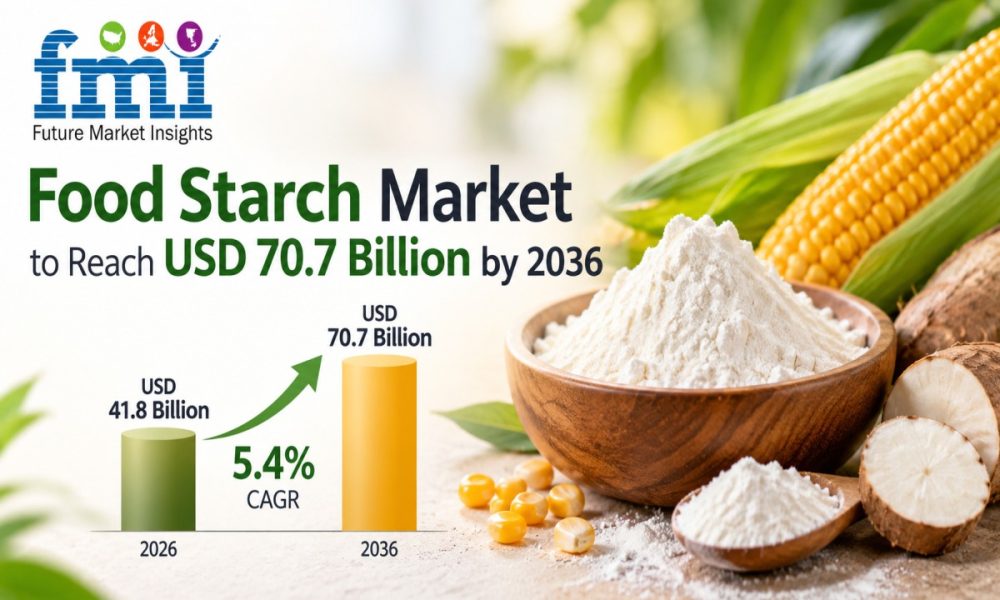
The global Food Starch Market is projected to reach USD 70.7 billion by 2036, up from USD 41.8 billion in 2026, expanding at a 5.4% CAGR during the forecast period, according to the latest analysis by Future Market Insights (FMI).
Get Detailed Market Forecasts, Competitive Benchmarking, and Pricing Trends:
https://www.futuremarketinsights.com/reports/sample/rep-gb-15445
Wheat Continues to Lead Source Demand
Wheat is estimated to account for 30.3% of source demand in 2026, making it the leading source category.
Wheat starch benefits from established cereal-processing infrastructure and familiarity among food manufacturers. Its functionality supports applications across bakery, dairy and prepared foods, although source selection continues to depend on hydration, gel structure, processing conditions and the required finished-product characteristics.
Native / Regular Starch Anchors Product Type Demand
Native / Regular starch is projected to represent 32.4% of product type demand in 2026.
The category remains commercially attractive where standard thickening and gelling functionality can meet manufacturing requirements without additional modification. Buyers can avoid unnecessary formulation complexity when heat, acidity, freezing and shear conditions do not require specialized starch grades.
Dairy Beverages Lead End Use Applications
Dairy Beverages are expected to account for 27.7% of end use application demand in 2026.
Starch plays an important role in managing body, viscosity, suspension and mouthfeel in dairy beverages. Manufacturers evaluate starch grades based on their ability to provide consistent texture without creating excessive thickness or destabilizing other formulation components.
Processed Food Manufacturing Drives Market Expansion
Processed-food manufacturing remains a central demand driver for food starch.
Large-scale food plants require consistent ingredients because changes in viscosity, moisture management or gel structure can affect production efficiency and finished-product quality. Starch suppliers therefore compete not only on ingredient pricing but also on functionality, technical support and dependable sourcing.
Supply Continuity Can Slow Supplier Switching
Food manufacturers often build detailed specifications around a particular starch source and processing profile. Switching suppliers can require additional testing for viscosity, heat tolerance, labeling, processing behavior and raw-material consistency.
Supply reliability has consequently become an important part of the commercial value proposition. Producers with established manufacturing networks and technical support can reduce qualification risks for customers.
Functional and Resistant Starches Create New Opportunities
Functional native and resistant starch products are opening additional opportunities beyond conventional thickening.
Manufacturers seeking higher-fiber formulations, improved processing performance or differentiated nutritional positioning can consider specialized starch varieties. However, commercial adoption still depends on maintaining acceptable taste, mouthfeel, texture and production efficiency.
South Korea Leads Highlighted Country Growth
Among the highlighted country markets, South Korea is projected to record a 5.7% CAGR through 2036, followed by Japan at 5.3%, Germany at 4.9%, the UK at 4.2% and the USA at 3.8%.
South Korea’s growth is supported by food manufacturing and regional ingredient trade. Japan maintains structured monitoring of starch supply and demand, while Germany benefits from a significant food-processing base. The UK has a mature food-manufacturing industry, and the USA represents a large established market with broad starch usage across processed-food categories.
Competitive Landscape
The Food Starch Market includes global ingredient companies, botanical-specialist producers and suppliers focused on functional starch solutions.
Key companies profiled by FMI include Cargill, ADM, Ingredion Incorporated, Tate & Lyle, Roquette Frères, Royal Avebe, Emsland Group, Grain Processing Corporation, Tereos Group and BENEO.
Competitive positioning depends on botanical source breadth, functional starch capabilities, application expertise, technical support, production scale and geographic reach.
Broad ingredient suppliers compete through multi-source portfolios, while specialists differentiate through potato, pea, corn or rice starch expertise and application-specific solutions.
Key Industry Developments
The market continues to see investments in production capacity, application development and functional starch innovation.
In April 2026, Roquette Frères announced the inauguration of a new starch and polyol pilot center at its Lianyungang site in China, supporting laboratory development and pilot-scale industrial transformation.
In February 2026, Emsland Group launched Emjel LC 15, a functional starch designed for vegan and vegetarian jelly and gum applications, extending starch functionality into specialized formulations.
In September 2025, Tate & Lyle launched its Sensation formulation tool in Asia Pacific, initially focused on yogurt applications and designed to connect consumer mouthfeel expectations with ingredient solutions.
Analyst Perspective
“Food starch purchasing is increasingly tied to how reliably an ingredient performs inside the customer’s production process. Suppliers that combine consistent texture with practical reformulation support and dependable sourcing can strengthen recurring customer relationships.” — Nandini Roy Choudhury, Principal Consultant, Future Market Insights
Exclusive Discounts on Full Report
Food Starch Market – https://www.futuremarketinsights.com/reports/food-starch-market
Report Scope
The FMI study covers the Food Starch Market by source, product type, end use application and region. Sources include wheat, corn, rice, potato, tapioca and other sources. Product types include native/regular, pre-gelatinized, cross-linked, stabilized, RS Type 2, RS Type 3, RS Type 4 and enzyme-treated starch. End-use applications include dairy beverages, bakery and cake mixes, dairy products, confectionery, soups, sauces and spreads, cereals and snacks, processed meat, poultry and seafood, and dips and dressings.
The research covers North America, Latin America, Western Europe, Eastern Europe, East Asia, South Asia and Pacific, and the Middle East and Africa. The forecast period extends from 2026 to 2036.
Key Executive Benefits
- Decision-Ready Insights
- Reduced Strategic Risk
- Market Entry Confidence
- Competitive Advantage
- Faster Growth Decisions
- Primary Market Validation
To explore how FMI Custom Research can support your strategic priorities, connect with our team at [email protected].
About Future Market Insights (FMI)
Future Market Insights, Inc. is an ESOMAR-certified, ISO 9001:2015 market research and consulting organization trusted by Fortune 500 companies. With a global presence across the U.S., UK, India and Dubai, FMI delivers data-driven insights across 30+ industries and 1,200 markets worldwide.



