
Food Grade Ethanol Market: The Unsung Powerhouse of the Food & Beverage Industry
In an era where consumers demand higher quality, cleaner ingredients, and robust safety standards, the global food grade ethanol market has emerged as a vital and steadily expanding segment of the broader ethanol industry. Though often overshadowed by fuel ethanol in public discourse, food grade ethanol plays a key role across multiple sectors — from flavor extraction and preservatives in food products to high-purity alcoholic beverages and botanical extracts. With increasing processed food consumption, globalization of food supply chains, and progressive regulatory frameworks, this market is poised for meaningful growth through the next decade.
What Is Food Grade Ethanol and Why It Matters
Food grade ethanol refers to ethanol that meets stringent purity and safety specifications for use in food and beverage applications. Unlike industrial or fuel grade ethanol, food grade ethanol must satisfy regulatory requirements for human consumption and often commands higher production precision and traceability. This makes it indispensable for manufacturers seeking consistent quality, clean-label formulations, and compliance with global food safety standards.
Its applications span a wide spectrum, including use as a solvent for natural flavors, antimicrobial preservatives, processing aids for confectionery and bakery products, and base alcohol in spirits and craft beverages. Ethanol’s versatility as both a functional ingredient and a processing medium underpins its strategic importance for producers aiming to innovate while meeting consumer expectations for quality and safety.
Get Your FREE Sample Report Instantly – Click Now: https://www.persistencemarketresearch.com/samples/26470
Market Size and Growth Outlook
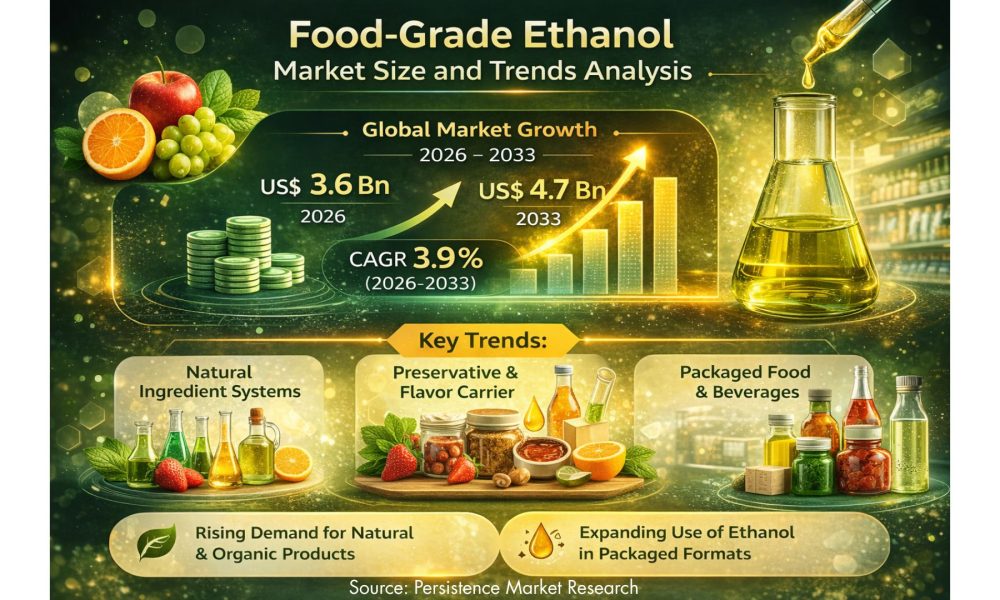
According to Persistence Market Research, the global food grade ethanol market was valued at approximately US$3.6 billion in 2026 and is projected to grow to about US$4.7 billion by 2033, representing a CAGR of around 3.9% over the forecast period.
This steady growth reflects both expanding demand across traditional applications and emerging opportunities in high-purity and specialty product segments. The market’s relatively stable CAGR suggests long-term structural dynamics — including sustained processed food consumption, expansion of premium and craft beverage markets, and increasing regulatory emphasis on clean-label products — are likely to support ongoing expansion.
Key Drivers Fueling the Market
- Rising Demand from Food Processing and Beverages
One of the most influential drivers of the food grade ethanol market is its broad utility in food processing and beverage manufacturing. Ethanol is extensively used as a flavor carrier and solvent in confectionery, bakery, and beverage products where it enhances shelf stability and sensory properties. This is especially true in products with natural flavor extracts, where ethanol helps extract, stabilize, and preserve delicate botanical essences.
The global rise in processed and convenience foods — driven by urbanization, higher disposable incomes, and changing lifestyles — has further entrenched ethanol’s importance as a functional ingredient. In confectionery and bakery applications alone, food grade ethanol can account for significant formulation volumes as manufacturers seek consistent, high-quality flavor profiles and preservation performance.
- Clean-Label and Natural Ingredient Trends
Consumer preferences are shifting toward products with transparent ingredient lists and minimal synthetic additives. As a natural fermentation-derived compound, ethanol aligns with these “clean-label” expectations, making it a preferred solvent and preservative in premium and natural food formulations.
This trend is particularly strong in developed markets like North America and Europe, where regulatory frameworks and consumer awareness reinforce demand for naturally derived ingredients. Manufacturers increasingly replace synthetic solvents with fermented ethanol to meet both regulatory standards and consumer desires.
- Expansion of Premium and Craft Beverage Sector
The global alcoholic beverage industry continues to grow, particularly in premium and craft segments. High-purity food grade ethanol is essential for spirit production, dilution, blending, and finishing, driving demand from distillers and beverage producers worldwide. Premium alcoholic beverages emphasize flavor integrity and production quality, pushing producers to secure consistent supplies of high-grade ethanol.
Craft distilleries and premium beverage brands — especially in North America and Europe — rely on ethanol for the extraction of botanical elements and to achieve specific flavor profiles, further expanding the application base.
- Process Innovation and Regulatory Harmonization
Improvements in fermentation technology and high-precision distillation techniques have increased the yield and quality of food grade ethanol, reducing production variability and lowering per-unit costs. This has enabled smaller producers to compete and facilitated consistent global supply chains.
Regulatory harmonization across regions has simplified compliance for multi-market food product launches. Standardization of safety and quality thresholds helps producers scale operations and ensures smoother cross-border commerce for ingredient suppliers and food manufacturers alike.
Market Segmentation: Source and Application Insights
Source Types: Sugarcane and Grain
The market is segmented by source type, with sugarcane-based ethanol expected to hold the largest revenue share (around 40% in 2026) due to its high fermentation efficiency, consistent quality profile, and established production infrastructure. Sugarcane ethanol benefits from lower impurity levels and robust agricultural bases in Brazil, India, and other major producers.
However, grain-based ethanol is projected to grow at the fastest pace (around 4.4% CAGR) through 2033, driven by abundant cereal supplies, mature dry-mill technologies, and proximity to large food processing hubs in the U.S., Europe, and China. Grain ethanol’s logistical advantages and stable feedstock pricing strengthen its competitive position.
Application Segments: Flavoring and Preservation
Among application segments, ethanol used as a flavoring agent is expected to dominate with roughly a 30% share of demand in 2026, reflecting its extensive use in extracts, essences, and beverage formulations.
Conversely, food preservative applications are set to grow at the fastest rate (about 4.6% CAGR), as manufacturers increasingly adopt ethanol’s antimicrobial properties to extend shelf life and meet clean-label consumer expectations across baked goods, fruit products, and ready-to-eat lines.
Regional Market Dynamics
North America: Market Leader
North America is poised to capture approximately 32% of the global food grade ethanol market share in 2026, led by strong food processing and specialty beverage sectors, advanced production technologies, and strict regulatory frameworks that drive quality compliance.
Asia Pacific: Fastest-Growing Region
The Asia Pacific region is forecast to be the fastest-growing market, with growth exceeding 4.5% through 2033, as expanding processed food manufacturing, rising export volumes, and rising purchasing power fuel demand. China, India, and ASEAN economies are pivotal growth engines, with increasing bakery, confectionery, and beverage output.
Emerging policy initiatives, such as state-level production incentives in India, further encourage local ethanol purification capacity expansion and strengthen regional supply chains for food grade applications.
Competitive Landscape
The global food grade ethanol market shows moderate consolidation, led by established industrial players with integrated production and distribution networks. Key participants include:
- Cargill Incorporated
- Archer Daniels Midland (ADM)
- Wilmar International
- Green Plains Inc.
- Raízen
- COFCO Group
- MGP Ingredients
- Manildra Group
- Godavari Biorefineries
These companies leverage extensive feedstock sourcing, advanced distillation capabilities, and partnerships with food and beverage manufacturers to maintain competitive positioning and ensure supply reliability.
Get a Customized Market View in One Click: https://www.persistencemarketresearch.com/request-customization/26470
Challenges and Emerging Opportunities
Despite positive prospects, the food grade ethanol market faces challenges such as feedstock price volatility, regulatory compliance costs, and capital intensity of high-purity production infrastructure.
However, opportunities abound in the development of organic and non-GMO ethanol varieties, expansion into nutraceutical and herbal extract markets, and alignment with sustainability standards. With consumer demand favoring natural, high-quality ingredients, strategic innovation could unlock new growth corridors over the next decade.
Conclusion
The global food grade ethanol market is charting a steady path of growth, supported by rising processed food consumption, clean-label trends, and expanding premium beverage production. With a projected value of nearly US$4.7 billion by 2033 and resilient demand from diverse food applications, ethanol stands as a cornerstone ingredient in the evolving food and drink ecosystem. Manufacturers and investors alike must navigate feedstock dynamics, regulatory landscapes, and consumer preferences to harness the full potential of this versatile and strategically critical market.
About Persistence Market Research:
Persistence Market Research delivers strategic research solutions that drive business growth. Founded in 2012 and registered in England and Wales in 2023 as Persistence Research & Consultancy Services Ltd., we have completed 3,600+ custom and syndicated studies and supported 2,700+ projects for leading research firms. Combining traditional methodologies with modern tools, we provide actionable insights to multinational corporations, consultants, investors, and government bodies, earning strong trust through long-term client relationships.
Contact Us:
Persistence Market Research
Second Floor, 150 Fleet Street,
London, EC4A 2DQ, United Kingdom
USA Phone: +1 646-878-6329
UK Phone: +44 203-837-5656
Email: [email protected]
Web: https://www.persistencemarketresearch.com




