
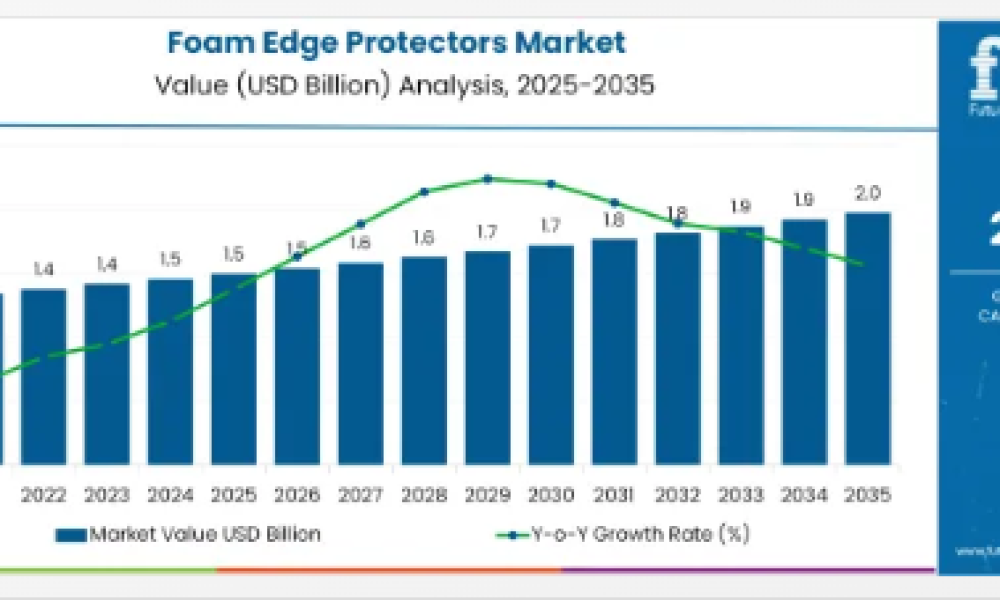
In a data-rich revelation, the global foam edge protectors market is poised to escalate from USD 1.5 billion in 2025 to USD 2.0 billion by 2035, exhibiting a compound annual growth rate (CAGR) of 2.8 percent, fueled by surging demand in packaging protection and sustainability initiatives.
Key Market Insights at a Glance
The foam edge protectors industry is underpinned by rising use in shock-absorbing transit applications, cost-effective cushioning, and a shift toward lightweight, recyclable packaging solutions. Among product types, the U-profile category commands a leading share, thanks to its versatile structural protection for edges and corners. On the materials front, polyethylene foam holds a dominant 42 percent share, valued for its resilience, moisture resistance, and recyclability. Among end-use industries, logistics and transportation is a top revenue generator, reflecting the critical need to safeguard goods in global supply chains.
Regional Overview
Geographically, North America, Europe, and Asia–Pacific emerge as the primary engines of foam edge protector demand. North America benefits from a mature e-commerce industry, stringent safety standards, and strong investment in automated packaging, which together sustain robust consumption.
Europe, driven by regulatory focus on circular economy principles and environmental compliance, channels demand into recyclable and reusable foam protectors. Meanwhile, Asia–Pacific stands out as a high-growth region, powered by rapid industrialization, expanding logistics infrastructure, and rising manufacturing activity across countries such as China and India, which increasingly rely on protective packaging in their export-oriented economies.
Competitive Landscape
The competitive terrain is stratified into three tiers. Tier-1 firms, including Pregis, Sealed Air, and Nefab, lead with approximately one third of the global market, leveraging scale, innovation in sustainable foam, and global distribution. Tier-2 players like FP International and Storopack contribute nearly 29 percent, largely by offering flexible, cost-efficient solutions tailored to regional demand. Tier-3 participants, consisting of smaller regional producers and start-ups, represent about 38 percent; they thrive by focusing on eco-friendly materials and niche applications, and by adapting quickly to regulatory shifts.
Segment Overview
Breaking down the market by product, the U-profile foam edge protector remains the largest, as its design perfectly suits various geometries and offers reliable protection in both manual and automated packaging lines. Other profiles—such as L-profile, R-profile, CC, O, and U-tulip—also see specialized use across industries. Regarding material composition, besides the dominant polyethylene foam, segments like extruded TPE, EPS, NBR, and polyurethane foam are gaining traction, especially where tailored protection or biodegradability is needed. In terms of end-use, industries such as logistics, warehousing, manufacturing, electronics, and construction are among the most active adopters.
Market Outlook: Powering the Next Decade
Over the next ten years, the foam edge protectors market is expected to be driven by a convergence of globalization, e-commerce maturity, and environmental consciousness. The emphasis on sustainable packaging is pushing manufacturers to innovate in recyclable and biodegradable foam materials. Moreover, the complexities of modern supply chains—longer transit times, automated warehousing, and re-usable packaging strategies—are making foam edge protection indispensable. As businesses increasingly prioritize cost efficiency, product safety, and sustainability in tandem, foam edge protectors will become central in packaging optimization strategies globally.
Competitive Strategic Developments
Key market players are actively responding to these trends. Pregis has introduced fully recyclable foam edge protectors, while Sealed Air is launching lightweight, high-impact variants. Nefab is deepening its footprint via custom-molded foam solutions tailored to industrial clients. FP International is scaling production of compostable foam, and Storopack continues to invest in recyclable and flexible edge protector lines. These moves not only reinforce their market positions but also align with circular-economy goals.
Key Players of Sustainable Label Industry
Major players shaping this sustainability-driven landscape include Pregis LLC, Sealed Air, Nefab, FP International, and Storopack. Their strategic focus on R&D, material innovation, and eco-friendly manufacturing has carved a clear path toward more responsible packaging. Supporting participants—such as Polymax, Nomaco, Polartech, Springpack, and Nordpack—are also contributing through regional expertise and custom-profile offerings.
Recent Strategic Developments
In recent years, we have seen a surge in the launch of biodegradable and recyclable foam edge protectors, reflecting growing regulatory and customer demand for eco-conscious packaging. Some players are expanding their production capacity in high-growth geographies, particularly in Asia–Pacific. Others are entering partnerships to enable closed-loop recycling, enhancing both scalability and environmental credentials.
Subscribe for Year-Round Insights → Stay ahead with quarterly and annual data updates: https://www.futuremarketinsights.com/checkout/13475
Have a specific Requirements and Need Assistant on Report Pricing or Limited Budget please contact us – [email protected]
About Future Market Insights (FMI)
Future Market Insights, Inc. (ESOMAR certified, recipient of the Stevie Award, and a member of the Greater New York Chamber of Commerce) offers profound insights into the driving factors that are boosting demand in the market. With a vast team of over 400 analysts worldwide, FMI provides global, regional, and local expertise on diverse domains and industry trends across more than 110 countries.



