
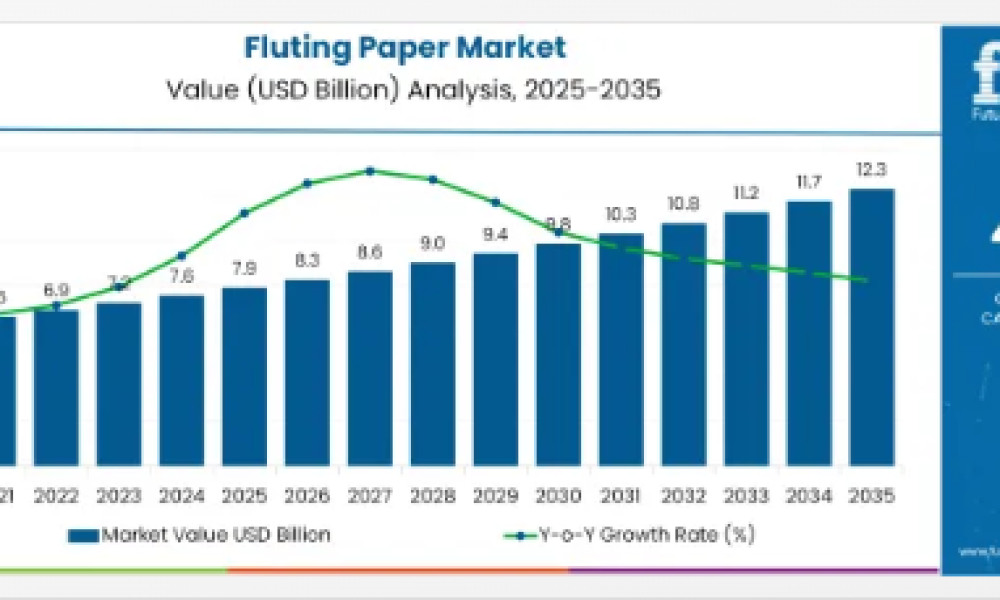
The global fluting paper market, according to the latest Future Market Insights report, is poised for a meaningful expansion — from an estimated USD 7.9 billion in 2025 to USD 12.3 billion by 2035, growing at a compound annual growth rate (CAGR) of around 4.5%. This data-driven projection reflects robust demand, driven by sustainability mandates, e-commerce growth, and technological innovation within packaging.
Key Market Insights at a Glance
In 2025, C-flute paper emerges as the dominant product type, commanding approximately 34% of global fluting paper revenues. The rigid form (as opposed to flexible) holds a clear edge, accounting for roughly 62% of market share, a testament to its structural strength and adaptability to automated corrugated board production. When it comes to packaging format, rolls trump sheets, capturing 68% of total availability share; the continuous-feed capability of rolls aligns well with high-throughput converting lines, reducing waste and boosting efficiency.
Sustainability is a clear catalyst: regulatory pressure to curb plastic use, coupled with consumer and brand focus on eco-friendly materials, is elevating demand for recycled and high-performance fluting grades. Meanwhile, automation in corrugation plants and optimizing machine-line throughput are reshaping supply chain dynamics.
Regional Overview
While North America and Europe continue to play critical roles — fueled by mature e-commerce ecosystems, advanced recycling infrastructure, and strong sustainability mandates — Asia-Pacific is emerging as the engine of growth. Rapid industrialization, burgeoning e-commerce activity, and increased adoption of fiber-based packaging in markets such as China and India are driving Asia-Pacific’s outsized contribution. In parallel, Latin America, the Middle East, and Africa report steady but more moderate growth, underpinned by incremental investments in packaging capacity and eco-conscious logistics.
Competitive Landscape
The competitive terrain in the fluting paper industry is moderately consolidated. Tier-1 players such as Smurfit Kappa, Mondi Group, and DS Smith dominate with approximately 32% market share, leveraging their scale, R&D, and global footprint. Tier-2 firms — including International Paper, Stora Enso, and WestRock — account for about 29%, focusing on flexible, sustainable, and cost-efficient packaging solutions. The remaining 39% of the market is served by Tier-3 manufacturers: regional or niche players who bring agile innovation, localized sustainability credentials, and responsive service to their territories.
Segment Overview
Across product types, C-flute leads, followed by A-flute, B-flute, E-flute, and F-flute, each tailored for specific cushioning, stacking, and space-saving needs. In form, the rigid variant is preferred over flexible thanks to its higher compression resistance and suitability for structural packaging. For availability, roll formats dominate over sheets because of their fit with continuous corrugation lines. Regarding end-use, the key industries are food and beverage, e-commerce & retail, and industrial shipping, each looking to balance protection, sustainability, and cost.
Market Outlook: Powering the Next Decade
Looking ahead, the fluting paper market is projected to propel the next wave of packaging innovation. Suppliers are expected to heavily invest in recycled and virgin-blend fibers, promote circular economy practices, and develop novel flute profiles to minimize material use while maintaining strength. Automation, from advanced pulp lines to digitally integrated corrugating plants, will optimize margins and throughput. Premium printing surfaces will further expand into high-end e-commerce packaging, retail display, and structural retail-ready formats. The fluting paper sector is transforming — not just in material efficiency but in sustainability, design sophistication, and regional responsiveness.
Key Players of Sustainable Fluting Paper Industry
Some of the leading companies shaping this transformation include Smurfit Kappa, Mondi, DS Smith, International Paper, and Stora Enso. These players are raising the bar by launching FSC-certified recycled fluting, lightweight high-strength grades, and moisture-resistant variants engineered for food-safe packaging.
Recent Strategic Developments
Major moves in the market reflect a pivot toward sustainability and capacity build-out. Several top-tier suppliers have introduced ultra-lightweight, high-strength fluting papers and fully recyclable formats tailored for e-commerce. Some are scaling up regional milling operations, particularly in Asia-Pacific, to shorten supply chains and align with local demand. Notably, producers are strengthening fiber sourcing partnerships, expanding recycling infrastructure, and retrofitting plants with automation and digital quality controls. These coordinated efforts highlight a clear, future-focused commitment to greener packaging, efficiency, and growth.
Subscribe for Year-Round Insights → Stay ahead with quarterly and annual data updates: https://www.futuremarketinsights.com/checkout/13471
Have a specific Requirements and Need Assistant on Report Pricing or Limited Budget please contact us – [email protected]
About Future Market Insights (FMI)
Future Market Insights, Inc. (ESOMAR certified, recipient of the Stevie Award, and a member of the Greater New York Chamber of Commerce) offers profound insights into the driving factors that are boosting demand in the market. With a vast team of over 400 analysts worldwide, FMI provides global, regional, and local expertise on diverse domains and industry trends across more than 110 countries.



