
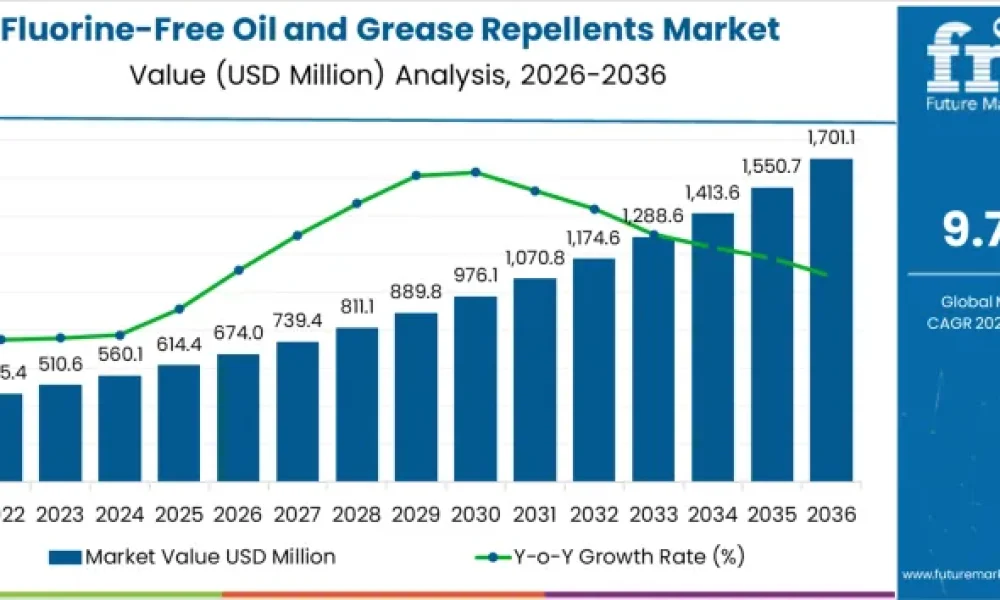
The global fluorine-free oil and grease repellents market is projected to grow from an estimated USD 674 million in 2026 to USD 1,701.1 million by 2036, registering a robust 9.7 % compound annual growth rate (CAGR) over the forecast period. This expansion reflects accelerating industry transitions away from traditional fluorinated chemistries toward environmentally responsible alternatives in packaging, textiles, and technical surfaces, underscoring the rising demand for sustainable, high-performance repellents that comply with stringent global regulations.
As consumer awareness intensifies and global policy frameworks tighten around per- and polyfluoroalkyl substances (PFAS), manufacturers across sectors are prioritizing fluorine-free solutions that maintain oil and grease resistance without the ecological and health drawbacks of legacy fluorinated coatings. This trend is reshaping product portfolios and supply chains worldwide, spotlighting the strategic importance of eco-conscious material innovations.
Key Market Insights at a Glance
The fluorine-free oil and grease repellents market is anchored by silicone-based repellents, which currently hold the largest share due to their balanced performance in oil resistance, thermal stability, and regulatory acceptance. Hydrocarbon and paraffin coatings serve cost-sensitive applications, while emerging bio-based formulations appeal to brand owners with strong sustainability mandates. Across applications, food contact paper and packaging account for a significant portion of demand, as these sectors prioritize safe, recyclable solutions that prevent grease migration while meeting consumer and regulatory standards.
Growth dynamics vary by geography. North America and Europe lead adoption, driven by early regulatory action and established sustainability commitments among major brands, while Asia Pacific markets are experiencing rapid expansion fueled by large-scale textile production and increased demand for eco-friendly surface treatments. India and China, in particular, are forecasted to see above-average growth rates as manufacturing hubs integrate fluorine-free repellents into apparel, packaging, and industrial fabrics.
Segment Overview
The market’s segmentation by chemistry type reveals silicone-based repellents commanding roughly 30 % of demand, bolstered by their combined performance attributes and alignment with environmental safety objectives. Hydrocarbon/paraffin and polyurethane dispersions provide alternatives for specific application requirements, while bio-based repellents are gaining traction amid sustainability-centric procurement strategies. End-use segments span from food packaging and technical textiles to industrial fabric treatments and automotive interiors, each with tailored requirements for oil, grease, and stain resistance.
Application trends show food contact packaging as the most prominent segment, responsible for approximately one-third of global uptake. This reflects both the volume of packaging produced annually and the regulatory pressures faced by food service and consumer goods manufacturers to eliminate fluorinated coatings. Apparel and textile applications are evolving rapidly, with fluorine-free systems integrated into performance garments and home textiles in response to consumer demand for safe, durable products.
To access the complete data tables and in-depth insights — Request Your Sample Report Now
Regional Overview
Regionally, North America and Europe remain pivotal due to established regulations targeting PFAS and strong adoption of green chemistry principles. These markets are characterized by early implementation of fluorine-free technologies in both packaging and textile segments. Asia Pacific, led by China and India, is experiencing fast-paced growth driven by expanding industrial production and rising export demands for environmentally compliant materials. Latin America and Middle East & Africa show emerging interest, particularly in sustainable packaging and hospitality sectors, as global brands standardize fluorine-free solutions across supply chains.
Competitive Landscape
The competitive landscape is diverse, comprising both traditional chemical manufacturers and innovators specializing in sustainable surface treatments. Key players such as Chemours, Archroma, Huntsman Corporation, Dow Inc., and Rudolf Group are expanding their fluorine-free portfolios through strategic investments in R&D, partnership programs with manufacturers, and performance optimization initiatives that shorten adoption cycles. These companies are increasingly focused on co-development with mill partners and brand owners to ensure compliance with restricted substance lists and to meet evolving functional criteria.
Emerging entrants are making inroads by offering bio-based and multifunctional repellents that couple oil and grease resistance with added attributes like breathability or moisture management, appealing to niche segments within apparel and performance textiles. Across the competitive spectrum, differentiation is achieved through verified performance data, regulatory documentation, and support services that ease integration into existing processing lines.
Market Outlook: Powering the Next Decade
Looking ahead, the fluorine-free oil and grease repellents market is poised for sustained growth as regulatory frameworks expand and sustainability becomes non-negotiable for global brands. Technological innovations—such as enzymatic and advanced polymer systems—are anticipated to close performance gaps with traditional fluorinated chemistries, unlocking broader adoption in heavy-duty industrial and high-soiling applications. Continued emphasis on eco-label certifications and lifecycle performance will further bolster market confidence in fluorine-free alternatives.
Key Players of Sustainable Label Industry
Leading companies are aligning product development with environmental compliance, catering to evolving customer demands for safe, high-performance repellents. These efforts are supported by collaborative research, sustainability certifications, and targeted expansions into high-growth regions. As the market continues to mature, strategic differentiation through service excellence and technical support will be a hallmark of enduring leadership.
Recent Strategic Developments
Recent industry developments include enhanced formulation techniques that improve wash durability and repellency performance, partnerships between chemical innovators and textile manufacturers, and accelerated testing standards for fluorine-free products in high-exposure applications. These trends reflect a broader shift toward harmonizing performance with sustainability, offering end users reliable alternatives to legacy fluorochemistries.
Have a specific Requirements and Need Assistant on Report Pricing or Limited Budget please contact us – [email protected]
About Future Market Insights (FMI)
Future Market Insights, Inc. (FMI) is an ESOMAR-certified, ISO 9001:2015 market research and consulting organization, trusted by Fortune 500 clients and global enterprises. With operations in the U.S., UK, India, and Dubai, FMI provides data-backed insights and strategic intelligence across 30+ industries and 1200 markets worldwide.
Why Choose FMI: https://www.futuremarketinsights.com/why-fmi



