
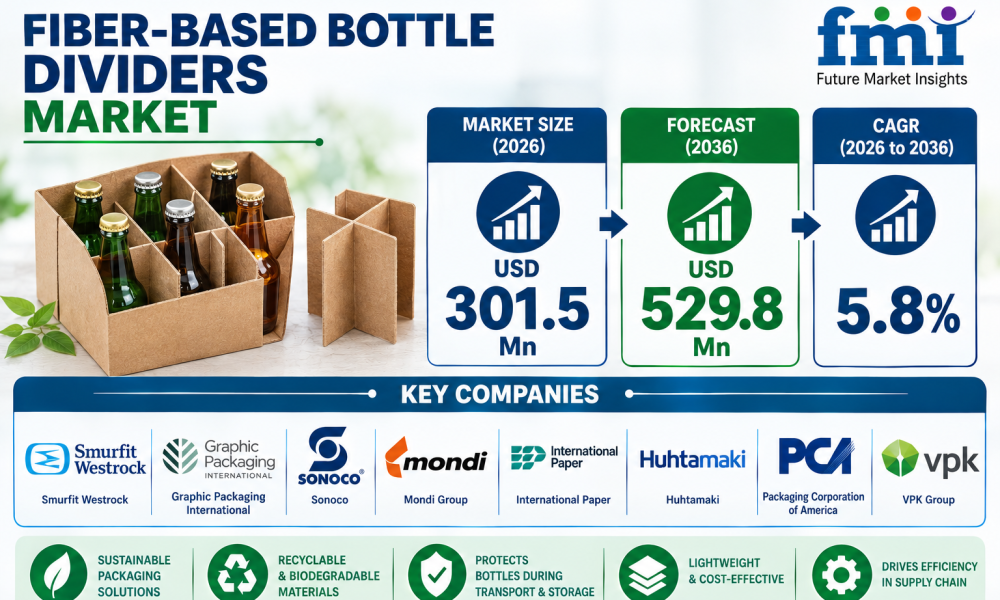
The global Fiber-Based Bottle Dividers Market is projected to grow from USD 301.5 million in 2026 to USD 529.8 million by 2036, expanding at a 5.8% CAGR during the forecast period, according to Future Market Insights. Demand is being shaped by beverage packers seeking fiber-based separators that protect glass bottles while meeting recyclability requirements and maintaining compatibility with existing case-packing operations.
Fiber-based dividers are becoming an important component of secondary and transport packaging for beverages. Their role is straightforward: maintain bottle spacing, reduce bottle-to-bottle contact, and protect decorated glass during handling and distribution. However, commercial adoption depends on more than material selection. Board caliper, slot geometry, humidity resistance, compression performance, and automated case-packing compatibility all influence qualification.
>> Get Detailed Market Forecasts, Competitive Benchmarking, and Pricing Trends: https://www.futuremarketinsights.com/reports/sample/rep-gb-34623
Grid-Cell Partitions Lead Product Demand
Grid-cell partitions are projected to account for 48.0% of product-type demand in 2026, making them the leading product category.
Interlocking cells create repeatable bottle pockets that limit container contact without requiring a molded cavity. Flat-shipped grids can also allow technicians to check slot accuracy before automated case packing.
For beverage producers, consistent geometry is particularly important when the same outer case runs through established packing equipment. Small changes in board thickness or slot dimensions can affect bottle spacing and machine performance.
Recycled Chipboard Holds a 44.0% Share
By material, recycled chipboard is estimated to account for 44.0% of the market in 2026.
The material provides controlled caliper and repeatable slot formation for recurring beverage cases. Established fiber-recovery routes also make recycled chipboard compatible with the wider secondary-packaging structure.
However, recycled-board properties can vary with input material and moisture exposure. Beverage packers therefore need to confirm that stiffness and slot geometry remain stable during storage, transport, and repeated case-packing cycles.
12-Cell Formats Represent 40.0%
12-cell formats are expected to hold a 40.0% share of cell-count demand in 2026.
The format balances bottle density with case weight and provides a practical configuration for multi-bottle beverage shipments.
Cell count is not simply a packaging-design decision. Bottle diameter, case dimensions, board caliper, handling conditions, and automated packing requirements all influence the final divider specification.
A divider that increases bottle density but creates packing-line interruptions can undermine the intended material and logistics savings.
Glass Bottle Separation Leads Applications
Glass bottle separation is forecast to account for 46.0% of application demand in 2026.
Filled glass bottles can strike each other inside shipping cases, creating breakage and surface-damage risks. Dividers create physical separation between bottles and help maintain controlled spacing during distribution.
Wine and spirits applications place additional emphasis on protecting decorated surfaces while maintaining case-erection efficiency. Bottle diameter and divider compression therefore need to be considered together when developing a commercial format.
FMI Principal Consultant Nandini Roy Choudhury states:
“Fiber-based bottle divider repeat business depends on cell geometry that protects decorated glass without disrupting case-packing equipment. The decisive test is stable board caliper and slot geometry under humidity, distribution loads and repeated case-packing trials.”
Direct / OEM Supply Leads the Sales Channel
Direct / OEM sourcing is projected to account for 46.0% of sales-channel demand in 2026.
Direct engagement allows packaging engineers to set divider dimensions against bottle geometry and case equipment before production release.
This route is particularly relevant when beverage companies use several bottle sizes or require customized cell configurations. Technical coordination can continue from prototype trials through repeat conversion and production supply.
Material Efficiency Creates a Market Opportunity
Packaging-waste rules are increasing pressure to reduce unnecessary secondary-packaging material.
Regulation (EU) 2025/40 establishes a 50% maximum empty-space ratio for grouped and transport packaging under Article 24. Fiber dividers can concentrate protective material around bottle-contact points while supporting more efficient case designs.
The opportunity is therefore not simply to replace plastic separators with fiber.
Integrated divider and outer-case design can help packaging engineers right-size the complete secondary pack while maintaining protection through distribution.
Board Costs and Qualification Remain Challenges
Switching to a new divider specification can involve material trials, transport testing, case-packing adjustments, and production downtime.
FMI notes that recycled-board price movements can also affect the economics of substitution. Sonoco increased prices for converted paperboard products, including partitions, by 7% in June 2026 as input costs rose.
These factors mean beverage companies need to evaluate material savings alongside qualification costs and the operational impact of changing an established divider specification.
👉 Access the Complete Report in PDF Format: https://www.futuremarketinsights.com/reports/brochure/rep-gb-34623
Country Markets Show Different Growth Profiles
FMI forecasts the following country CAGRs for 2026–2036:
- Brazil: 6.1%
- United Kingdom: 5.4%
- United States: 5.2%
- Germany: 5.0%
- Japan: 4.5%
These are forecast growth rates rather than rankings of current market size. Local fiber availability, recovery systems, packaging regulations, beverage production, and qualification practices influence market conditions.
Brazil’s market is influenced by long inland distribution routes and humid storage conditions. The UK connects packaging material selection with producer reporting and disposal-fee exposure.
The USA benefits from regional corrugated-conversion networks but must address different state-level packaging requirements. Germany combines mature recovery infrastructure with strict qualification across automated bottle-packing lines.
Japan places greater emphasis on dimensional consistency and controlled changes to proven packaging formats.
Competitive Landscape
The market remains fragmented across integrated corrugated groups, converted-paperboard specialists, and molded-fiber manufacturers.
Notable companies profiled by FMI include Smurfit Westrock, Graphic Packaging International, Sonoco, Mondi Group, International Paper, Huhtamaki, Packaging Corporation of America, and VPK Group.
Smurfit Westrock, Mondi Group, International Paper, Packaging Corporation of America, and VPK Group combine corrugated conversion with regional manufacturing networks for customized protective formats.
Graphic Packaging International and Sonoco provide converted-paperboard capabilities for beverage programs requiring controlled material specifications. Huhtamaki adds molded-fiber manufacturing for bottle-protection applications requiring dedicated tooling and qualification.
Recent developments include Smurfit Westrock’s January 2026 documentation of the Hol(e)y Tray divider for 10-liter bottles, which achieved 27% fewer handling steps and 9.1% lower packaging costs. Mondi completed its acquisition of Schumacher Packaging’s Western Europe operations in April 2025, while International Paper completed its combination with DS Smith in January 2025.
About the Fiber-Based Bottle Dividers Market
The FMI study evaluates the market by product type, material, cell count, application, end use, sales channel, and region.
Product categories include grid-cell partitions, molded pulp dividers, layer pad dividers, and custom inserts. Materials include recycled chipboard, corrugated fiberboard, molded pulp, and solid fiberboard. Applications include glass bottle separation, wine and spirits, beer and cider, and other beverages.
To explore how FMI Custom Research can support your strategic priorities, connect with our team at – [email protected]
About Future Market Insights (FMI)
Future Market Insights, Inc. is an ESOMAR-certified, ISO 9001:2015 market research and consulting organization trusted by Fortune 500 companies. With a global presence across the U.S., UK, India, and Dubai, FMI delivers data-driven insights across 30+ industries and 1200 markets worldwide.



