
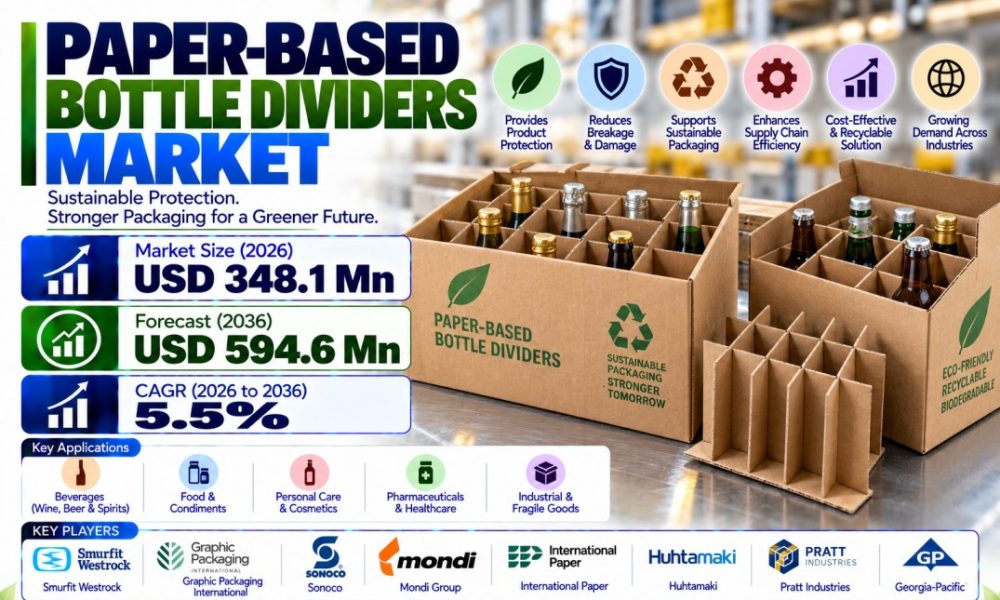
The global Paper-Based Bottle Dividers Market is projected to grow from USD 348.1 million in 2026 to USD 594.6 million by 2036, registering a 5.5% CAGR during the forecast period, according to Future Market Insights.
Demand is being supported by beverage packers looking for paper-based separators that reduce bottle-to-bottle contact while remaining compatible with existing case structures and recycling systems. The growing focus on recyclable secondary packaging is also influencing material-selection decisions.
The European Commission’s Packaging and Packaging Waste Regulation, which came into force in February 2025, is increasing design pressure on packaging components that need to combine product protection with improved recyclability.
👉 Access the Complete Report in PDF Format: https://www.futuremarketinsights.com/reports/brochure/rep-gb-34629
Grid-Cell Partitions Lead Product Demand
Grid-cell partitions are expected to account for 50.0% of product type demand in 2026. Their fixed-cell structure provides individual compartments around bottles, helping limit lateral movement during transportation and distribution.
For beverage packers, however, protection is only one part of the qualification process. Divider geometry must also remain consistent enough for automated insertion and repeatable case-packing operations.
Bottle diameter, shoulder geometry, cell clearance and board caliper all influence the final divider specification.
Recycled Chipboard Holds a 48.0% Material Share
Recycled chipboard is projected to represent 48.0% of material demand in 2026. Its combination of stiffness and established recovered-fiber conversion routes makes it suitable for internal case components where structural performance is more important than consumer-facing appearance.
Consistent board caliper and accurate cutting remain important because slot variation can reduce bottle isolation and create insertion problems on automated packing lines.
Glass Bottle Separation Remains the Core Application
Glass bottle separation is forecast to hold 46.0% of application demand in 2026.
Glass containers require physical separation to reduce contact and breakage during repeated handling. Divider performance therefore depends on how well the cell structure matches the bottle configuration and outer case.
The market also reflects the continuing importance of alcoholic beverage packaging. Alcoholic beverages are expected to account for 44.0% of end-use demand in 2026, supported by recurring glass formats across wine, spirits and bottled beer.
Qualification and Board Costs Remain Key Challenges
The shift toward paper-based dividers is not simply a material substitution exercise.
Paperboard price increases can affect the economics of conversion, while failed line trials can delay adoption. Sonoco announced a 7% price increase in June 2026 for converted paperboard products, including partitions and protective packaging.
As a result, beverage manufacturers need to evaluate the complete commercial case. Material savings must be considered alongside breakage reduction, line performance, qualification costs and replenishment requirements.
Future opportunities are emerging for suppliers that combine recycled-fiber grades with case-specific engineering and reliable automated insertion performance.
Regional Growth
Brazil is projected to record the highest CAGR among the profiled countries at 5.9%, followed by the United Kingdom at 5.2%, the USA at 5.0%, Germany at 4.8%, and Japan at 4.3%.
Brazil’s long transport corridors create demand for efficient protective components and regional supply. In the United Kingdom, producer-responsibility requirements are making packaging material selection more commercially relevant.
In the USA, differences between state-level packaging policies can complicate specifications across national beverage networks. Germany’s established recycling infrastructure increases documentation requirements, while Japanese beverage packers place strong emphasis on dimensional consistency.
>> Get Detailed Market Forecasts, Competitive Benchmarking, and Pricing Trends: https://www.futuremarketinsights.com/reports/sample/rep-gb-34629
Competitive Landscape
The competitive landscape includes Smurfit Westrock, Graphic Packaging International, Sonoco, Mondi Group, International Paper, Huhtamaki, Pratt Industries, and Georgia-Pacific.
Competition centers on board consistency, die-cut precision, conversion capability, regional supply and technical support. Direct partition capability competes alongside broader paperboard and corrugated packaging platforms.
Nandini Roy Choudhury, Principal Consultant at Future Market Insights, notes:
“Paper-based bottle dividers earn repeat business by protecting glass without slowing case packing or adding unnecessary board weight. Repeat programs pair verified cell geometry with stable recycled-paperboard supply and local technical support for each bottle-case configuration.”
Report Scope
The Paper-Based Bottle Dividers Market covers product types including grid-cell partitions, chipboard dividers, layer pad dividers and custom inserts. Materials include recycled chipboard, kraft paperboard and corrugated fiberboard.
Applications include glass bottle separation, wine and spirits, beer and cider, and other beverages. The study also evaluates end use, cell count, sales channel and regional markets.
To explore how FMI Custom Research can support your strategic priorities, connect with our team at – [email protected]
About Future Market Insights (FMI)
Future Market Insights, Inc. is an ESOMAR-certified, ISO 9001:2015 market research and consulting organization trusted by Fortune 500 companies. With a global presence across the U.S., UK, India, and Dubai, FMI delivers data-driven insights across 30+ industries and 1200 markets worldwide.



