

Every debate about merger value creation eventually collapses into a single number. For the $81 billion Paramount–Warner Bros. Discovery merger, that number is $6 billion (or more), which is the synergy value the combined company is expected to be delivered within three years of closing.
Wall Street has been busy arguing whether the target is reachable, but we believe that is the wrong argument. Synergy math, debt multiples, and the projected EBITDA are instruments of observation. They measure the price of scale, but they say almost nothing about whether the business underneath is aligned to produce durable value. And that gap, between what our financial tools measure and what actually creates value, is about to become the defining problem for a lot more companies than Paramount.
What the Warner Deal Reveals About Value Creation in M&A
Strip away the golden-era language and the structure is stark. The combined company emerges carrying something close to $80 billion in debt, a load that lands near 6.5 times annual earnings and is a level analysts consider steep for a media business. Leadership has promised no asset sales and no cuts to content spending. The whole plan leans on hitting that $6 billion synergy target within three years.
Here’s the tension nobody’s pricing. The assets generating the cash to service that debt are the ones shrinking fastest. Traditional television still throws off real money, but the segment is eroding at close to ten percent a year by some estimates, and streaming isn’t projected to match the scale of legacy TV for years. The deal borrows against a melting asset to buy scale.
You can build a flawless synergy model on top of that and still watch the system fail. Because the model measures the price. It doesn’t measure the alignment.
The Numbers Are a Rearview Mirror in Merger Value Creation
Look closely at how the leverage gets reported and you can watch the instrument bend. Paramount tells investors the combined company lands at 4.3 times net debt to earnings at close. Analysts say 6.5, and both are right.
The difference is that Paramount’s figure is stated on a synergized basis. It books the $6 billion as though it has already been delivered. And what is that $6 billion, exactly? Migrating two companies onto a single ERP system, consolidating streaming technology stacks, procurement savings, a smaller real estate footprint. Job cuts of course, which management notes are less than half the total, as if that were reassuring.
Every one of those is an activity. Not one of them is value. Yet the balance sheet has already recorded them as such, three years before the work is done. That is the whole problem in a single ratio.
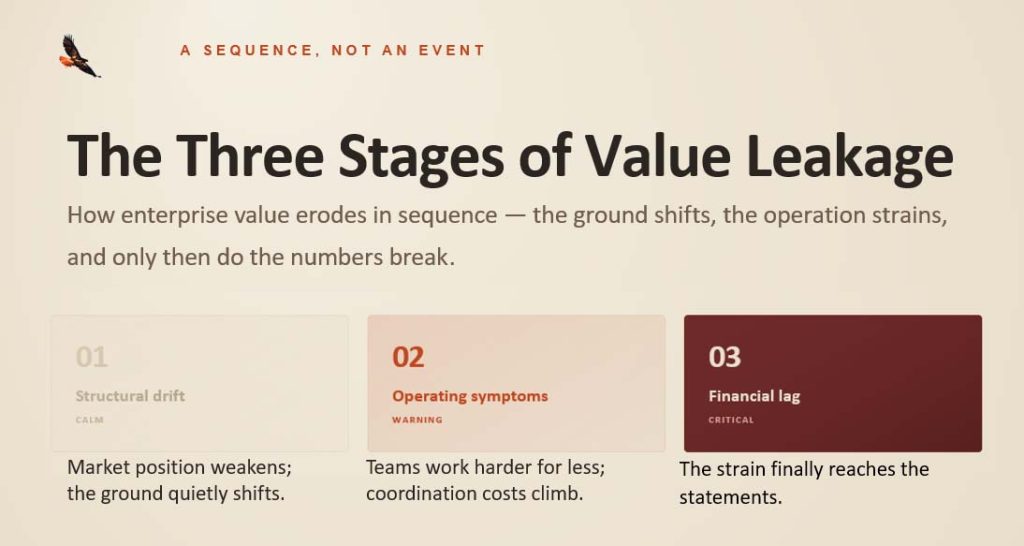
Value doesn’t leak all at once. It leaks in stages.
- Structural drift comes first. Market position weakens, or the ground the business stands on quietly shifts. In media, that was cord-cutting and streaming years before it showed up as a crisis.
- Operating symptoms spread next. Teams work harder for less, coordination costs climb and cost-cutting rounds pile up until there’s nothing obvious left to trim which is roughly where Warner already sits after years of austerity.
- The financial lag appears last. By the time the strain hits the statements, the pattern has been forming for years, and the cost of correction has compounded.
Dashboards, KPI reports, and quarterly reviews are genuinely useful for monitoring progress against targets you’ve already set. But they are not built to diagnose the structural conditions that produce those outcomes in the first place. They tell you what happened, but they’re quiet about why, and even quieter still about what the system needs to change before the next cycle begins.
This is the typical trap. While leadership steers by the rearview mirror, the road ahead has already changed shape.
Technology Is Forcing the Question on Everyone
Media is simply the most visible case because the disruption is furthest along, but the same forcing function is bearing down on every industry technology touches. That means just about everyone.
Streaming rewrote entertainment. AI is now rewriting software, services, and knowledge work. Shifting distribution keeps rewriting retail and consumer brands. In each case, technology changes the structure of an industry faster than the financial statements can register it, and companies keep navigating by outcome metrics that describe a world that no longer exists.
This is where the win/win discipline matters. Scale acquired without alignment isn’t value, it’s exposure. The mergers that endure aren’t the biggest ones; they’re the ones where the combined system actually fits together, where customers, employees, and capital all still win once the dust settles. When any of those parties loses, the value was never really there. It was borrowed against the future and recorded as a win too early. It does not represent long-term merger value creation.
Diagnosis Before the Lag
So the sharper question isn’t “can Paramount hit its synergies?” It’s this: is the combined system aligned to create value while the ground keeps moving under it? This becomes the question every company must answer before venturing into merger value creation.
Answering that requires a different discipline than a dashboard. It means examining the structural conditions such as market position, operating capability, and capital allocation before the financial lag appears. Once value leakage reaches the statements, correction is slow and expensive. It means treating the business as one interconnected system rather than a stack of quarterly line items. That is the real substance of value creation in M&A: not the price you model going in, but the alignment you can read before the numbers move.
This is precisely the shift the Enterprise Value Creation Roadmap can bring to the surface: the structural conditions that produce financial outcomes, made visible before the lag shows up in the numbers. Not a verdict on any single deal, but a way to read the system that produces the verdict.
What the Spreadsheet Can’t Answer
The Warner deal will be judged, for now, on a spreadsheet. And spreadsheets are honest about one thing: they record what already happened.
Whether $81 billion becomes durable value or a durable burden won’t be settled in the synergy model. It’ll be settled by whether anyone diagnosed the system, the alignment between a shrinking core, a growing bet, and a market that refuses to hold still, before the numbers forced the answer.
Scale is the price of admission, but alignment is the whole game.