
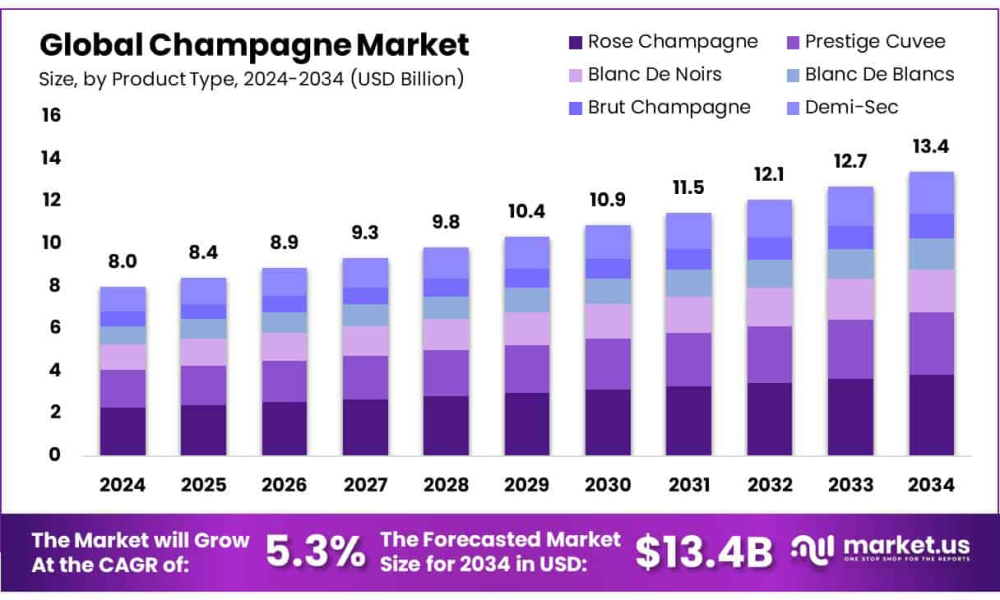
New York, NY – June 30, 2025 – The Global Champagne Market is set to grow significantly, reaching an estimated USD 13.1 billion by 2034, up from USD 8.0 billion in 2024, with a steady 5.3% CAGR from 2025 to 2034. This growth is driven by rising demand for premium sparkling wines, especially in celebrations, luxury events, and gourmet dining.
The 2010 Dietary Guidelines for Americans define moderate alcohol consumption as up to one drink per day for women and two drinks per day for men. The International Grape and Wine Organization projects China’s wine market to reach 462.4 billion yuan ($65.4 billion) by 2026, doubling 2021 figures, with a compound annual growth rate of 11.5% for still wine and 11.3% for sparkling wine, driven by millennial and Gen Z adoption of Western lifestyles.
In France, 36% of wine drinkers now regularly choose organic wine, reflecting a growing European trend toward organic options. The Organic Trade Association reports a nearly 10% annual increase in U.S. organic wine sales over the past decade, with rising demand for organic and biodynamic Champagne. The Comité Champagne notes a 20% reduction in carbon emissions per bottle and a 50% decrease through their zero-herbicide goal, underscoring the Champagne industry’s commitment to sustainability.
Important Revelation
- The global champagne market was valued at USD 8.0 billion in 2024.
- The global champagne market is projected to grow at a CAGR of 5.3 % and is estimated to reach USD 13.1 billion by 2034.
- Among product types, rose champagne accounted for the largest market share of 28.6%.
- Among grape varieties, Pinot Noir accounted for the majority of the market share at 46.5%.
- By capacity, 750 ML accounted for the largest market share of 67.4%.
- By distribution channel, on-trade accounted for the majority of the market share at 58.5%.
- Among producers, houses accounted for the largest market share of 74.5%
- North America is estimated as the largest market for champagne with a share of 39.4% of the market share.
➤ Download Exclusive Sample Of This Premium Report (Including Full TOC, Table & Figures): https://market.us/report/champagne-market/request-sample/
Report Segmentation
Product Type Analysis
- The champagne market is segmented by product type into prestige cuvée, blanc de noirs, blanc de blancs, rosé champagne, brut champagne, and demi-sec. Rosé champagne captured a notable 28.6% revenue share, driven by its popularity among younger, lifestyle-driven consumers. Its vibrant hue, fruity profile, and striking visual appeal make it a top choice for celebrations and social gatherings. The wine’s versatility in food pairings further boosts its demand across diverse occasions. Growing interest in Western culture, moderate consumption in emerging markets, and strong social media influence significantly fuel its market growth.
Grape Variety Analysis
- The Champagne market is segmented by grape variety into Pinot Noir, Pinot Meunier, Chardonnay, and others. Pinot Noir holds a commanding 46.5% market share in 2024, owing to its ability to craft full-bodied, complex champagnes with excellent aging potential. A key component in blanc de noirs and rosé variants, its rising popularity stems from its rich structure and depth, making it a preferred choice among producers. Its adaptability across vineyards and prominence in premium blends further solidify its market dominance.
Capacity Analysis
- The champagne market is categorized by capacity into 200 mL, 375 mL, 750 mL, 1500 mL, and above 1500 mL. The 750 mL bottle led with a 68.4% share, recognized as the global standard for champagne. Its popularity for personal consumption, gifting, and event use stems from its balanced affordability and portion size, appealing to individual buyers, restaurants, and celebratory occasions. Producers leverage this size for branding and marketing, reinforcing their market leadership.
Distribution Channel Analysis
- The Champagne market is divided into on-trade and off-trade distribution channels, with the on-trade segment leading at 67.2% of the market share. This dominance is driven by strong demand from hotels, restaurants, bars, and event venues, fueled by the growing popularity of social dining, luxury experiences, and celebratory occasions. The resurgence of large-scale events, weddings, and tourism post-pandemic has further boosted on-trade sales. Premium branding and personalized service in these settings enhance champagne’s appeal in upscale social environments.
Producers Analysis
- The champagne market includes houses, growers, and cooperatives, with houses commanding a 74.5% share in 2024. Their dominance is attributed to robust global brand recognition, extensive distribution networks, and consistent quality. Iconic producers like Moët & Chandon, Veuve Clicquot, and Dom Pérignon invest heavily in marketing, exports, and innovation, appealing to both luxury and mainstream consumers. Their strong presence in high-end retail and on-trade channels further cements their market leadership.
Market Key Segmentation
By Product Type
- Prestige Cuvee
- Blanc De Noirs
- Blanc De Blancs
- Rose Champagne
- Brut Champagne
- Demi-Sec
By Grape Variety
- Pinot Noir
- Pinot Meunier
- Chardonnay
- Others
By Capacity
- 200 Ml
- 375 Ml
- 750 ML
- 1500 Ml
- Above 1500Ml
By Distribution Channel
- On-trade
- Pubs, Bars & Cafes
- Hotels & Restaurants
- Others
- Off-trade
- Supermarkets/Hypermarkets
- Specialty Stores
- Convenience Stores
- Online Stores
By Producers
- Houses
- Growers
- Cooperatives
Geopolitical Impact Analysis
- Recent U.S. tariffs on European wines and champagnes have significantly disrupted the global champagne market. The U.S. imposed a 200% tariff on alcoholic beverages, including wines and champagnes, imported from the European Union. This measure, initiated by President Donald Trump, retaliates against the EU’s 50% tariffs on American whiskey.
- These tariffs have raised serious concerns among French Champagne producers and European wine exporters, given France’s prominence as a leading Champagne producer. The U.S., a key export market, is now a source of financial risk and market instability for these producers. According to the French Federation of Wine and Spirits Exporters (FEVS), U.S. sales have declined by 20% due to the tariffs.
- The uncertainty caused by these tariffs threatens the stability of European wine producers and retailers, impacting prices and sales. Globally, the tariffs may push European producers to seek alternative markets, potentially reshaping trade flows and intensifying competition for limited demand, which could hinder overall champagne market growth.
- Major European beverage companies have also felt the impact. Shares in Pernod Ricard dropped by nearly 4%, Rémy Cointreau fell 3.5%, and LVMH, owner of Moët & Chandon, declined by 1.4%, reflecting investor concerns over the tariffs’ effects on the European wine industry.
Factors Affecting the Growth of the Champagne Market
1. Grape Quality & Harvest Conditions: Champagne’s taste depends on grape quality, affected by weather, soil, and harvest timing. Poor weather (frost, hail) reduces yield, increasing prices. Climate change alters grape ripening, forcing producers to adapt. Consistent quality is key for brand reputation, making vineyard management crucial.
2. Production Costs & Regulations: Strict Champagne production rules (AOC laws) limit methods, increasing costs. Labor, aging, and bottling expenses impact pricing. Smaller producers struggle with high costs, while big brands benefit from economies of scale.
3. Consumer Preferences & Trends: Demand shifts with tastes—brut is popular, while sweeter styles decline. Younger buyers prefer sustainable, organic options. Celebrity endorsements and limited editions boost sales. Economic downturns shift demand to cheaper sparkling wines.
4. Global Economic Conditions: The Champagne market is a luxury product, sensitive to recessions and disposable income. Strong economies in the US, China, and Europe drive sales. Currency fluctuations affect export pricing, influencing demand in key markets.
5. Competition from Other Sparkling Wines: Prosecco, Cava, and other sparkling wines offer cheaper alternatives, pressuring Champagne sales. Marketing efforts highlight Champagne’s exclusivity, but price-conscious buyers often opt for substitutes.
Competitive Landscape
- Champagne Nicolas Feuillatte
- Laurent-Perrier
- Lanson-BCC
- LVMH
- Pernod Ricard
- Piper-Heidsieck
- Champagne Pommery
- Taittinger
- Thiénot Bordeaux-Champagnes
- Veuve Clicquot Ponsardin
- Cook’s California Champagne
- Korbel California Champagne
- Champagne Lanson
- Canard-Duchêne
- Moët Hennessy
- Other Key Players
Get in Touch with Us: Market.us (Powered By Prudour Pvt. Ltd.)
Address: 420 Lexington Avenue, Suite 300, New York City, NY 10170, United States
Send Email: [email protected]
Refer More Related Reports:



