
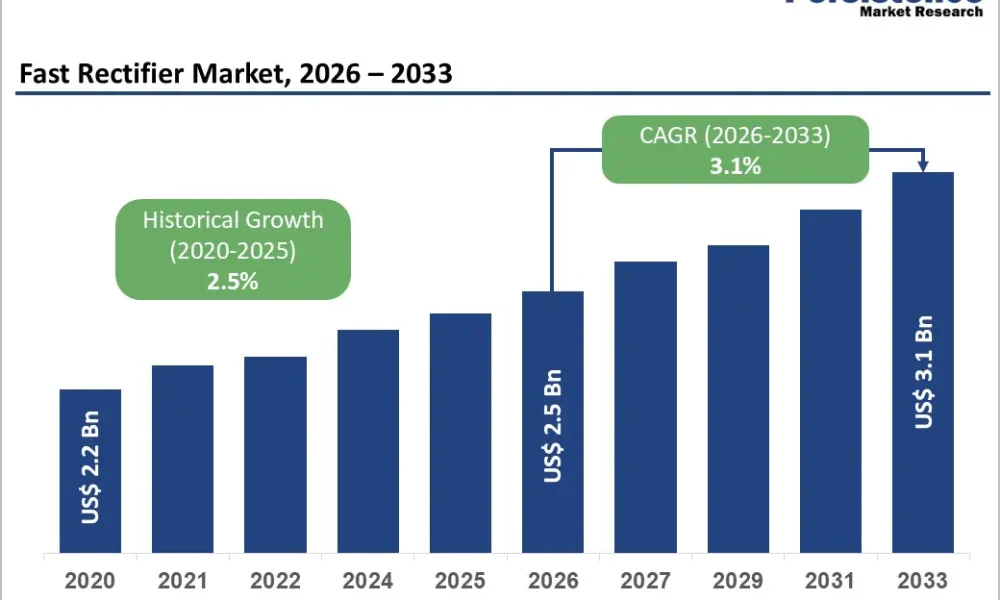
The global fast rectifier market is entering a phase of steady and technology-driven growth, fueled by the rapid electrification of transportation systems and the accelerating integration of renewable energy infrastructure. The market is projected to reach US$ 2.5 billion by 2026 and further expand to US$ 3.1 billion by 2033, registering a CAGR of 3.1% from 2026 to 2033. Historically, the market grew at a CAGR of 2.5% between 2020 and 2025, reflecting a consistent but evolving demand pattern.
Fast rectifiers play a crucial role in modern power electronics by enabling efficient high-frequency switching and minimizing reverse recovery losses. As industries increasingly demand compact, high-performance, and thermally efficient power systems, fast rectifiers have become foundational components in electric vehicles (EVs), renewable energy systems, industrial automation, and advanced communication infrastructure.
Industry Highlights
- Leading Region: Asia Pacific (~41% share)
- Fastest-Growing Region: North America (~36% share)
- Leading Category: Standard Fast Recovery Diodes (~52% share)
- Fastest-Growing Category: Ultra-Fast Recovery Diodes
- Key Opportunity: EV powertrains and renewable energy systems
Market Drivers
- Accelerating Electric Vehicle Adoption
The transition toward electric mobility is one of the strongest growth catalysts for the fast rectifier market. Modern EV architectures rely heavily on efficient power conversion systems, including onboard chargers, inverters, and battery management systems (BMS).
As automakers shift from traditional 400V platforms to 800V high-voltage systems, the demand for high-performance rectifiers with reduced switching losses continues to surge. Silicon Carbide (SiC) devices, increasingly adopted in EV platforms, further amplify this need.
Leading semiconductor players such as Infineon Technologies AG, ON Semiconductor, and ROHM Semiconductor are investing significantly in advanced rectifier technologies tailored for EV powertrains.
The EV revolution is not only reshaping automotive engineering but also redefining competition in the semiconductor space.
- Renewable Energy Integration and Smart Grid Expansion
Global commitments to carbon neutrality and decarbonization are accelerating solar, wind, and distributed energy installations. Solar PV systems, projected to grow at nearly 20% CAGR through 2032, rely on efficient rectification to optimize inverter operations and ensure grid stability.
Government initiatives such as the Inflation Reduction Act are injecting large-scale funding into clean energy infrastructure, directly boosting demand for high-efficiency power components, including fast rectifiers.
Additionally, smart grids and energy storage systems require components capable of handling bidirectional power flow and fluctuating loads—areas where fast rectifiers play a pivotal role.
Market Restraints
- High Manufacturing Costs
Ultra-fast recovery rectifiers demand advanced fabrication processes, including precision doping, epitaxial growth, and tightly controlled cleanroom environments. Establishing a manufacturing facility can require capital investments exceeding US$ 50 million, creating significant entry barriers.
Companies such as STMicroelectronics and Toshiba Electronic Devices maintain competitive advantages due to their vertically integrated production models and strong capital backing.
- Supply Chain Vulnerabilities
The semiconductor industry remains sensitive to geopolitical tensions and trade restrictions. Tariffs introduced during U.S.–China trade conflicts increased production costs and forced supply chain diversification.
Since advanced semiconductor fabrication remains geographically concentrated, disruptions from natural disasters, pandemics, or regulatory changes can significantly impact fast rectifier availability.
Market Opportunities
- Industrial Automation and IoT Growth
Industrial automation systems increasingly require high-frequency, energy-efficient components to minimize heat generation and electromagnetic interference. Ultrafast rectifiers now account for nearly 37% of the industrial motor drive segment.
Robotic systems, smart manufacturing units, and material-handling equipment rely on precise power management, positioning fast rectifiers as essential enablers of Industry 4.0 transformation.
Companies such as Nexperia and Diodes Incorporated are actively expanding portfolios targeting automation applications.
- Wide-Bandgap Semiconductor Technologies
Silicon Carbide (SiC) and Gallium Nitride (GaN) represent a transformative opportunity in rectification technology. These materials enable:
- Higher voltage operation
- Faster switching speeds
- Lower thermal losses
- Improved energy efficiency
In 2025, Infineon Technologies AG released its first 200mm SiC-based products, underscoring commercial maturity in wide-bandgap technologies.
Manufacturers investing in SiC and GaN production capacity are likely to capture premium segments in EV infrastructure, renewable systems, and high-performance industrial electronics.
Category-wise Analysis
Forward Voltage Insights
The 1.0V–1.5V forward voltage segment leads with nearly 45% market share due to its balanced efficiency, mature production ecosystem, and broad compatibility across automotive and telecom applications.
However, demand for >1.5V rectifiers is growing rapidly as next-generation EVs and renewable systems prioritize enhanced thermal management and reduced switching losses.
Material Type Insights
Standard Fast Recovery Diodes (FRDs) dominate the market with ~52% share due to:
- Proven reliability
- Cost-effectiveness
- Established production infrastructure
Companies like Vishay Intertechnology and Microchip Technology maintain strong FRD portfolios.
Meanwhile, Ultra-Fast Recovery Diodes (UFRDs) and Schottky diodes are the fastest-growing categories, driven by increasing demand for sub-100ns recovery performance in automotive and high-frequency systems.
Elevate your business strategy with comprehensive market data. Request a sample report now: https://www.persistencemarketresearch.com/samples/21943
Industry Analysis
Automotive Sector (48% Share)
Automotive applications dominate demand, supported by:
- EV adoption
- Electrified powertrains
- Advanced driver-assistance systems (ADAS)
- High-voltage charging systems
Rectifiers are essential in onboard chargers, DC-DC converters, traction inverters, and auxiliary systems.
Renewable & Industrial Applications
Renewable energy systems and advanced industrial equipment represent high-growth segments. As factories modernize and deploy smart automation, efficient power conversion becomes critical.
Semiconductor players such as Littelfuse and Fuji Electric are expanding industrial-focused rectifier offerings.
Regional Insights
North America (36% Share)
North America holds a significant share, driven by semiconductor investments and strong automotive electrification. Federal initiatives under the CHIPS and Science Act are strengthening domestic semiconductor production.
Silicon Valley and Midwest automotive hubs serve as innovation centers for next-generation rectifier technologies.
Europe
Europe is expanding at approximately 3.4% CAGR, supported by aggressive EV mandates and renewable targets. Germany anchors regional growth, with strong automotive OEM concentration and semiconductor innovation.
Companies such as Semikron are reinforcing Europe’s position in high-performance rectification systems.
Asia Pacific (41% Share – Leading Region)
Asia Pacific dominates global growth, accounting for ~41% of total share. China leads global EV production and semiconductor scaling, while Taiwan, Malaysia, Vietnam, and India expand fabrication capabilities.
Cost-efficient production, vertical integration, and strong export manufacturing provide competitive advantages across the region.
Competitive Landscape
The fast rectifier market is moderately consolidated, with global leaders maintaining strong market influence through:
- Vertically integrated manufacturing
- Broad product portfolios
- Strategic R&D investments
- Long-term automotive supply agreements
Emerging regional players focus on niche customization and localized support, intensifying competition.
Key Industry Developments
- November 2024: Vishay Intertechnology introduced four automotive-grade eSMP solutions in SMF (DO-219AB) packaging.
- February 2025: Infineon Technologies AG released first 200mm SiC-based rectifier products.
- May 2025: Nexperia reported revenue of US$ 2.06 billion and expanded investments in SiC and GaN production.
Future Outlook
The fast rectifier market will continue evolving alongside:
- EV electrification
- High-voltage battery architectures
- Renewable energy grid integration
- Industrial automation expansion
- Wide-bandgap semiconductor commercialization
Although growth remains moderate at 3.1% CAGR, the market’s strategic importance in enabling energy-efficient power conversion ensures long-term relevance.
Manufacturers that successfully integrate wide-bandgap materials, enhance thermal performance, and optimize cost structures will secure competitive leadership through 2033 and beyond.
Conclusion
The global fast rectifier market is poised to reach US$ 3.1 billion by 2033, driven by the convergence of electric mobility, renewable energy expansion, and industrial digitalization. Asia Pacific leads in scale, North America drives innovation, and Europe reinforces regulatory-driven demand.
As power electronics become increasingly central to the global energy transition, fast rectifiers will remain indispensable components at the heart of modern electrical systems.
Related Reports:




