
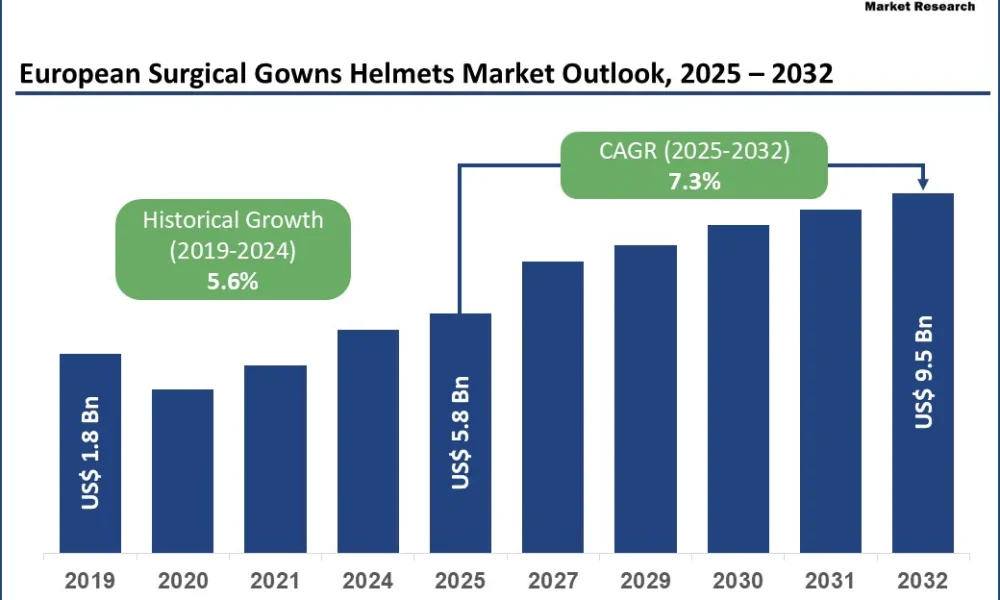
The European surgical gowns and helmets market is an essential segment of the broader healthcare and medical protective equipment industry. With a growing focus on infection control, safety, and innovation in surgical procedures, this market is experiencing robust expansion. The European market for surgical gowns and helmets is projected to grow from US$5.8 billion in 2025 to US$9.5 billion by 2032, registering a compound annual growth rate (CAGR) of 7.3%. Several key factors, including rising surgical procedures, stringent regulations, and advancements in protective equipment, are propelling the growth of this market.
Overview of the European Surgical Gowns and Helmets Market
The surgical gowns and helmets market in Europe encompasses a wide range of protective apparel designed to ensure the safety of both patients and medical professionals during surgical procedures. As healthcare systems become increasingly sophisticated, the need for high-quality surgical gowns and helmets has surged, particularly in response to the heightened awareness of hospital-acquired infections (HAIs) and the adoption of complex surgeries. The demand for disposable surgical gowns and ventilated surgical helmets is on the rise, fueled by the growing volume of surgical procedures, the stringent infection control regulations enforced across European countries, and the need for comfort and efficiency during surgeries.
The market is characterized by an increasing adoption of single-use products, such as disposable gowns and helmets, which offer the benefit of reducing the risk of cross-contamination. With countries like Germany, the UK, and France driving the demand for protective surgical gear, the market is expected to continue its steady growth. Technological advancements in the design and materials of surgical gowns and helmets, such as the integration of air filtration systems and the use of biodegradable materials, are also contributing to the market’s expansion.
Download Your Free Sample & Explore Key Insights: https://www.persistencemarketresearch.com/samples/3341
Market Statistics and Key Growth Drivers
In 2025, Germany is projected to hold the largest share of the European surgical gowns and helmets market, contributing around 30%. The country’s highly advanced healthcare infrastructure, coupled with its rigorous infection control standards, ensures the continued dominance of the German market. Meanwhile, France is expected to be the fastest-growing market, with a 20% share in 2025, owing to its robust universal healthcare system and a growing emphasis on infection prevention.
Key drivers of market growth include the increasing number of surgical procedures, the rising prevalence of chronic diseases that require surgical intervention, and the heightened focus on infection control in medical settings. Additionally, the shift toward eco-friendly surgical gowns and helmets, as well as innovations in product design, further fuels market expansion. The rising demand for minimally invasive surgeries, which require precise infection control measures, is another key factor driving the need for advanced surgical protective equipment.
Key Highlights from the Report
• Market size is projected to reach US$9.5 billion by 2032, growing at a CAGR of 7.3%.
• Germany leads the market with a 30% share in 2025.
• France is the fastest-growing market, expected to account for 20% of the share by 2025.
• Disposable surgical gowns dominate with a 55% market share in 2025.
• Ventilated surgical helmets hold a 45% share of the market in 2025.
• Polypropylene is the leading material, contributing 50% of market revenue.
Market Segmentation
The European surgical gowns and helmets market can be segmented based on product type, material, end-use, and geographical region. In terms of product types, disposable surgical gowns lead the market, accounting for a significant share. These gowns are favored for their cost-effectiveness and ease of use, particularly in high-volume surgical settings. Reinforced surgical gowns, which offer greater fluid resistance, are gaining traction in specialized surgeries, particularly those requiring advanced protection, such as orthopedic and cardiovascular procedures.
On the surgical helmet side, ventilated helmets dominate the market due to their advanced air filtration systems and ergonomic design, which ensures comfort for surgeons during prolonged procedures. Disposable surgical helmets, although newer to the market, are growing rapidly due to their disposable nature and cost-effectiveness, making them ideal for ambulatory surgical centers.
Material-wise, polypropylene holds the largest market share due to its lightweight, cost-effective, and fluid-resistant properties, which make it ideal for single-use gowns. However, other materials, like polyester, are emerging as key players in the market, particularly in reusable surgical gowns and ventilated helmets.
The end-user segmentation shows that hospitals are the largest consumers of surgical gowns and helmets, given their high volume of surgical procedures. Ambulatory surgical centers (ASCs) are also becoming increasingly important, as the rise in outpatient surgeries drives demand for cost-effective, disposable protective gear.
Regional Insights
The European surgical gowns and helmets market exhibits distinct trends across different regions, with key markets including Germany, France, the UK, and the rest of the European Union.
Germany remains the dominant player in the market, accounting for 30% of the total market share in 2025. The country’s robust healthcare infrastructure, stringent infection control regulations, and large surgical volumes drive this dominance. Germany’s commitment to advanced healthcare technology, including robotic surgeries, increases the demand for high-quality surgical gowns and ventilated helmets, particularly those made of reinforced and sustainable materials.
The UK follows closely with a market share of 25% in 2025, driven by the National Health Service’s (NHS) focus on infection control and the country’s aging population, which drives a need for orthopedic and cardiovascular surgeries. The rising demand for eco-friendly surgical products, such as recyclable gowns, also contributes to the growing market in the UK.
France, with its universal healthcare system, is expected to experience the fastest growth. The demand for disposable surgical gowns and ventilated helmets is soaring, particularly in hospitals and ambulatory surgical centers. The country’s increasing focus on infection control and its aging population contribute significantly to the market’s expansion.
Other regions, particularly Eastern Europe, are witnessing slower growth, as they grapple with budget constraints and a preference for lower-cost disposable surgical gowns. However, the rising adoption of eco-friendly products and the development of healthcare infrastructure in these areas is expected to provide new opportunities for market growth.
Get Custom Insights Designed for Your Business: https://www.persistencemarketresearch.com/request-customization/3341
Market Drivers
Several factors are contributing to the growth of the European surgical gowns and helmets market. A significant driver is the increasing prevalence of hospital-acquired infections (HAIs), which has led healthcare facilities across Europe to prioritize stringent infection control measures. Surgical gowns and helmets play a crucial role in reducing the transmission of pathogens in operating rooms, ensuring the safety of both patients and medical professionals.
The growing number of surgical procedures, driven by rising chronic diseases, an aging population, and the increasing adoption of minimally invasive surgeries, is another major factor. As surgeries become more frequent, the demand for protective surgical apparel, especially gowns and helmets, has surged.
Furthermore, advancements in surgical technology and materials science have led to the development of more comfortable, durable, and sustainable surgical gowns and helmets. This includes innovations such as ventilated surgical helmets with air filtration systems and eco-friendly disposable gowns made from biodegradable materials.
Market Restraints
Despite the promising growth prospects, the European surgical gowns and helmets market faces several restraints. One of the main challenges is the high cost of reusable surgical gowns and ventilated helmets, which can deter smaller healthcare facilities from adopting these products. Reusable surgical gowns, in particular, require costly sterilization and maintenance, making them less attractive to budget-constrained hospitals and clinics.
Moreover, regional disparities in healthcare funding can limit the adoption of premium products like ventilated surgical helmets in parts of Eastern Europe. Hospitals in these regions tend to favor disposable alternatives, which, while cost-effective, may not always offer the same level of comfort and protection as their reusable counterparts.
Market Opportunities
The growing focus on sustainability presents a significant opportunity for the market. Manufacturers are increasingly turning to eco-friendly materials such as biodegradable polypropylene and recyclable gowns to meet both regulatory requirements and consumer demand for greener healthcare solutions. Innovations in bio-based polymers and the development of more sustainable manufacturing processes are expected to open new revenue streams, especially in countries with stringent environmental regulations, such as Germany and the UK.
Additionally, the rise of ambulatory surgical centers (ASCs) represents a growing segment within the market. As outpatient surgeries increase, the demand for cost-effective, disposable surgical gowns and helmets is expected to surge. This trend is particularly evident in the UK, where the healthcare system is under pressure to manage rising costs and improve access to surgical care.
Checkout Now & Download Complete Market Report: https://www.persistencemarketresearch.com/checkout/3341
Company Insights
Several key players are dominating the European surgical gowns and helmets market, with many focusing on product innovation, sustainability, and expanding their market reach.
• 3M
• Cardinal Health
• Medline Industries
• Kimberly-Clark
• Halyard Health
• Molnlycke
• Ansell
• DuPont
• Owens & Minor
• Paul Hartmann
• STERIS
• Medicom
• Alpha Pro Tech
• Prestige Ameritech
• Garmex
Recent Developments
3M launched a new line of eco-friendly disposable surgical gowns in July 2024, crafted from biodegradable polypropylene to reduce environmental impact.
Medline Industries expanded its reinforced surgical gowns portfolio in Germany in April 2025, strengthening its position in the European market.
Conclusion
The European surgical gowns and helmets market is poised for significant growth, driven by factors such as the increasing volume of surgical procedures, heightened focus on infection control, and advancements in protective equipment technology. While challenges such as the high cost of reusable products and regional disparities in healthcare funding exist, opportunities in sustainability and the rise of ambulatory surgical centers offer promising avenues for market expansion. The competitive landscape remains dynamic, with leading companies constantly innovating to meet evolving market needs. As the demand for high-quality, eco-friendly, and cost-effective surgical protective gear continues to rise, the European market for surgical gowns and helmets is well-positioned for long-term growth.




