
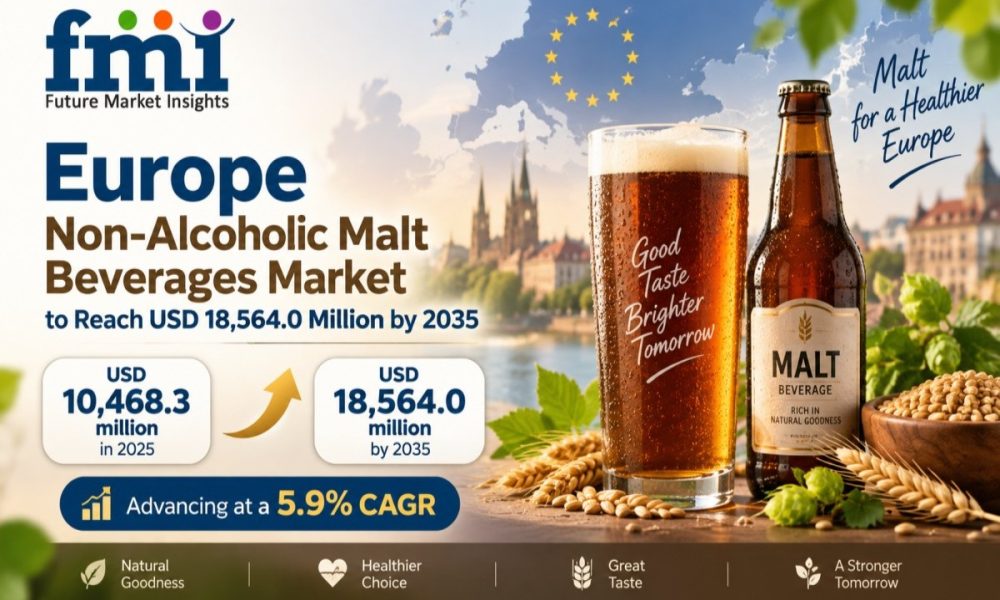
Europe non-alcoholic malt beverages market projected to grow from USD 10,468.3 million in 2025 to USD 18,564.0 million by 2035 at a 5.9% CAGR, according to Future Market Insights
The Europe Non-Alcoholic Malt Beverages Market is projected to reach USD 18,564.0 million by 2035, up from an estimated USD 10,468.3 million in 2025, expanding at a compound annual growth rate (CAGR) of 5.9% during the forecast period, according to the latest analysis by Future Market Insights (FMI).
The market is set to create an incremental opportunity of USD 8,095.7 million between 2025 and 2035. Growth is propelled by the rising trend of alcohol moderation, heightened consumer health consciousness, the adoption of functional and low-calorie drinks, and widespread distribution expansion across European retail and hospitality channels.
Non-alcoholic malt beverages are primarily brewed using barley and selected grains, serving as a functional alternative to conventional alcoholic beers and sugary soft drinks. The industry encompasses malt beers, malt-based soft drinks, and malt extracts offered in original, fruit, spiced, and herbal flavor profiles, packaged in convenient cans, bottles, and pouches across on-premise (HoReCa) and off-premise retail formats.
Get Detailed Market Forecasts, Competitive Benchmarking, and Pricing Trends:
https://www.futuremarketinsights.com/reports/sample/rep-gb-21992
Malt-Based Soft Drinks Lead Product Innovation Malt-based soft drinks are projected to account for 40.0% of the product type segment in 2025, establishing their position as the fastest-growing and most transformative category.
Consumers increasingly view malt soft drinks as a balanced, lower-sugar alternative to conventional sodas and high-calorie energy drinks. Manufacturers are enhancing appeal by infusing formulas with natural ingredients, vitamins, minerals, and electrolytes to deliver distinct wellness and functional hydration benefits.
The category is moving beyond traditional malt flavours. Leading players are diversifying their portfolios with sophisticated citrus, ginger, herbal, and exotic fruit blends, reshaping social drinking occasions for younger and health-conscious European demographics.
Cans and Bottles Command Packaging Demand Can packaging is estimated to capture 50.0% of the overall packaging segment in 2025.
The dominance of cans is driven by consumer demand for lightweight, portable, and on-the-go convenience suitable for outdoor gatherings and casual social events. At the same time, glass bottles remain essential for craft, premium, and artisanal malt beverages, preserving brand heritage and elevated table presentation.
Environmental sustainability has emerged as a key operational mandate across Europe. Major brewers are actively reducing plastic reliance by transitioning to 100% recyclable aluminum cans and piloting bio-based and paper bottle solutions to align with regional climate and packaging regulations.
Germany Anchors European Consumption Germany is expected to account for 28% of total European market value in 2025, maintaining its position as the largest regional market.
A deeply rooted brewing culture combined with declining per-capita alcohol intake has accelerated Germany’s pivot toward premium alcohol-free variants. Domestic brewing leaders such as Bitburger and Krombacher have expanded their low-sugar and functional malt beverage portfolios to match widespread active lifestyle trends.
France is projected to hold 22% of the market in 2025, followed by Italy at 18%, Spain at 16%, and the United Kingdom exhibiting rapid expansion fueled by strong craft non-alcoholic brewing and widespread availability across on-trade pubs and bars.
Semi-Annual Growth Momentum Accelerates FMI’s semi-annual tracking reveals consistent sequential acceleration in revenue realization across Europe. Growth for the 2025 to 2035 forecast cycle is estimated at a 4.5% CAGR in H1, climbing to a 5.6% CAGR in H2.
This trajectory highlights seasonal peaks in beverage consumption during the summer months, alongside sustained brand investments in marketing campaigns and distribution footprint expansion during the second half of each calendar year.
Competitive Landscape The European Non-Alcoholic Malt Beverages Market is led by established multinational brewing conglomerates alongside dynamic craft and regional innovators.
The top three manufacturers represent a combined 70% share of regional market revenue in 2025:
- Anheuser-Busch InBev leads with a 30% revenue share.
- Heineken N.V. accounts for 25% of market revenue.
- Carlsberg Group holds 15% of regional revenue.
- Molson Coors Beverage Company and Diageo account for 12% and 8% respectively, with regional and craft producers comprising the remaining 10%.
Tier 1 brewers are consolidating leadership through facility expansions such as Carlsberg’s dedicated non-alcoholic facility in Poland and expanded retail partnerships, while Tier 2 craft players such as BrewDog and Camden Town Brewery drive differentiation through exotic flavour innovation and localized brand positioning.
Analyst Perspective “Transforming convenience foods, animal feed, and industrial processes through advanced non-alcoholic malt beverage solutions is opening new commercial pathways. Brands that effectively pair natural functional ingredients with sustainable packaging are best positioned to capture long-term loyalty across Europe.”— Nandini Roy Choudhury, Principal Consultant, Future Market Insights
Exclusive Discounts on Full Report: https://www.futuremarketinsights.com/reports/europe-non-alcoholic-malt-beverages-market
Report Scope
The FMI study covers the Europe Non-Alcoholic Malt Beverages Market across product type, flavour, packaging type, distribution channel, and country.
Product categories include malt beers, malt-based soft drinks, malt extracts, and others. Flavour profiles comprise original/plain, flavoured (fruit, spices), and herbal. Packaging formats include cans, bottles, pouches, and others. Distribution channels track B2B (HoReCa) alongside B2C outlets including hypermarkets/supermarkets, convenience stores, and online retail.
Geographic analysis covers Germany, the United Kingdom, France, Italy, Spain, Belgium, the Netherlands, the Nordic region, Hungary, Poland, the Czech Republic, and the Rest of Europe across a 2025 to 2035 forecast timeframe.
FMI’s research methodology combines extensive primary stakeholder interviews with rigorous secondary analysis of trade databases, corporate financial disclosures, and industry production statistics to establish verifiable market models.
Key Executive Benefits
- Decision-Ready Insights
- Reduced Strategic Risk
- Market Entry Confidence
- Competitive Advantage
- Faster Growth Decisions
- Primary Market Validation
To explore how FMI Custom Research can support your strategic priorities, connect with our team at – [email protected]
About Future Market Insights (FMI)
Future Market Insights, Inc. is an ESOMAR-certified, ISO 9001:2015 market research and consulting organization trusted by Fortune 500 companies. With a global presence across the U.S., UK, India, and Dubai, FMI delivers data-driven insights across 30+ industries and 1,200 markets worldwide.



