
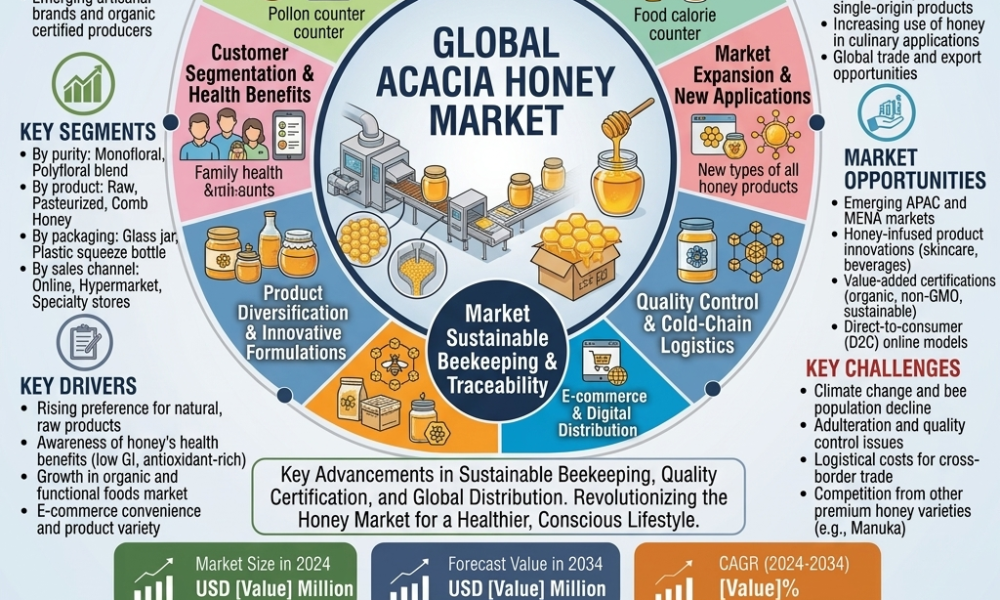
ROCKVILLE, Md., September 21, 2026 — The global acacia honey market is projected to increase from USD 596.2 million in 2026 to USD 1.23 billion by 2036, registering a 6.0% CAGR during the forecast period, according to a new analysis by Fact.MR. The market was valued at USD 562.5 million in 2025, with an absolute opportunity of approximately USD 634.3 million expected between 2026 and 2036.
Acacia honey is gaining attention in food and beverage applications where manufacturers and consumers value its mild flavor, light color, and relatively slow crystallization. These characteristics allow it to function as a sweetener without strongly altering the underlying taste of beverages, bakery products, and other formulations.
The market is also being shaped by greater interest in botanical origin, organic certification, traceability, and premium honey formats. Retail and online channels are expanding access to specialty honey products, while food manufacturers are evaluating acacia honey for applications requiring a relatively neutral sweetness profile.
Get detailed market forecasts, competitive benchmarking, and pricing trends:https://www.factmr.com/connectus/sample?flag=S&rep_id=15866
Organic Acacia Honey Holds the Leading Type Share
Organic Acacia Honey is projected to account for 32.9% of the market by type in 2026, making it the largest type segment covered by the Fact.MR assessment. Its position reflects consumer interest in certified and traceable food products and the premium positioning associated with organic honey.
Conventional acacia honey continues to serve buyers that place greater emphasis on price and availability. However, certification and documented origin are becoming increasingly relevant in premium retail channels, where consumers compare products based on provenance and labeling information.
For producers and distributors, this creates an opportunity to differentiate products through clear documentation rather than relying solely on broad natural-sweetener claims.
Food and Beverage Applications Lead Demand
The Food and Beverage segment is expected to represent 30.2% of the acacia honey market in 2026, making it the leading application category. Acacia honey’s mild taste and liquid handling characteristics make it suitable for beverages, bakery products, and other formulations where a strong honey flavor may not be desirable.
Pharmaceutical and other applications form additional portions of the market. Demand in these areas is more closely linked to product positioning and specific formulation requirements.
Food manufacturers are also examining acacia honey in clean-label formulations. Its botanical origin and recognizable ingredient profile can support product positioning where consumers are seeking alternatives to highly processed sweetening systems.
Traceability and Origin Documentation Become More Important
The market’s development is increasingly tied to the ability of suppliers to demonstrate product authenticity and consistent sourcing.
Organic and traceable honey positioning is identified by Fact.MR as an important demand driver, particularly in the UK, United States, and Germany. Retailers and buyers may require certification evidence, origin documentation, and batch-level information before placing premium honey products on shelves.
Single-origin positioning represents another opportunity. By communicating floral origin, sourcing region, certification status, and product characteristics, brands can provide consumers with clearer reasons for differences in price between acacia honey products.
Premium pack sizes, gifting formats, clean-label beverage applications, and online subscription models offer additional opportunities for market participants.
Harvest Variability and Authenticity Concerns Remain Challenges
Supply-side conditions remain an important consideration for the industry. Harvest variability and price exposure are identified as the leading restraint in the Fact.MR analysis.
Weather conditions and floral availability can affect supply planning and pricing before customer contracts are finalized. These fluctuations can create challenges for food processors and retailers seeking predictable procurement costs.
Certification and labeling requirements can also extend the time required to enter premium retail channels. In addition, concerns surrounding adulteration and authenticity remain relevant in import-dependent markets.
These factors create opportunities for suppliers that can provide consistent batches, reliable origin documentation, certification records, and transparent sourcing information.
UK Records the Highest Listed Country CAGR
The United Kingdom is projected to record the highest listed CAGR at 8.4% from 2026 to 2036, supported by premium grocery demand and interest in certified specialty foods.
Australia follows with a projected 7.3% CAGR, while the United States is expected to expand at 6.8%. Canada is forecast to register 6.6%, followed by Germany at 6.3%.
The UK market is supported by demand for premium and certified food products. Australia is seeing opportunities in specialty retail and gifting, while the United States benefits from broad food and beverage applications. Canada’s growth is linked to specialty stores and online product discovery, whereas Germany’s market is shaped by organic retail demand and detailed product documentation.
Analyst Perspective
“Acacia honey companies need to show how the product fits each use case. Organic positioning supports premium retail demand, but repeat sales are expected to depend on consistent flavor and clear labeling. Reliable supply is expected to decide repeat sales more than broad natural sweetener claims,” said Shambhu Nath Jha, Principal Consultant at Fact.MR.
Competitive Landscape
The competitive landscape includes companies focused on specialty honey, botanical-origin products, organic honey, and premium retail formats.
Companies profiled in the Fact.MR assessment include Savannah Bee Company, ARD Dynamic Enterprise Sdn. Bhd. (Ardeen Madu), Bee Seasonal, Apicoltura Gabannini, Mileeven Fine Foods, Littleover Apiaries, CD S.A., Bulgarian Nuts Ltd. (Bulgarian Bee), and Bionectar Mézfeldolgozó és Kereskedelmi Kft.
Competition is expected to depend on product authenticity, origin documentation, certification status, consistency, packaging, and the ability to communicate specific product characteristics to retail and foodservice buyers.
Report Scope
The Fact.MR study analyzes the Acacia Honey Market across type, application, and region.
By type, the report covers Organic Acacia Honey and Conventional Acacia Honey. Applications include Food and Beverage, Pharmaceutical, and Others. Regional coverage spans North America, Latin America, Europe, East Asia, South Asia and Pacific, and the Middle East and Africa, with detailed country analysis covering the United Kingdom, Australia, United States, Canada, and Germany.
Explore More Related Studies Published by Fact.MR Research
Functional Fonio Grains Market-
Gummy Texture Stabilizers Market-
About Fact.MR
Fact.MR is a market research and consulting firm providing industry intelligence across food and beverage, healthcare, technology, automotive, chemicals, consumer goods, and other industries. Its research combines primary and secondary research, company analysis, market sizing, forecasting, and industry interviews to support strategic business decisions.
Media Contact
Fact.MR
Email: [email protected]
Website: https://www.factmr.com/



