
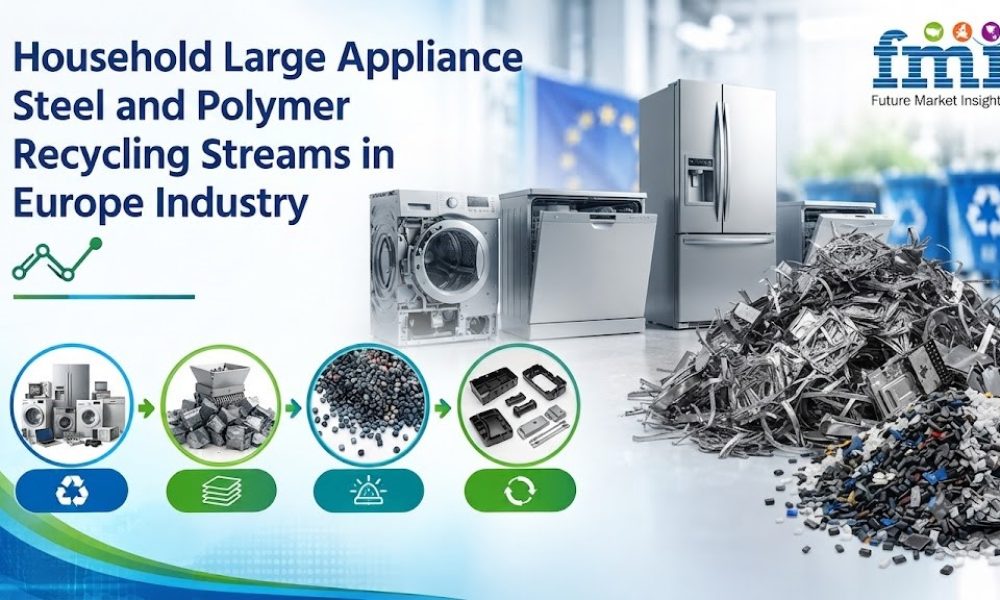
The household large appliance steel and polymer recycling streams industry in Europe is valued at USD 1.1 billion in 2026 and is projected to reach USD 1.9 billion by 2036, expanding at a 5.6% CAGR during the forecast period, according to Future Market Insights (FMI). The industry was valued at USD 1.03 billion in 2025 and is expected to create an incremental opportunity of USD 0.84 billion between 2026 and 2036.
The market is moving beyond bulk metal recovery as recyclers seek greater value from appliance plastics. Investments in sensor-based sorting, density separation, electrostatic sorting, and improved dismantling processes are supporting cleaner secondary material streams. At the same time, tighter controls on WEEE treatment and rising disposal costs for unrecyclable shredder residue are increasing the commercial importance of recovery yields.
Get detailed market forecasts, competitive benchmarking, and pricing trends: https://www.futuremarketinsights.com/reports/sample/rep-gb-32806
Steel Remains the Primary Material Stream
Steel is expected to account for 78.0% of the material stream segment in 2026, making it the largest recovered material from household large appliances. Large white goods remain predominantly steel-based, allowing recyclers to establish a dependable revenue stream through magnetic and ferrous recovery.
However, reliance on bulk ferrous output alone can limit overall value capture. Copper entanglement, mixed residues, and contamination can reduce steel-bale quality, while unrecovered ABS and HIPS plastics can increase residue-management costs.
For processors, the commercial opportunity is increasingly linked to improving recovery across both metal and polymer fractions rather than maximizing ferrous throughput alone.
Refrigeration Leads Appliance-Type Demand
Refrigeration equipment is projected to represent 31.0% of the appliance-type segment in 2026. Refrigerators and freezers provide a significant feedstock stream, but their treatment requires specialized infrastructure because refrigerants and insulation foams must be handled before shredding.
Certified degassing systems and controlled foam treatment are therefore important operational requirements. Proper treatment can also create opportunities to recover cleaner HIPS fractions from refrigerator interiors for downstream compounding.
Separation Becomes a Key Processing Stage
Separation is forecast to account for 34.0% of the process-stage segment in 2026. As appliance designs become more complex, recyclers need to isolate ferrous metals, stainless steel, polymers, rubber, and mixed residues with greater accuracy.
Density-based systems can separate heavier material from lighter plastics, while near-infrared technologies help identify polymer types. Electrostatic sorting can also support recovery of mixed dark plastics that are difficult for conventional optical systems to distinguish.
The quality of this stage directly affects downstream material value. Calibration, dust management, contamination control, and consistent feedstock preparation are increasingly important for maintaining output specifications.
Ferrous Scrap Provides the Revenue Base
Ferrous scrap is expected to hold a 64.0% share of the output-grade segment in 2026. Its established secondary-steel market and ability to absorb substantial volumes make ferrous recovery an important foundation for recycling-plant economics.
At the same time, demand for higher-quality recycled polymers is creating an additional route for value generation. Processors capable of producing consistent ABS and HIPS fractions can pursue applications beyond lower-value mixed residue streams.
EPR Schemes Support Collection Stability
EPR schemes are projected to account for 46.0% of the collection-channel segment in 2026. Producer-responsibility structures provide recyclers with more organized appliance flows, better traceability, and greater visibility into incoming tonnage.
Stable feedstock is particularly important for facilities carrying high fixed costs. Organized municipal collection, retail take-back programs, installer returns, and bulk contracts can complement EPR channels and improve plant utilization.
Poland and Spain Show Strong Growth Potential
Country-level growth varies across the European market:
- Poland: 7.1% CAGR from 2026 to 2036
- Spain: 6.5% CAGR
- Italy: 6.2% CAGR
- United Kingdom: 5.6% CAGR
- France: 5.5% CAGR
- Germany: 5.2% CAGR
- Sweden: 5.0% CAGR
Poland’s growth is linked to the formalization of bulky-appliance recovery networks and development of regional consolidation capacity. Spain is seeing increased investment in downstream sorting and collection infrastructure, while Italy is benefiting from stronger formal collection and tracking systems.
More mature markets such as Germany, France, the United Kingdom, and Sweden are placing greater emphasis on yield optimization, material purity, and recovery from existing appliance volumes.
Polymer Purity Creates a New Commercial Focus
The increasing value of recycled polymers is changing investment priorities across European appliance recycling facilities. Cleaner ABS and HIPS output can attract demand from manufacturers and compounders when contamination and composition are controlled.
Legacy appliance plastics containing restricted or halogenated additives create a significant processing challenge. Conventional density separation may not adequately isolate certain brominated plastics, increasing the need for advanced detection and sorting technologies.
FMI identifies opportunities around direct manufacturer partnerships, advanced electrostatic sorting, and installer-network integration. Long-term off-take agreements can provide demand visibility for specific recycled polymer grades, while direct access to appliance return networks can improve the quality and consistency of incoming material.
Access the Complete Report in PDF Format: https://www.futuremarketinsights.com/reports/brochure/rep-gb-32806
Competitive Landscape
The competitive environment is shaped by plant networks, EPR relationships, logistics capabilities, hazardous-material handling infrastructure, and downstream polymer purification. Companies with established collection contracts and certified refrigeration-treatment capabilities can support stable processing volumes while meeting regulatory requirements.
Key companies profiled in the industry include Stena Recycling, TSR Recycling, REMONDIS Electrorecycling, Kuusakoski, Veolia, and EMR.
As European recyclers face increasing pressure to reduce residual waste and improve secondary-material quality, investment is expected to shift toward technologies that can recover greater value from both steel and complex polymer fractions.
Business Impact
FMI helps organizations transform market complexity into strategic clarity, enabling leadership teams to identify growth opportunities faster, optimize resource allocation, strengthen competitive positioning, and make high-stakes business decisions with confidence.
To explore how FMI Custom Research can support your strategic priorities, please connect with our team at – [email protected]
About Future Market Insights (FMI)
Future Market Insights, Inc. (FMI) is an ESOMAR-certified, ISO 9001:2015 market research and consulting organization, trusted by Fortune 500 clients and global enterprises. With operations in the U.S., UK, India, and Dubai, FMI provides data-backed insights and strategic intelligence across 30+ industries and 1200 markets worldwide.



