
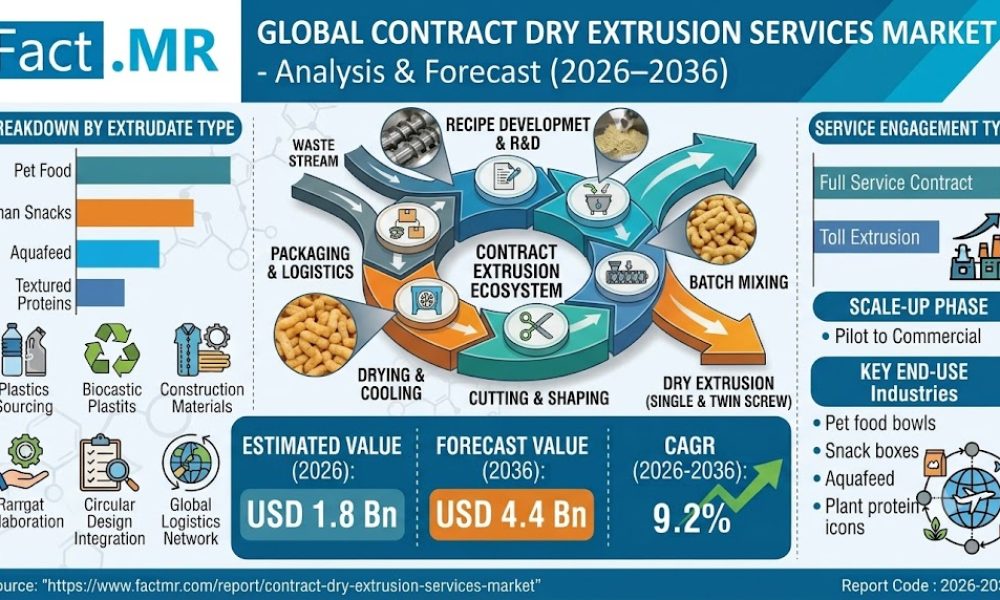
The global contract dry extrusion services market is projected to grow from USD 1.8 billion in 2026 to USD 4.4 billion by 2036, expanding at a 9.2% CAGR during the forecast period. The market reached USD 1.7 billion in 2025, creating an absolute opportunity of USD 2.6 billion between 2026 and 2036. Demand is being supported by food companies that use outside extrusion capacity for formulation trials, pilot production, scale-up work, and pre-commercial samples.
Contract dry extrusion allows food and ingredient companies to test recipes without immediately investing in a dedicated production line. Protein formulation teams can compare pea, soy, wheat, and pulse blends while checking water, heat, feed rate, screw speed, die conditions, texture, and drying requirements. Service providers can also produce TVP granules, chunks, crisps, and functional powders for customer testing before routine production begins.
The U.S. Department of Agriculture Economic Research Service reported on June 11, 2026, that inflation-adjusted U.S. food spending reached USD 2.51 trillion in 2025. The scale of the food sector provides a broad base for product development and outside processing services.
Get Detailed Market Forecasts, Competitive Benchmarking, and Pricing Trends: https://www.factmr.com/connectus/sample?flag=S&rep_id=16561
Global Segment Leaders
- Pilot extrusion — 35.0% share in 2026: Pilot extrusion leads the service-scope segment because it gives food teams enough material for meaningful process and texture testing without requiring a full production line.
- Pea protein — 38.0% share in 2026: Pea protein leads the feedstock segment because it is widely tested in dry textured food formulations. Service teams can adjust water, feed rate, screw speed, and die conditions in a controlled sequence.
- TVP granules — 34.0% share in 2026: TVP granules hold the leading extrudate share because their dry form simplifies sample handling and later food-use testing. Chunks and crisps remain relevant where larger bite or puffed structures are required.
- Lab — 30.0% share in 2026: Lab-scale work leads the scale segment because early recipe development typically uses limited material. Pilot and demonstration runs can follow once the formulation shows sufficient promise.
Country-Level Performance
- United States — 10.3% CAGR: The USA records the highest projected CAGR among the five profiled countries. A large food-manufacturing base and broad development infrastructure support outside pilot work. U.S. Bureau of Labor Statistics data published on September 4, 2026, showed preliminary seasonally adjusted food-manufacturing employment of 1.7646 million in August 2026.
- Germany — 10.0% CAGR: Germany’s market is supported by crop availability and established extrusion engineering. Destatis reported on May 19, 2026, that German farms were expected to cultivate 6.03 million hectares of grain for the 2026 harvest, providing a broad raw-material base for food and protein trials.
- France — 9.6% CAGR: France is projected to expand at 9.6%, supported by food-processing activity and diverse crop inputs. Agreste reported on April 14, 2026, that France had an estimated 7.0 million hectares of straw cereals for the 2026 crop season.
- United Kingdom — 9.3% CAGR: The UK market is expected to grow at 9.3%, with food manufacturers using external development capacity before investing in dedicated extrusion lines. The Office for National Statistics reported on July 24, 2026, that food manufacturing represented 22.9% of total UK manufacturers’ product sales in 2025.
- Japan — 8.1% CAGR: Japan records the lowest CAGR among the five profiled countries. Food companies are expected to focus on targeted formulation trials as they manage input costs and product consistency. Japan’s Statistics Bureau reported on January 23, 2026, that food prices rose 6.8% in 2025.
Regional Context
Fact.MR covers North America, Latin America, Western Europe, Eastern Europe, East Asia, South Asia & Pacific, and the Middle East & Africa, with country-level analysis for the United States, Germany, France, the United Kingdom, and Japan. The five-country CAGR range spans 2.2 percentage points, from 10.3% in the USA to 8.1% in Japan.
North America benefits from a large food-manufacturing base and multiple pilot-development opportunities. Western European markets combine crop availability with established food-processing and extrusion skills. The UK has a sizeable processed-food manufacturing sector, while Japan’s market is shaped more closely by formulation economics and food-input costs.
Competitive Landscape
Key companies profiled in the contract dry extrusion services market include PacMoore, Armada Ingredients, Erbacher Food Intelligence, Nutromode Snacks, and SPS Nutrifoods. Their relevance spans formulation trials, pilot extrusion, scale-up, texture development, sample production, and selected toll-processing requirements.
PacMoore and Armada Ingredients operate within a service landscape where food and ingredient companies can use outside extrusion capacity before committing recipes to larger production lines. Their relevance includes process development involving protein feedstocks, texture formation, operating conditions, and scale-up documentation.
Erbacher Food Intelligence, Nutromode Snacks, and SPS Nutrifoods broaden the provider group across trial and scale-up requirements. The market covers work involving pea, soy, wheat, pulse blends, and novel proteins, with output including TVP granules, chunks, crisps, functional powders, and related dry extrudates.
Analyst Opinion
Shambhu Nath Jha, Principal Consultant at Fact.MR, stated:
“Contract dry extrusion helps when customers need process proof before capital approval. Demand is expected to rise as more protein recipes move from lab work into pilot runs. Service firms should pair extrusion skill with clear scale-up records and private customer testing.”
Market Considerations
For food companies, ingredient suppliers, and contract extrusion providers, several operating factors remain important:
- Process documentation: Screw setup, feed rate, moisture, heat, die configuration, and drying conditions need to be recorded so results can be transferred to larger equipment.
- Feedstock control: Protein and grain inputs can behave differently during extrusion, making consistent material preparation important for comparing trial results.
- Texture testing: Pilot output needs to provide enough material for texture, cooking, sensory, and customer-use testing.
- Confidentiality: Companies testing new protein blends or proprietary recipes need clear privacy and material-control terms before outside trials begin.
- Scale-up transfer: Pilot results need to translate into operating ranges and equipment settings suitable for commercial lines.
- Toll capacity: Limited access to repeat commercial toll-manufacturing capacity can become a constraint after the development stage.
Fact.MR identifies confidential pilot campaigns, pulse-blend optimization, and pre-commercial sample production as opportunity areas. Limited true toll-manufacturing capacity, formula-transfer risk, and the cost of repeated trial iterations remain constraints.
Research Methodology
Fact.MR’s analysis draws on 120+ sources, 35+ company portfolios, 25+ countries, and more than 20 industry interviews. Primary research includes discussions with manufacturers, service providers, technology developers, distributors, end users, and subject-matter experts. Desk research covers government statistics, regulatory publications, company filings, trade data, technical studies, industry associations, standards, public policy, and other authoritative sources.
Market estimates combine historical performance, demand indicators, pricing and volume trends, segment shares, company participation, country-level growth, adoption patterns, investment activity, and barriers to market expansion. The report uses a hybrid top-down and bottom-up assessment based on food-manufacturing activity, crop and ingredient availability, extrusion service portfolios, scale-up infrastructure, and country-level operating conditions.
Explore More Related Studies Published by Fact.MR Research:
Soluble Flour Substitutes Market
Party Supply Rental Market
About Fact.MR
Fact.MR is a leading provider of market research and consulting services, offering syndicated and customized research across industries including Consumer Goods, Healthcare, and Chemicals & Materials.



