
The global electronic cylinder lock credentials market is experiencing significant transformation as digital access control technologies replace traditional mechanical locking systems. Increasing demand for secure, contactless, and intelligent authentication solutions across residential, commercial, and government sectors is fueling rapid industry expansion.
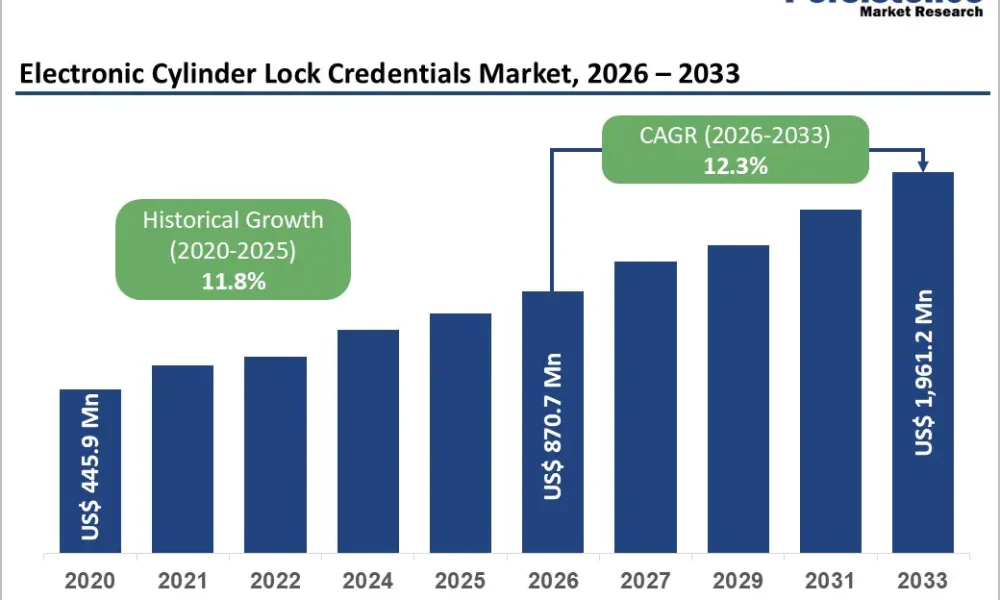
The market is estimated to be valued at US$ 870.7 million in 2026 and is projected to reach US$ 1,961.2 million by 2033, expanding at a compound annual growth rate (CAGR) of 12.3% during the forecast period from 2026 to 2033. This growth is largely driven by accelerating smart city initiatives, increasing cybersecurity awareness surrounding physical access control, and the widespread integration of Internet of Things (IoT) technologies in building security systems.
Electronic cylinder lock credentials provide advanced authentication methods such as RFID cards, mobile credentials, biometrics, and encrypted digital keys that allow organizations to manage building access in real time. These systems improve operational efficiency, strengthen security monitoring, and eliminate the vulnerabilities associated with traditional keys.
Growing Demand for Contactless and Mobile-Based Access Control
One of the most powerful drivers of the electronic cylinder lock credentials market is the global shift toward contactless access technologies. Organizations across industries are replacing mechanical keys with digital credentials that enable fast, secure, and remote authentication.
Technologies such as radio-frequency identification (RFID) and near-field communication (NFC) credentials are widely used in corporate offices, hospitals, universities, and hotels. These credentials allow users to access facilities by simply tapping a card or smartphone, improving both convenience and security.
Mobile-based access solutions are becoming particularly popular because they eliminate the need for physical access cards. Employees, residents, and visitors can use smartphone apps or digital wallets to unlock doors and authenticate their identity. These systems allow administrators to grant or revoke access instantly, providing real-time control over facility security.
The growing popularity of smart locks and connected security systems is further accelerating demand for electronic cylinder lock credentials. Deadbolt smart locks, in particular, are widely trusted for their reliability and enhanced security capabilities. Integration with cloud-based access platforms allows organizations to monitor activity logs, detect suspicious behavior, and manage access privileges remotely.
Smart City Initiatives and Government Infrastructure Modernization
Government-led infrastructure modernization programs are playing a crucial role in expanding the electronic cylinder lock credentials market. As cities around the world adopt smart city frameworks, digital access control systems are becoming a core component of urban security strategies.
Public institutions, including government offices, healthcare facilities, and educational campuses, are upgrading outdated mechanical locks with advanced electronic systems. These upgrades provide improved security, better monitoring capabilities, and compliance with modern cybersecurity standards.
Regulatory organizations such as the National Institute of Standards and Technology have introduced guidelines for secure deployment of connected access control technologies. These frameworks help ensure that electronic lock systems meet strict encryption and authentication requirements, boosting confidence in credential-based access solutions.
In addition, government cybersecurity agencies such as the Cybersecurity and Infrastructure Security Agency emphasize the importance of stronger physical security systems to protect critical infrastructure. As a result, public sector institutions are investing heavily in advanced access control technologies that incorporate secure electronic credentials.
Elevate your business strategy with comprehensive market data. Request a sample report now: https://www.persistencemarketresearch.com/samples/11389
Cybersecurity Risks and System Vulnerabilities Remain Key Challenges
Despite rapid technological advancements, the electronic cylinder lock credentials market still faces challenges related to cybersecurity vulnerabilities. Because these systems rely on digital communication technologies such as Bluetooth, Wi-Fi, and cloud connectivity, they can be exposed to cyber threats if not properly secured.
Security researchers have identified vulnerabilities in certain smart lock systems, including weak encryption protocols, outdated firmware, and limited patch management capabilities. Attack methods such as signal interception, replay attacks, and communication jamming can potentially allow unauthorized access if systems are poorly configured.
These risks are particularly concerning for sectors with strict security requirements, including financial institutions, government facilities, and healthcare organizations. In such environments, a compromised credential system could lead to severe operational disruptions and compliance violations.
To address these concerns, manufacturers are investing heavily in advanced encryption methods, secure firmware updates, and continuous vulnerability testing. Strong cybersecurity standards and multi-layer authentication technologies are expected to become essential components of next-generation electronic lock credential systems.
High Implementation Costs and Operational Expenses
Another challenge affecting market adoption is the high cost of implementing electronic cylinder lock credential systems. Transitioning from traditional locks to digital access infrastructure requires significant upfront investment.
Organizations must purchase electronic locks, credential readers, authentication software, and access management platforms. Additionally, integration with existing security systems and building management platforms can increase installation complexity and costs.
Operational expenses also contribute to the total cost of ownership. These include cloud subscription services, credential lifecycle management, regular system updates, and ongoing cybersecurity monitoring.
For small businesses and residential property owners, these costs can be a barrier to adoption. In many developing markets, financial constraints often delay the deployment of advanced access control solutions despite their long-term security benefits.
However, as technology prices decline and cloud-based platforms become more accessible, electronic credential systems are expected to become increasingly affordable for a broader range of users.
Opportunities in Biometric Authentication and AI-Based Access Intelligence
Technological innovation is creating new opportunities for electronic cylinder lock credential providers. One of the most promising developments is the integration of biometric authentication technologies such as fingerprint recognition, facial identification, and iris scanning.
Biometric-enabled credentials provide a higher level of security by verifying unique biological characteristics instead of relying solely on physical cards or digital keys. This approach significantly reduces the risk of credential duplication or unauthorized sharing.
Artificial intelligence and machine learning are also transforming access control systems. AI-powered platforms can analyze user behavior patterns and detect anomalies that may indicate potential security threats. For example, if a credential is used at unusual times or locations, the system can trigger alerts or request additional authentication.
These advanced capabilities are particularly valuable in high-security environments such as airports, data centers, research laboratories, and government facilities. As organizations increasingly prioritize intelligent security systems, demand for biometric and AI-enabled credential solutions is expected to rise significantly.
Expanding IoT Ecosystems and Cloud-Based Access Management
The growth of Internet of Things (IoT) ecosystems is another major factor supporting the electronic cylinder lock credentials market. Modern buildings increasingly rely on connected devices to automate security, lighting, climate control, and energy management.
Cloud-managed access control platforms allow organizations to manage credentials across multiple facilities without requiring on-site servers. Administrators can issue, modify, or revoke access permissions instantly from a centralized interface.
This capability is especially valuable for enterprises operating across multiple locations. It simplifies credential management while improving security monitoring and operational efficiency.
Emerging interoperability standards such as ETSI EN 303 645 and ISA/IEC 62443 are also helping accelerate adoption. These frameworks ensure that different security devices can communicate effectively, reducing integration complexity and improving system reliability.
RFID Key Cards Continue to Dominate Product Demand
Among various credential types, RFID key cards remain the most widely used solution in the electronic cylinder lock credentials market. These cards account for approximately 42.1% of the market share due to their durability, standardized protocols, and compatibility with enterprise access control systems.
In fact, nearly 75% of commercial access control installations rely on RFID-based credentials. These cards are commonly used in office buildings, hospitals, hotels, and educational institutions where large numbers of users require controlled access.
Contact-based electronic keys are still used in certain retrofit and cost-sensitive environments. However, digital credentials are gradually replacing these traditional solutions due to their superior flexibility and management capabilities.
Meanwhile, mobile credentials are emerging as the fastest-growing category. Smartphone-based authentication allows users to unlock doors without carrying additional cards or keys. Enterprises increasingly view mobile credentials as the future of access control, particularly in smart buildings and digitally connected workplaces.
Commercial Sector Leads Market Adoption
The commercial sector represents the largest end-user segment in the electronic cylinder lock credentials market, accounting for roughly 58% of total demand.
Businesses are rapidly adopting electronic credential systems to manage employee access, protect sensitive areas, and streamline visitor management. Large organizations with multiple offices or facilities particularly benefit from centralized access control platforms that provide real-time monitoring and audit trails.
Retail stores, logistics centers, hotels, and corporate campuses are among the leading adopters of digital credential technologies. These organizations prioritize secure and efficient access management to protect assets and improve operational workflows.
The residential sector is also emerging as a high-growth market. Smart homes and modern apartment complexes increasingly feature electronic access systems that allow residents to use smartphones or digital credentials to unlock doors. Real estate developers are incorporating these technologies into new building designs to enhance property value and attract tech-savvy buyers.
Regional Market Insights
North America
North America holds the largest share of the electronic cylinder lock credentials market, accounting for approximately 39.8% of global demand. High adoption of smart home technologies, mature security infrastructure, and strong enterprise demand are key factors supporting regional growth.
Residential smart lock installations are particularly widespread in the United States and Canada. Property managers and homeowners increasingly prefer digital credentials that offer convenient mobile-based access and enhanced security monitoring.
Europe
Europe represents another important market, driven by strong regulatory frameworks related to data protection and cybersecurity. Regulations such as General Data Protection Regulation influence the development of secure credential systems that protect sensitive user information.
Countries such as Germany, the United Kingdom, and France are adopting cloud-based access control solutions that support multi-site operations and strict security compliance requirements.
Asia Pacific
Asia Pacific is emerging as the fastest-growing regional market, accounting for approximately 32% of global demand. Rapid urbanization, expanding commercial infrastructure, and government-backed smart city programs are fueling strong market growth.
Major economies including China, Japan, South Korea, and India are witnessing widespread adoption of electronic credential systems across residential high-rise buildings, office complexes, and public infrastructure projects.
Rising digital literacy, increasing middle-class populations, and competitive local manufacturing capabilities are further supporting large-scale deployment of advanced access control technologies throughout the region.
Competitive Landscape
The electronic cylinder lock credentials market is moderately consolidated, with several global companies competing through technological innovation and strategic partnerships.
Leading companies are focusing on expanding their digital credential ecosystems, integrating advanced technologies such as biometrics, edge computing, and AI-based analytics into their access control platforms.
Key industry players include:
- ASSA ABLOY Group
- Dormakaba Group
- Allegion plc
- SALTO Systems
- SimonsVoss Technologies
- HID Global
- Identiv Inc.
- NXP Semiconductors
- Thales Group
- IDEMIA
These companies are investing in product innovation, strategic acquisitions, and partnerships to strengthen their positions in the rapidly evolving digital access control market.
Future Outlook
The electronic cylinder lock credentials market is poised for substantial growth over the coming decade. Increasing adoption of smart infrastructure, expanding IoT ecosystems, and rising security concerns are expected to drive sustained demand for digital credential solutions.
Technological advancements such as biometric authentication, AI-driven security analytics, and cloud-based access management platforms will continue to reshape the industry landscape.
As organizations prioritize intelligent and scalable security systems, electronic cylinder lock credentials will play a central role in enabling secure, efficient, and connected access control across residential, commercial, and government environments worldwide.
Related Reports:




